
3. Balancing Agencies and In-House Talent in Your Team
- Nitin Agarwal Head of Growth & Revenue, Shopsy by Flipkart
In this section, Nitin explains how to structure a marketing team across performance, content, CRM, and brand management, and how to prevent silos between teams by aligning roles and responsibilities.
Marketing usually involves 3 – 4 broad departments or functions.
One is performance marketing. Their world is Facebook and Google paid media. They are more like analysts and scientists who are busy with Excel.
Second is your social and creative team which are more creative folks. You can also call them content marketing. This team should also give you that viral impetus from time to time.
The third team, based on the business you are in, would be your CRM team. And as you expand, the fourth person or function would be brand management.
Eventually, you hire a marketing head who oversees all four functions and bridges the gaps between them.
For this, you have to find somebody who can understand both the needs of the content marketing and performance marketing person.
You typically don’t have that marketing head person very early.
In this case, you might have the content marketing talent reporting to a senior performance marketer. This would leave them disgruntled because they’d be working with somebody who doesn’t understand their work and vice versa. That’s a conundrum you will always have.
This is why, as founders, you either play the role of a marketing head or, in an ideal scenario, eventually hire one. Sometimes, brand managers will have the maturity to work with all the teams. One way to do it is to hire a brand manager as you scale.
Have all the teams roll up into that particular person, whether content marketing, performance marketing, or your CRM retention, notification, etc.
But until then, you’ll have to play that role, and that’s why you need to define budgets, etc., for them right at the beginning rather than having them fight around between themselves.
One standard failure mode is that silos emerge between the performance marketing and content teams. The content team would create great content that the performance folks could use as digital ads, but they wouldn't know.
You must constantly push them to take ads or repurpose content marketing output as your performance ads. It’s almost a full-time job for one person to bridge that gap.
Product-led growth has to sit with the product. The marketing team can help you take the feature further.
For example, if the product team came up with a feature like a nice referral: Refer somebody and get an extra 10% off in your next campaign. Marketing must use it in their creatives, but they need help to lead such product-led growth initiatives.
Let the Product team be the owner of ideating and launching the initiatives, and the marketing team be responsible for making those initiatives reach a larger base through their marketing communication, whether it’s email, social media, or ads.
Nitin provides guidance on hiring early-stage marketing team members and emphasizes the importance of working with midsized agencies for performance marketing, while also outlining how to complement the team with specialists.
For early-stage marketing, a team of four people — Facebook and Search experts, an Analyst, and a Social Media Strategist — usually works. They can work directly with the Co-Founder or the Head of Marketing.
Early on, you should also invest in getting a mid-sized marketing agency on board for Performance Marketing.
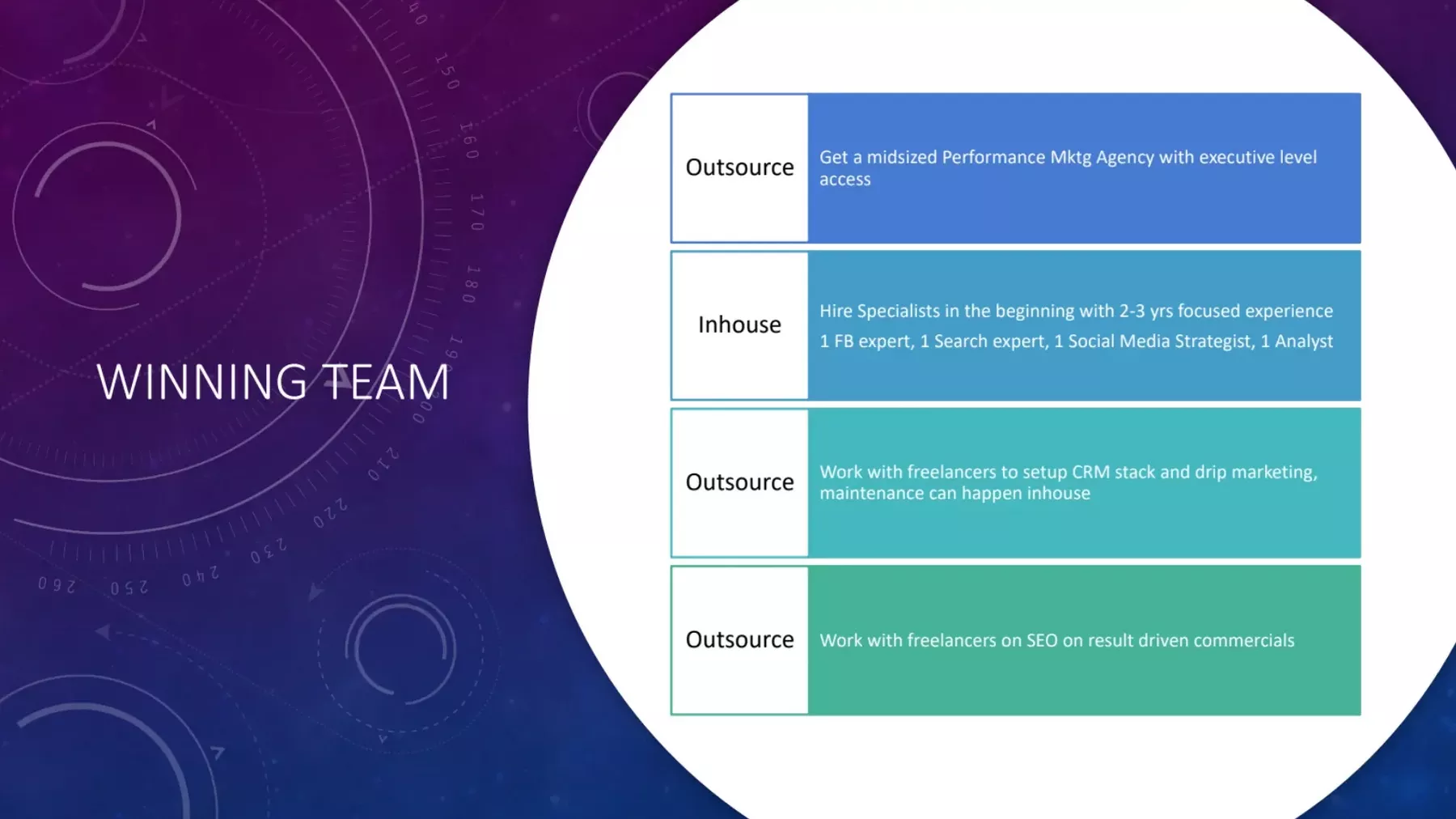
Hiring a strong team in-house is a struggle, and it takes time to build expertise. Working with an agency takes away that stress. You pay that extra 3 – 4% commission, but it comes with better ROI, meaning you spend less and burn less on marketing.
I emphasize midsized performance marketing agencies because they should treat your account with respect and love. Ideally, you should have CXO-level access.
If you work with a large agency, they will see little revenue coming from you. They will only deploy young people to work on your account, leading to a mediocre impact.
Once you start building an in-house team, start with a Facebook expert. Then, you can move on to Search and then a Social Media Strategist.
Now, this Facebook expert will cost you at least 8 – 12 lac in the market, but definitely hire one because a lot of your budget will go into Facebook, and it needs careful sponsored optimization.
Don’t hire a generalist at this stage. They likely don’t know as much about Facebook as they need to. Hire an expert.
Only hire a Search expert if your budget allows and Search is a large enough channel for you. But I feel you don’t always need a Search expert. Search is easy to learn. Your Facebook person can learn Search if needed, and that would be their growth path, too.
Then, if you’re focused on social media, hire a social media strategist.
Your social media strategist should double as a creative strategist and should be able to design creatives, work with influencers, and do the posts themselves.
When you get to a three-member team, you should hire an analyst to work with them in shared capacity. Because, at this stage, your Facebook or social media expert might not have analytical abilities.
It’s good to complement your team with an analyst at this stage who can manage all the Excels, the dashboards, the reviews and cadences, and shares data intelligence.
For your CRM stack, retention, marketing, and drip marketing, you can work with freelancers because often, what they have to do is come in and set up flows.
The bulk of the work is done once things are set up. After that, it’s creating creatives and rolling out campaigns, which can happen internally.
For these CRM flows, you can do a three-month, four-month project with an experienced freelancer to set up stuff and then maintain it in-house with your marketing team.
Even for SEO, you can outsource work. You can work with freelancers on result-driven commercials based on your traffic goals and sign off for at least six months. This formula works at heating up your team.