4. Atomberg’s Performance Choices Across the Funnel
- Arindam Paul Founding Member and CBO, Atomberg
In this snippet, Arindam details how Atomberg aligned paid media with key stages in the consumer journey, from awareness to purchase, ensuring each channel played a specific role in driving conversions.

I’ll tell you how we’ve used media choices in our journey, and perhaps it will help you start thinking about your own brand, its channels, and the consumer journey. I’ll explain what the consumer journey looks like for Atomberg and how we mapped our media choices and media strategy based on that journey.
You should figure out where that channel fits in your consumer journey. How is the purchase triggered?
For something like a fan, when someone starts thinking about buying fans, they have an initial consideration set of brands in mind which come up when they move into a new home or say they are doing renovations, or their old fans stop working. They don’t necessarily rely on Google or Facebook. Once you have an initial consideration set, that’s when they start their evaluation journey.
This is an evaluated category; it’s not an impulse category. It’s not like you “just” buy a fan. No one does that. There’s typically a two to three weeks lag between the first time someone encounters the brand and when you see the results in your Google Analytics and acquisition dashboards. This lag is consistent across most categories.
During this evaluation period, potential customers engage in various activities such as visiting offline stores, researching online, watching YouTube videos, and conducting Google searches. They provide signals to Google and Facebook that they are in the market to buy fans.
At the same time, there are a lot of people who do not evaluate online. They would directly go to the shop and make a purchase. Then there’s a point of purchase. Your point of purchase could be your Amazon, Flipkart, or retail counter.
There are two types of people who come to the point of purchase. One of them has already evaluated the category, and the other has not evaluated the category online at the point of purchase. To win at this point of purchase you need to have the right assortment, the right pricing, the right visibility, the right deals and discounts.
In our case, there’s also a post-purchase phase, which is why you have to consider an installation experience. Sometimes the fan may encounter issues since it’s an electronic product, and there might be a 2 – 3% failure rate. Therefore, it’s crucial to provide a delightful experience for the customers. The goal is for them to return to the same brand the next time they wish to purchase a fan.
By creating a positive post-purchase experience, they may come back directly to the point of purchase, and they escape the entire purchase journey. This is Atomberg’s consumer journey.
It would be beneficial if you could also understand how your consumers make their purchasing decisions. Consider factors such as when, why, and where they start. Do they begin their search with a specific set of brands in mind? Do they start with a generic search? Do they even know what they need?
In our case, our customers may know they need a fan. However, for many categories, especially for brands trying to establish new categories, customers may not even know what product can solve their problem.
Understand how your customers go about evaluating products and which channels they are using. Are they using YouTube, Amazon, or Google Search to evaluate? I think that’s something you should do before you even start making your media choices.
Just like you have to have your ICP (Ideal Customer Profile), you have to map the customer journey for your specific brand and product. You should do it as an exercise if you have not done it yet, and this will give you a lot of clarity, whether it’s in B2B or B2C.
In the below snippet, Arindam explains how top-funnel prospecting campaigns built awareness and how mid and bottom-funnel strategies like Google Search and retargeting drove conversions.
As a new brand, people were not familiar with Atomberg. When we were starting, my objective was to target the audience who were in the market for a category but were unaware of our brand. We ran several prospecting campaigns to reach those potential customers at the top of the funnel.
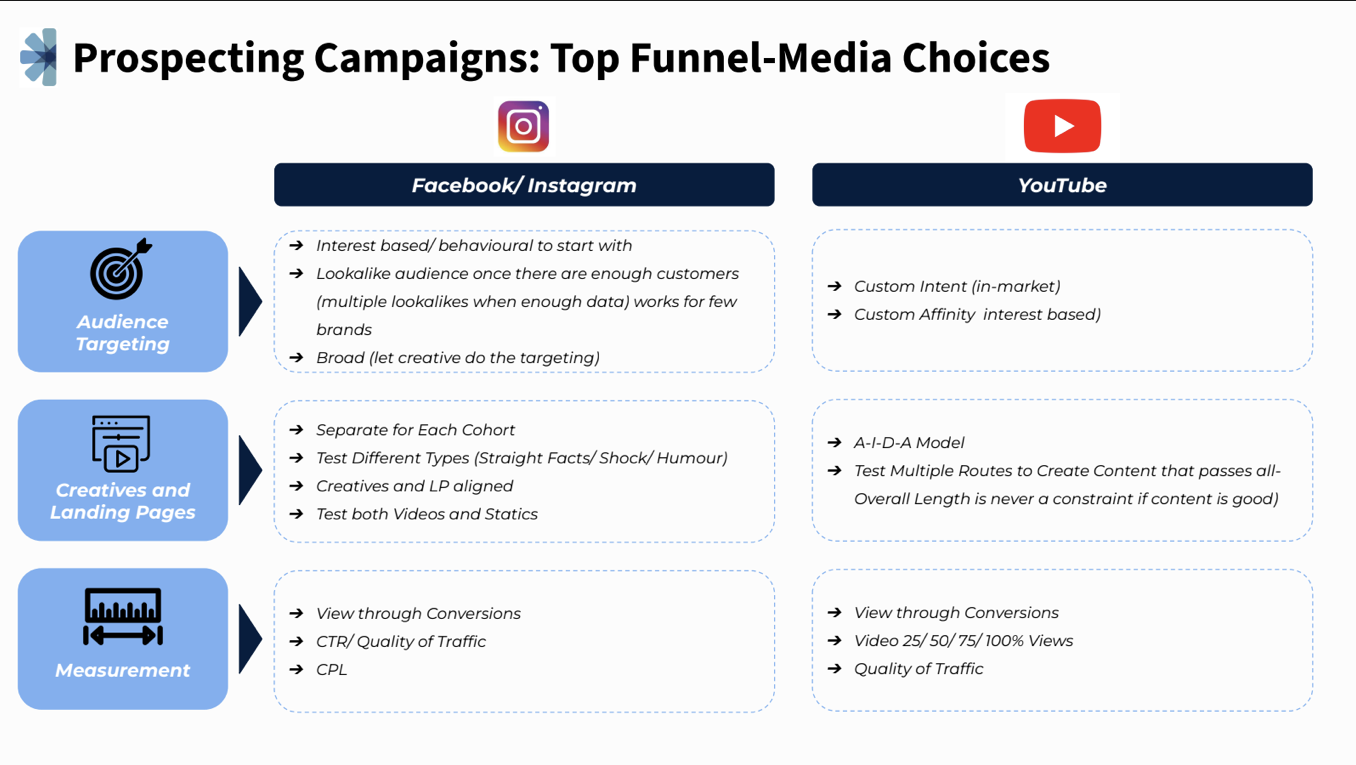
I used to send signals to Facebook targeting new home buyers or those interested in home décor and interiors. Facebook started showing them Atomberg ads. They would then visit our website.
These campaigns were optimized based on metrics like leads rather than immediate purchases, focusing on more top-of-funnel indicators like “add to cart,” etc.
We also used YouTube as a channel for prospecting. YouTube's benefit is that it has access to Google data, which is why it has much stronger intent data than Facebook. On the other hand, Facebook has much stronger affinity data.
Facebook would know whether you wear shoes or slippers or use and buy cosmetics based on your interactions with ads and their content. It’s about your interests, whether you watch cooking reels all day, etc.
Intent means explicitly searching for something like “ceiling fan online best price.” You typically search when you’re in the market to buy a fan or specific products. You’ll use keywords like “online yoga classes” or “hearing aid online” when you have a definite intent to make a purchase. In YouTube, what works best is working with custom intent audiences, which automatically define the in-market audience. Then, you can measure the results.
There are multiple ways to measure these campaigns, such as video views, 50 – 75% views, quality of traffic, and view-through conversions. You can optimize this campaign with the idea that people should become aware of your brand, especially those who are relevant and in the market, so that they can make a near-immediate purchase.
These are not pure awareness campaigns; they target people likely to buy soon. These were our top funnel choices. Again, when you plan your campaigns, consider your top-funnel choices and the targeting options available to you.
One of the most crucial aspects is the quality of your creatives and landing pages. It’s challenging to succeed in today’s marketing landscape without compelling creatives and optimised landing pages.
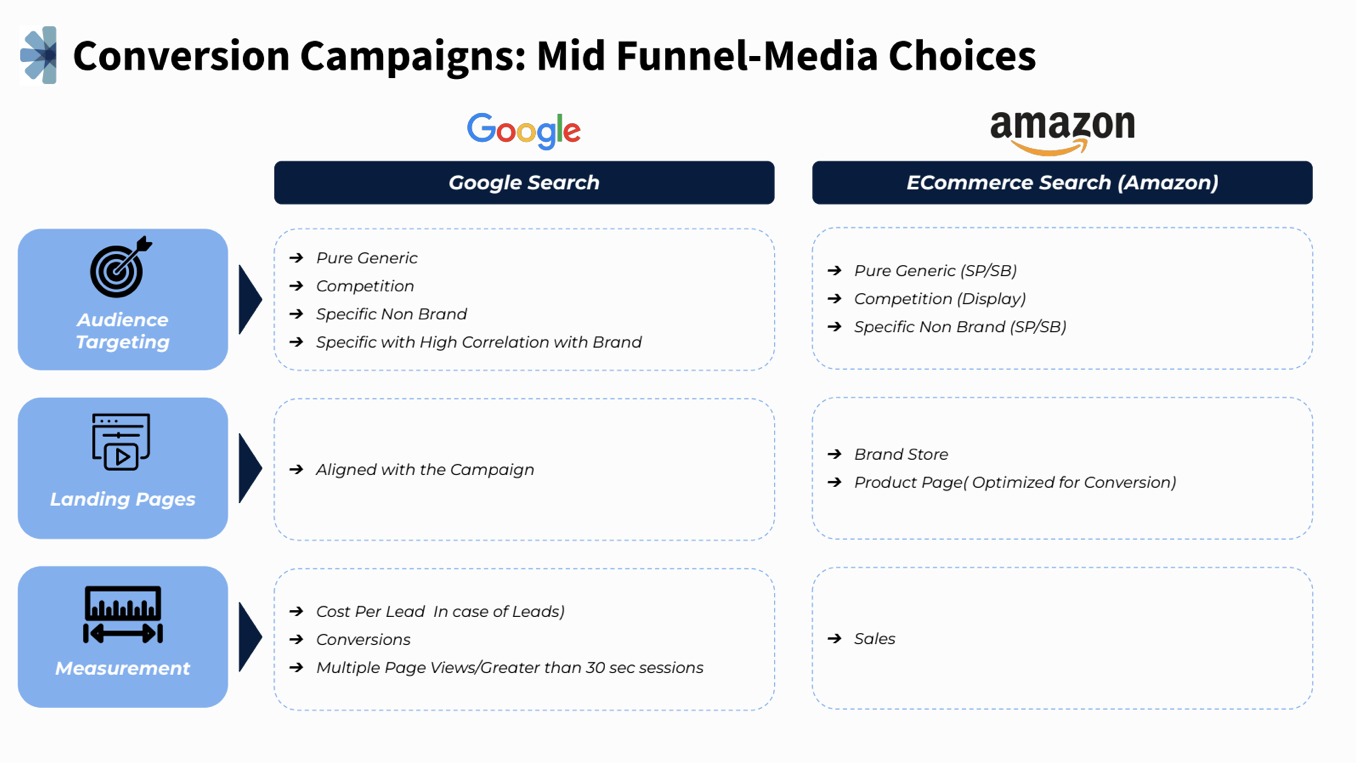
In the mid-funnel, we used Google Search. This was simple. You start with long-tail keywords like "BLDC fan," "smart fan," and "remote-controlled fan." These are keywords where you have the highest likelihood of winning.
For example, suppose you’re selling a hearing aid. In that case, one approach might be solving a specific problem with a hearing aid. Say you have a hearing aid that doesn’t have a visible appearance; it’s not noticeable in the ear.
People don’t want to be seen with a bulky hearing aid machine; they don’t want to appear old. I don’t know if this is intuitive, but you could start targeting long-tail keywords like “Invisible hearing aid”.
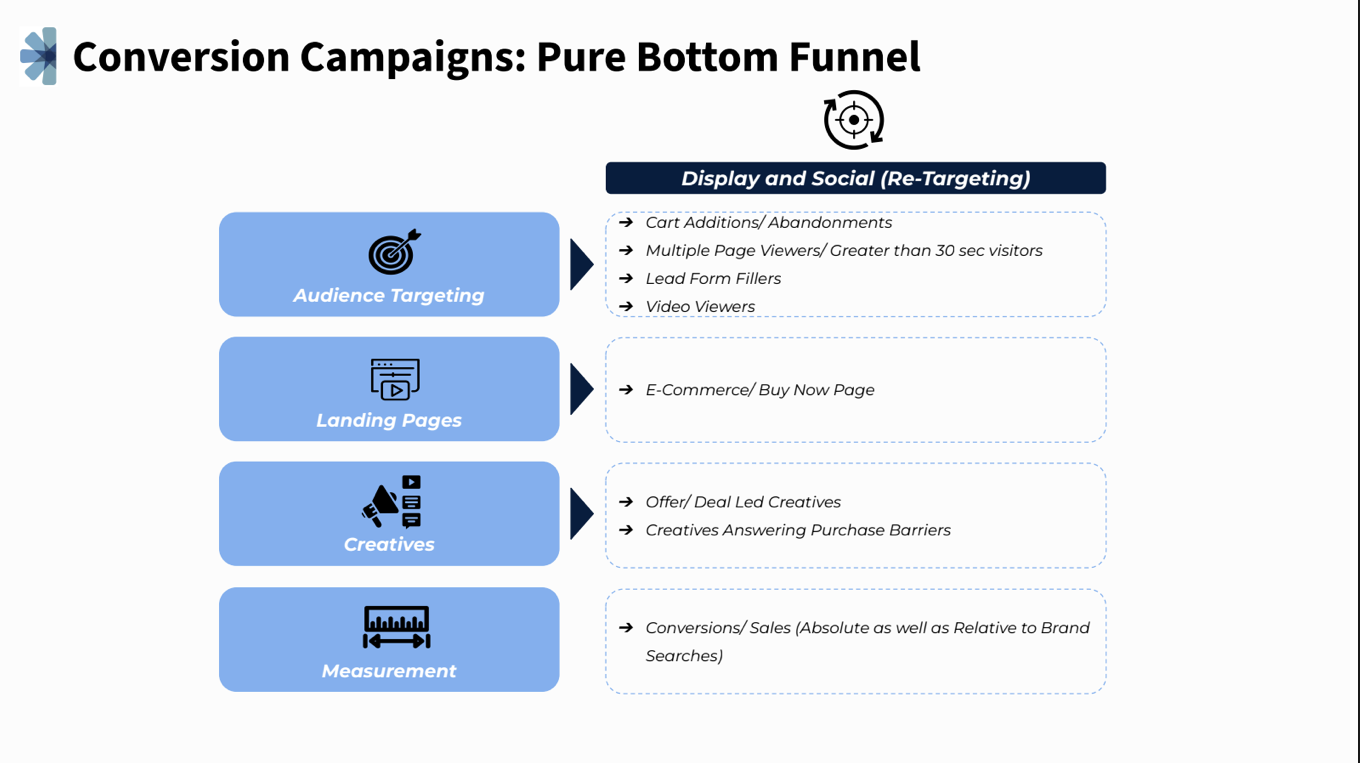
The last part is a pure bottom-funnel campaign. Here, retargeting on display and social really works.
At the bottom of the funnel, you target those who abandoned their cart, those who added but left, those who viewed the page multiple times, those who filled out your lead form, and those who have seen many of your videos.
You can define cohorts of audiences, and once you have a sizeable audience cohort, you can retarget them and bring them to your purchase page.
This must be led by offers or deal-led creatives that address purchase barriers.
For example, with an invisible hearing aid, a purchase barrier might be its perceived expense. Still, you can highlight that it lasts five years, has a 10-year warranty, and has other features. The measurement is also straightforward: conversion and sales.