
1. Building Brand Trust and Reach in Early Days
- Harish Narayanan Ex-Chief Marketing Officer, Myntra
- Deepak Abbot Co-Founder, Indiagold
In this snippet, Harish introduces the Trust and Reach framework for brand building, explaining how early-stage companies should focus on high-trust, low-reach channels before scaling to mass marketing.
When you’re thinking about Brand Building for your companies, you can consider the Trust and Reach framework.
Products can either be low trust or high trust, or low reach or high reach. Based on this they can be like celebs, influencers or friends.
If you are a product which requires a high trust — for example if you’re a B2B product with a very high ticket size — you would rather play as a friend.
This is how users will buy a house. This is how users will buy a car. This is how they’ll buy a fridge. Based on recommendations from a friend. This is also how you will start building a brand as a small scale, early-stage company still finding PMF.
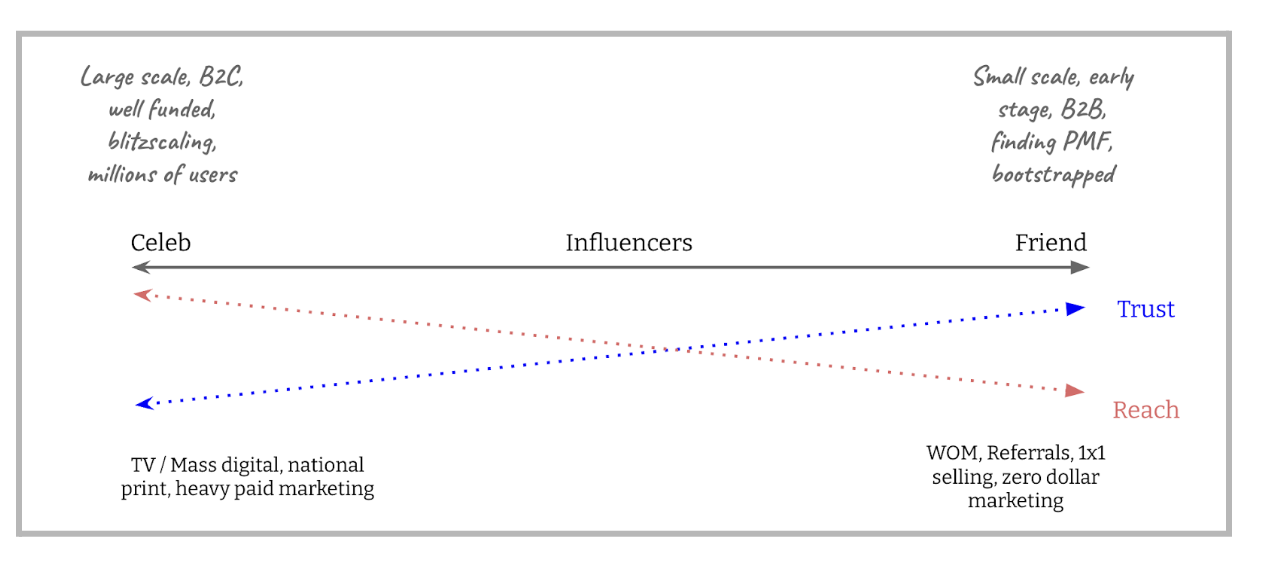
In the early stages your channels will all be word of mouth oriented, like referral programs, on ground events, and building communities. This is because you are in the high trust, low reach area.
If you become very large, say you are scaling from 100,000 to 10 million users, then you are on the Celeb side of the spectrum — high reach, low trust.
This is where all the TV marketing, digital campaigns, YouTube campaigns, print, and billboard etc come in.
In between is influencer or subject matter experts. They are middle in terms of trust, middle in terms of reach and trust.
As a startup, you have to start from friend and slowly go to celeb. At the start, just worry about going from friend to influencer. This itself can take five years.
Also, depending on the type of company or category, sometimes you might need to focus more on being high trust, even if that means low reach.
For example, if you are a health product or a financial services product, trust is a lot more important than having reach early on in the game. You have to spend more time building that trust.
Deepak shares how IndiaGold built brand trust with excellent customer service and transparency, stressing that providing a great customer experience is more effective than mass marketing for generating word of mouth in early-stages.
In the early stages of IndiaGold, we realized that there was no silver bullet to building brand trust. There was no one thing that we could do.
We didn’t have the money to go to the IPL, and we didn’t want to spend any money to experiment with videos, TV, CTV, etc.
At that stage, we were still determining if we had a product ready to be exposed to hundreds and thousands of people. So we took it slowly and it took a while.
While mass marketing, brand marketing, and all those visibility strategies eventually became part of our plan, things that worked in the early days were mostly very good customer service.
This included giving users grace period on missed EMIs, reminding them of delayed payments, veering off charges, having no processing fee, no foreclosure fee, no hidden charges etc.
The industry standard retention rates in our market are also very high — someone who takes a gold loan from a firm is 40% likely to come back and take it again from them — so we knew that if we had to retain customers, we needed to give them a good experience the first time.
The first-time experience, customer service, and transparency all added to our trust factor in those early days.
This is why we worked very hard on good onboarding. We made sure that all key actions happened fast. Money was released to users as soon as they closed the loan. Interest rates were low, even if that meant we only made money the second time.
All of this also got us good word of mouth, which was critical because we operated in a high-ticket category, and warm recommendations were a significant discovery channel.