
5. The Limits of Paid Marketing: Audience & Costs
- Arindam Paul Founding Member and CBO, Atomberg
- Vamsi Krishna Ex-Marketing Leader, Licious and Teabox
In this snippet, Arindam discusses the different types of demand in performance marketing, explaining the strategic limitations of scaling paid campaigns and the importance of transitioning to a diversified marketing mix.
These are very fundamental but these mental models will help you in deciding how to scale, when to scale, and what to scale when it comes to paid campaigns.
There are only three types of demand you can capture with Performance Marketing - people you can create awareness with, people already evaluating your product, and people already in the market for the category but not aware/evaluating your brand.
For the first of these, you define a TG and run awareness campaigns so that whenever they are ready to buy the category, you will be one of the three, four brands they would think of.
For example an Atomberg’s ideal consumer will be any consumer that earns more than five lakhs a year. There are around six and a half crore such households in India. The male is the decision maker.
This male decision maker of the house in those six crore households is my TG. Any awareness campaigns I would do, I would want to create awareness for that set of consumers. They might or might not buy. Only about 10% to 15% of them actually buy fans in a year.
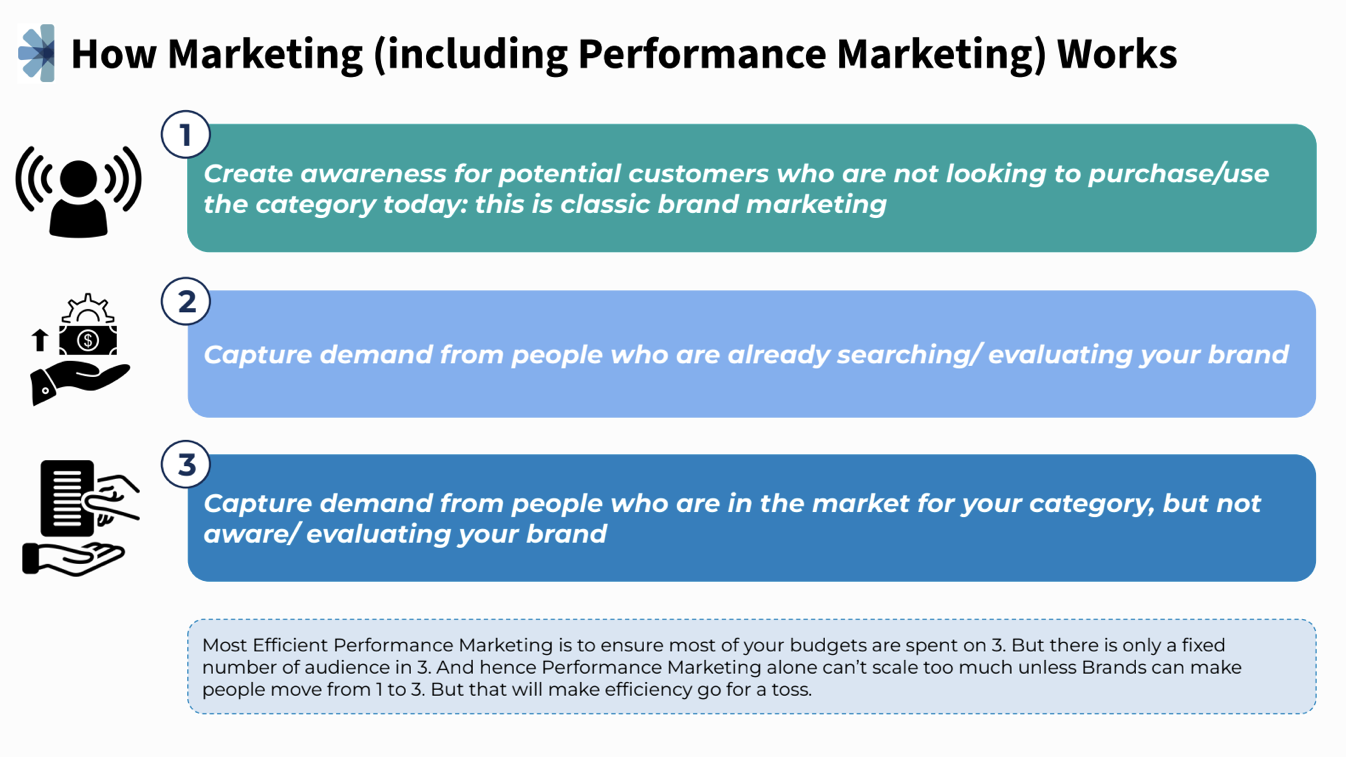
The second is to capture demand from consumers who are already searching for your brand. They would have heard of the brand, and would be aware — incoming brand search is what we call them.
You capture that demand because this is a very easy audience to convert. These are customers who are explicitly searching for the brand. Most brands have 8%-12% conversion rates with this audience. Good brands are even higher.
The last one is the one which I think all of performance marketing wants to do. This is trying to capture demand from people who are looking to buy your category, they might or might not be aware, but are definitely not evaluating your brand.
This is all the demand there is for you to work with on these platforms. This is the reason why performance marketing cannot be scaled beyond a point and diminishing returns set in.
For example, say you’re selling yoga as a service. There are only so many people in India who at some point of time are actively thinking of buying a yoga subscription or buying yoga pants. It is the same for hearing aids, and same for fans.
What happens is if you try and scale your performance marketing up too far, then by default you tell Facebook to spend any amount of money and most of it is spent on the first category — awareness.
These platforms will never tell you to spend less money. Tell them how much you want to spend, they will spend it. A lot of it will not be wasteful in the early stages, but if you evaluate it from a performance standpoint, it will be wasteful. Those leads will never buy or convert because they're not even actively looking for the category.
There are some exceptions. For example, if you have a product that caters to a universal need, such as gaming. Gaming is similar to betting, or, for that matter, now you can say stock market, F&O options, and all of this.
These cater to a universal dopamine rush, wherein you do this thing and you get some immediate rush. For those kinds of brands, performance marketing usually scales without hitting a diminishing curve.
Say you have products which cater to universal needs, universal problems, and are of very low ticket size with high impulse, low commitment, then performance marketing can keep scaling infinitely. But otherwise, it hits a scale.
That's why you need to continuously invest in creating awareness for your brand through content or through an ATL channel. Over the years, I think brands should also track how their dependence on performance marketing is coming down.
If, for example, out of 100 consumers, 80 are acquired through performance marketing today, the goal should be to reduce this to 60, and eventually 40. This marks a successful transition towards a more traditional and robust marketing strategy.
For example, if a Dove runs a performance campaign and some new-age shampoo brand runs a performance campaign, Dove will perform much better because people are already aware of Dove. They don’t have to run them through the entire funnel from awareness to action. This makes it much easier to convert people.
Vamsi complements Arindam’s perspective by noting how competition increases CAC over time and the necessity of balancing performance marketing with other strategies like organic, referral, and brand marketing.
Another aspect that affects CAC is the competition.
At an early stage, when you’re relatively new in a new category, it’s always low.
Suppose you’re an early entrant into a certain category. In that case, you might experience extremely efficient CAC initially. Still, as more and more competitors come in, the CACs are bound to increase.
Many founders expect that CAC should reduce over time and are shocked when it starts increasing. However, increase in CAC because of competition is good. It means that the market is maturing.
But this is also why you have to balance your Performance Marketing with Brand, Referral, Organic, or alternative non-digital efforts. Otherwise your CAC is bound to go up with time despite an efficient paid marketing engine.