
7. A Quick Guide to Setting Brand Goals: PMF to Series D+
- Harish Narayanan Ex-Chief Marketing Officer, Myntra
- Sai Ganesh Ex-Head of Brand, Dunzo
In this snippet, Sai emphasizes the importance of setting clear long-term brand destinations, advising early-stage companies to define their goals and focus on storytelling to grow authentically without relying solely on traditional marketing.
It’s an advantage for early-stage brands that today you don’t need TV ads anymore as table stakes to build awareness. As long as you are authentic, have a point of view, and understand your consumer, content and channels, you can hack the system and grow much faster than what you would have by paid marketing.
It's a great time to be an early-stage brand because you don't need to wait for the prime-time slot on television to get awareness. Yet, I don't think there are too many brands which only focus on brand marketing.
This is because most companies don’t know what they want their brand’s final destination to be and you can’t measure brand marketing with simple monthly metrics.
The only way to know if its working is if the founder, along with the marketing team, takes a call on the destination they want to reach in the long run and measure their current performance against that.
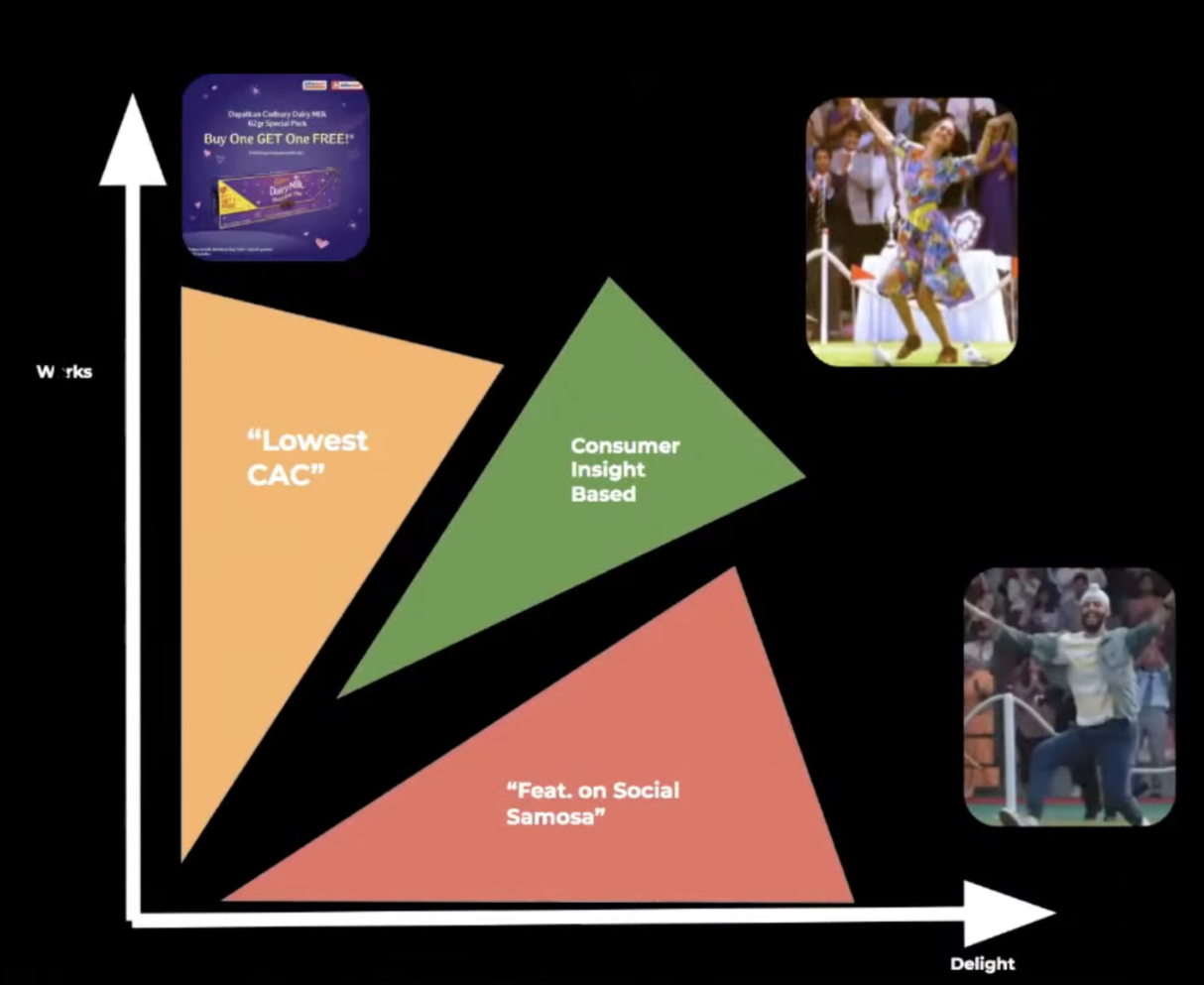
Once that destination is arrived at, it becomes easier to make all decisions later. That’s why this is the most important question to ask for yourself.
Some of the biggest brands in the world have poor logos, have stock photography-based communication but they’re extremely powerful brands. They don’t need those things to build the brand they are building.
The reason I’m also saying this is, because many brands come to me and say they want to be like some other big brand, do the same marketing as them. But if you really prod them, you realise that they don’t really want to reach that place.
They believe they want to be one of those brands which get featured on Social Samosa, but that doesn’t work for the business they are in. They might be better positioned for distribution-led or pricing-led brand marketing strategies, which doesn't really need delight so to speak.
Such dissonance does not work out well. Just pick a destination, especially the leadership, come up with one, two‑, and three-years charter goals for yourself, and stick to them.
These goals could be that in three years, you want to build a brand that has strong word of mouth among the young audiences in Tier‑1 cities, or that in the next one year you want to hire your base content team and discover the baseline for your social media.
Also, I think, the role of a marketer is of two kinds. There is brand management and there is CXO management. All marketers should spend 20 – 30% of their time storytelling internally. You have to be a good storyteller externally for sure, but internally as well.
You have to accept that you are asking your team to invest money, time, and resources behind an intuition based campaign, and for that, you have to be clever enough to use data to back your instinct. Selling your brand destination internally is just as important as selling it externally.
Brand marketers don’t share their ideas for the fear of feedback, but everybody will give you feedback. You’ll get to hear feedback even if you go to your partner. It’s important to differentiate between what is nitpicking, which is the noise part, and what is actual feedback that is positive and that helps you grow better.
Be open to feedback, but differentiate between the nitpicking bit, and sell your story.
Harish outlines how brand building evolves across different stages, starting with owned and earned media post-PMF and eventually scaling up to mass marketing as the company grows.
Another word for Brand is reputation. Brand (or reputation) is what you are known for in the mind of the customer because of your consistent and aligned actions over a long period across touchpoints.
Founders should think of brand building differently at different stages of the company’s evolution.
Before PMF, brand building is irrelevant. Focus on making a product that customers love and are ready to pay for (with $$ or with their attention). Once you are closer to hitting PMF, start building your brand through owned and earned media. No need to 'advertise' via paid media.
At this stage, your brand building should be focused on:
- Owned media — Product, CX, website, CS, CRM, blog, content etc. These are touchpoints where you engage with the customers you own. These channels will give you long-term compounding goodness in organic traffic, SEO benefits, scaled influence, etc.
- Earned media — PR and social media buzz. This is others talking about you. Build relationships with the Press and Subject Matter Experts (SMEs) at this stage. Get them to add value to your customers with their expertise. Keep them continuously updated on what’s happening with your brand.
Post PMF Y1 (Seed / Series A), you can continue to focus mainly on owned and earned media but start exploring mediums with a bit more reach, i.e., paid work with SMEs. You can consider different models of engaging them, such as creating long-term associations, getting them on board as investors/advisors, etc.
Series B / C, when scaling up to ~100cr ARR and beyond, is when you decide to scale your brand awareness and go mass. This is when your decisions regarding messaging/channel/celeb become important.
Post Series C, once your customers understand and remember who you are and your distinctive brand assets, you can drive communication on differentiation home. Head-to-head advertising, feature-led advertising, etc., become important when you have heavy competition.
By Series D, you have fully established 'Who am I?', 'What do I do for you?' and 'How am I better / distinctive than the competition?' Post this, you can explore emotional brand advertising that elevates the brand and creates a resonance with the customer.
At this stage, customers will buy because you talk about your values and how you make them ‘feel’. e.g., Nike, Under Armour, Ariel’s “Share the load,” Coke’s “Open Happiness,” etc.
Most financial companies and banks are at this stage. Even at this stage, brands would do functional advertising when they launch a new product or feature (e.g., Apple Face unlock). The same company might have different brands at different stages of evolution.
After this, once the brand enters the rarified air of established mass awareness and clear USPs established over some time, it can expand its influence into the culture. Some examples are Coke Studio, Red Bull Music Academy, etc.