
9. Scaling Performance Marketing with Data and Experimentation
- Vamsi Krishna Ex-Marketing Leader, Licious and Teabox
In this snippet, Vamsi emphasizes the importance of setting aside budget for experimentation and leveraging technology to scale performance marketing efficiently.
People often think that you can scale performance marketing just by spending more money. Unfortunately, it doesn’t work like a tap.
Performance Marketing is a time taking process — right from kickoff, defining the objectives, building in efficiencies into the funnel, and figuring out what campaigns to scale and scaling them.
This is really a marketer’s callout because I have been asked this by founders and CEOs many times before.
But once you’re in it, and you decide to scale your paid marketing, there are two critical aspects to it — experimentation and technology.
Experiments are key when scaling. What worked yesterday might not work tomorrow or what worked for your competitor might not work for you. The only way to determine this is through a lot of experimentation.
Encourage your marketing team to have 10 to 15% of their monthly budget kept aside for experiments, and encourage them to spend it on testing very clear hypothesis. Do not ask for any RoI on these funds.
If you do about 10 – 20 such experiments, you will discover at least one or two avenues that work for you and can be scaled. You need to do this in today’s world. If you just stick to the same approach, it will fade out over time.
Second aspect of scaling performance marketing is the technology.
Beyond a certain point, that is what drives paid marketing. You will very rarely see a large team doing this manually if there is large amounts of money being spent on it. There are automation platforms and engines that take care of much execution.
Marketing is 50% tech and 50% experimentation. In the early stages, tech teams want to focus on the product. But I think you need to prioritize marketing tech equally. This makes your go-to-market execution much faster.
You will have to invest in the data infrastructure and get that capability. Whether you want to change the customer experience, optimise the funnel, track new events, implement a new tool, or set up SEO backlinks — it is all dependent on tech.
This does not mean that you can automate 100% of it. About 50 – 60% gets automated but you still have to be the brains behind it and drive the strategy.
Below, Vamsi explains how optimizing performance marketing relies on tracking metrics effectively, integrating data across systems, and aligning campaigns with overall business goals.
We track a lot of data. I try to track data on a daily basis, weekly basis, and monthly basis, and I track every single metric that’s out there. Then we put them into different dashboards.
Knowing the metric is one thing, but making sure it is used right is a different challenge altogether. I often see that even if teams have a perfect measurement set up, there are usually large gaps in how data flows across all channels and back to their CRM or Analytics.
You’ll have to spend enough time over there to make sure the implementation of your CRM and Analytics tools is done in the best possible way.
Make sure you track all events and that all your data points flow back into the system so your marketers can use them to make decisions. That is the complete point after all.
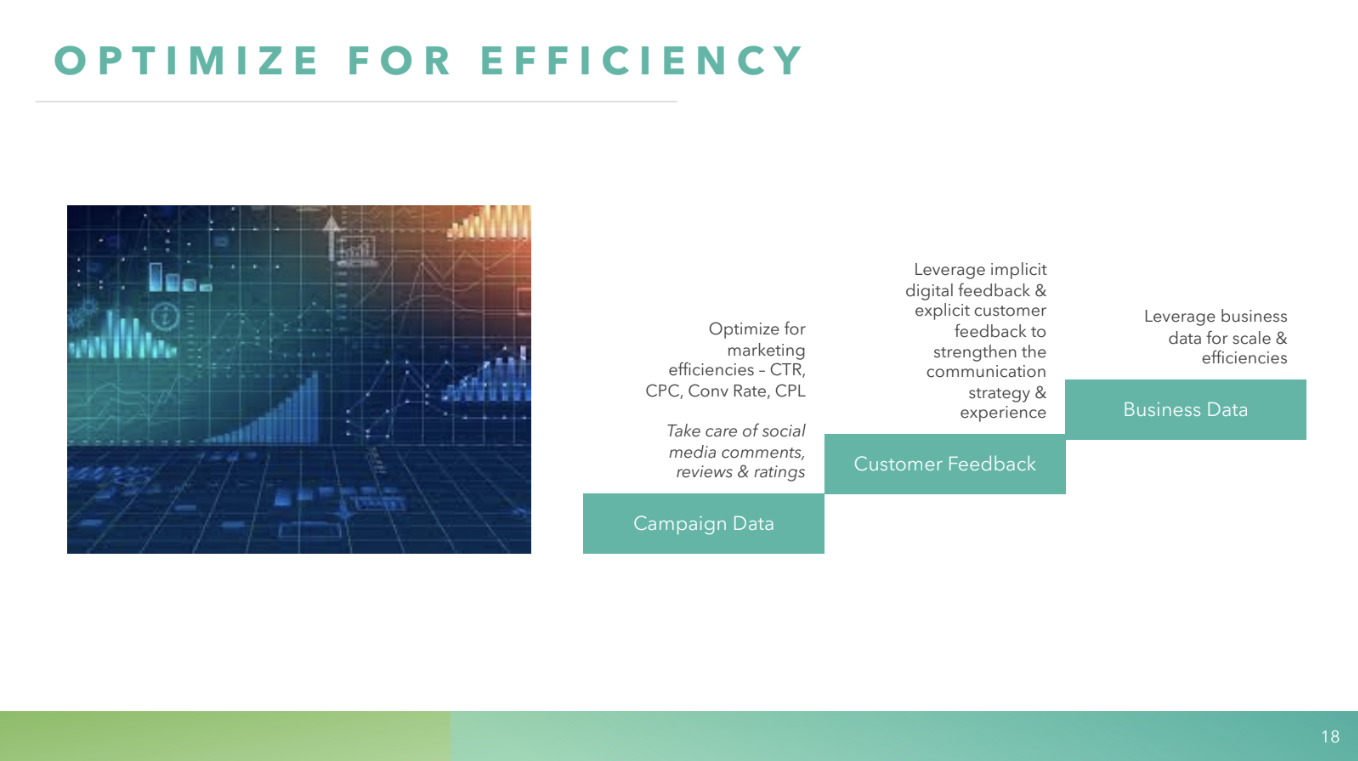
The way I see it, there are three levels of optimization that need to be done.
- Campaign Data
Any agency or marketer can do this for you. It’s a no-brainer. What is important here is having a quality layer over your creative communication.
- Customer Feedback
You have to take this into account and put it back in your performance marketing strategy to make sure that your funnel is optimized.
- Business Data
For example, at Licious or TeaBox or other FMCG companies, all marketers have to account for the production capacity before running paid ads.
If you don’t do this, you can end up generating more orders than you can serve or generating demand in an area that your company cannot serve.
The only way to avoid errors like this is to combine your performance marketing strategy with business metrics and business data points.
Everything you do in paid marketing has to tie back to what you’re trying to do at an overall brand level. It must go hand-in-hand.