
2. PMF First, Paid Marketing Later
- Harish Narayanan Ex-Chief Marketing Officer, Myntra
- Vamsi Krishna Ex-Marketing Leader, Licious and Teabox
In this snippet, Harish discusses the importance of achieving Product-Market Fit (PMF) and how rushing into paid marketing before establishing a paying customer base can amplify existing inefficiencies.
PMF means organic growth. People can’t stop talking about you, and they use you frequently.
Until you reach this point, please don’t do any growth or marketing, don’t listen to anybody, and don’t spend money on Facebook and Google Ads. They are useless.
The mistake most people make once they raise funds is to use Google and Facebook ads immediately because this hides many inefficiencies already in your product.
Remember, marketing is a loudspeaker. It will amplify goodness, but it will also amplify nonsense. If your features are bad or your customer service is not up to the mark, marketing will amplify all of that. It will take whatever you have and 10X that in the public. This is truer if you are a B2C company. Then, the amplification is 10X-20X.
This is why make sure you have PMF before you start marketing. The necessary and sufficient condition for a business is not a product, PMF, customer base, or distribution. It is a paying customer. If you don’t have a paying customer, you don’t have a business.
Customers need to pay you in some way before you start paid marketing. You should either receive attention or earn money.
If you are getting paid in terms of attention or money, then you have a product and a company. Otherwise, you don’t have a company. So please only invest in paid marketing after you even have a company.
Building on Harish’s advice, Vamsi highlights the importance of starting small, setting clear objectives, and optimizing customer touchpoints to build an efficient acquisition strategy before scaling.
Our first 500 customers didn’t come through performance marketing or we didn’t really sort of spend money on ads for them.
I’m not saying you should acquire consumers without spending. That’s not what I’m hinting at. You spend money, but on different channels, not necessarily always a Google or Facebook ad. Initial marketing must be much broader because the challenges at that stage are very different. You are still learning what your customers want, and how to communicate with them.
The next thing after this initial marketing is to define an acquisition strategy. And I mean define. I use this word specifically because I have often seen marketers and founders don’t spend time here. The minute they think of performance marketing, they jump straight to running ads.
It's extremely important to define your acquisition strategy. When you do this, you realise that the general internet knowledge - start with an awareness campaign, make a marketing funnel, offer discounts etc. - doesn’t work. People go everywhere. All customers are different personas. Everybody behaves differently.
Ads are just a channel. Before you start running them, you still need to define what do you want to do with them? How do you want to communicate? How do you want to nurture customers with them? What is your hook? How do you want to move users from ads to your platform?
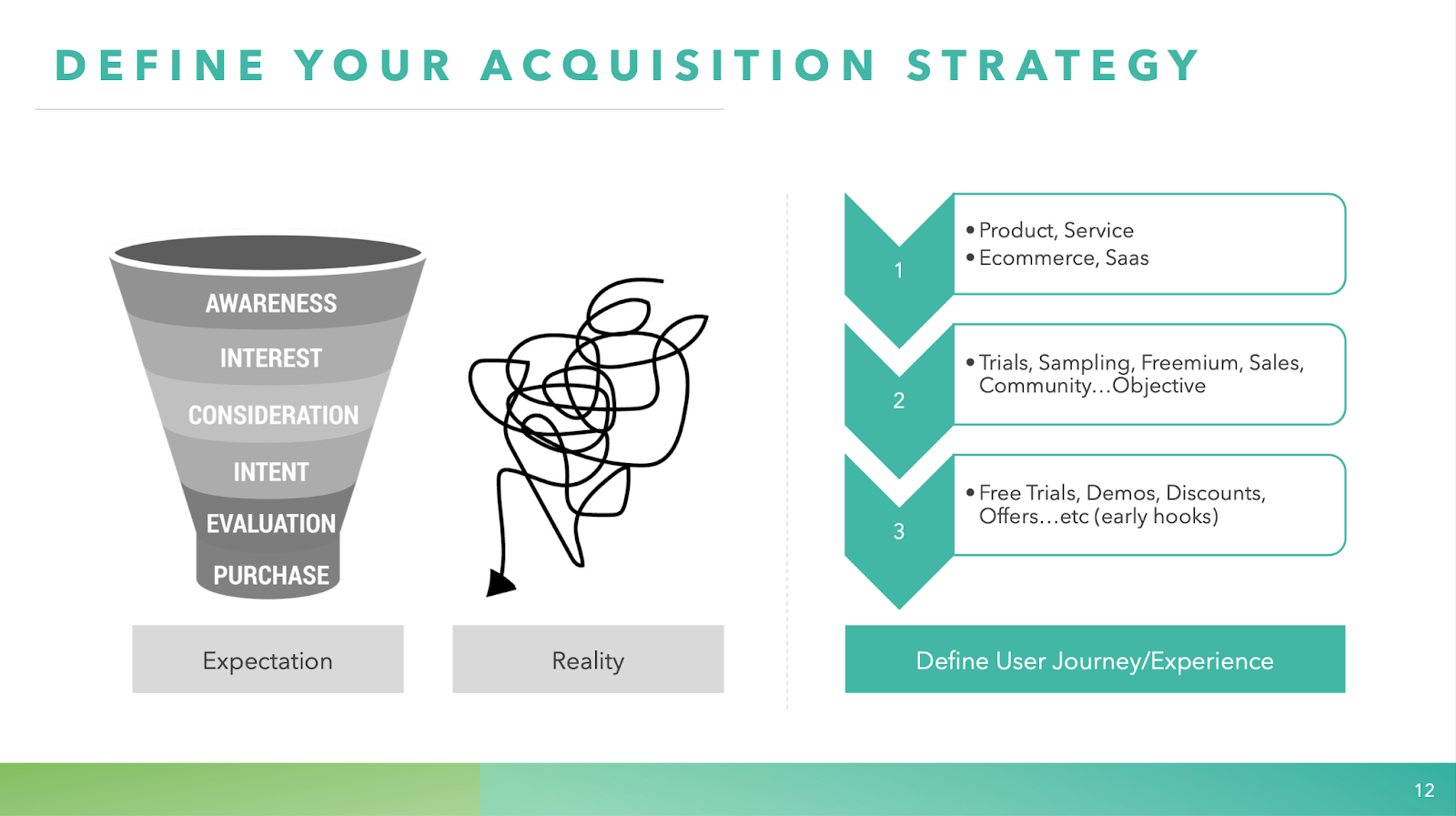
Customers come from various channels. They get pulled to you from different offerings. Someone might come from a referral, someone might have seen an offer and come looking for discounts, others might have clicked on your ads because they couldn’t find the product they were looking for from another brand.
This is why you have to define the objective of your first performance marketing acquisition very very clearly. Especially when you are acquiring your first ever set of customers from that channel. You can’t be doing everything.
What do you want to do? Do you want to drive trials? Do you want to do sampling? Do you want to just give out a product on a freemium model? Or do you just want to build a community for your first six months? What is going to be your objective?
Let the objective of your performance marketing or your acquisition strategy be a little more clear, and then figure out your early hooks.
You will have 100 different audiences. You might be running 200 campaigns. Your hook would be slightly different for different audiences across different campaigns. This is okay, but for a specific campaign, define it very clearly that what is the objective and what do you want to offer.
Because after one week or one month of running that campaign, you need to be able to go back and say what has worked and what hasn’t very very clearly.
Once you define your objectives, mapping out your entire user journey is very important. This is where I see a lot of leakages happening in performance marketing. You need to define your customer touch-points.
Whether you’re doing Google, Facebook, affiliate marketing or media buying, you need to know where you want your customers to land. Do you want them to land on a general site or do you want to have a very campaign specific communication landing page?
Defining your touch-points also helps you integrate various assets like your app, landing page, blog and website together. It helps you think through how to help your users navigate across platforms, where they drop off, and how to get them to the objective you want to be met.
This is a very critical component of building an efficient funnel. It gets missed many times and users end up landing in one place and going somewhere else without any sense of direction or an integrated approach to how you want them to navigate your brand.