
11. The Only Five Metrics You Need to Track
- Nitin Agarwal Head of Growth & Revenue, Shopsy by Flipkart
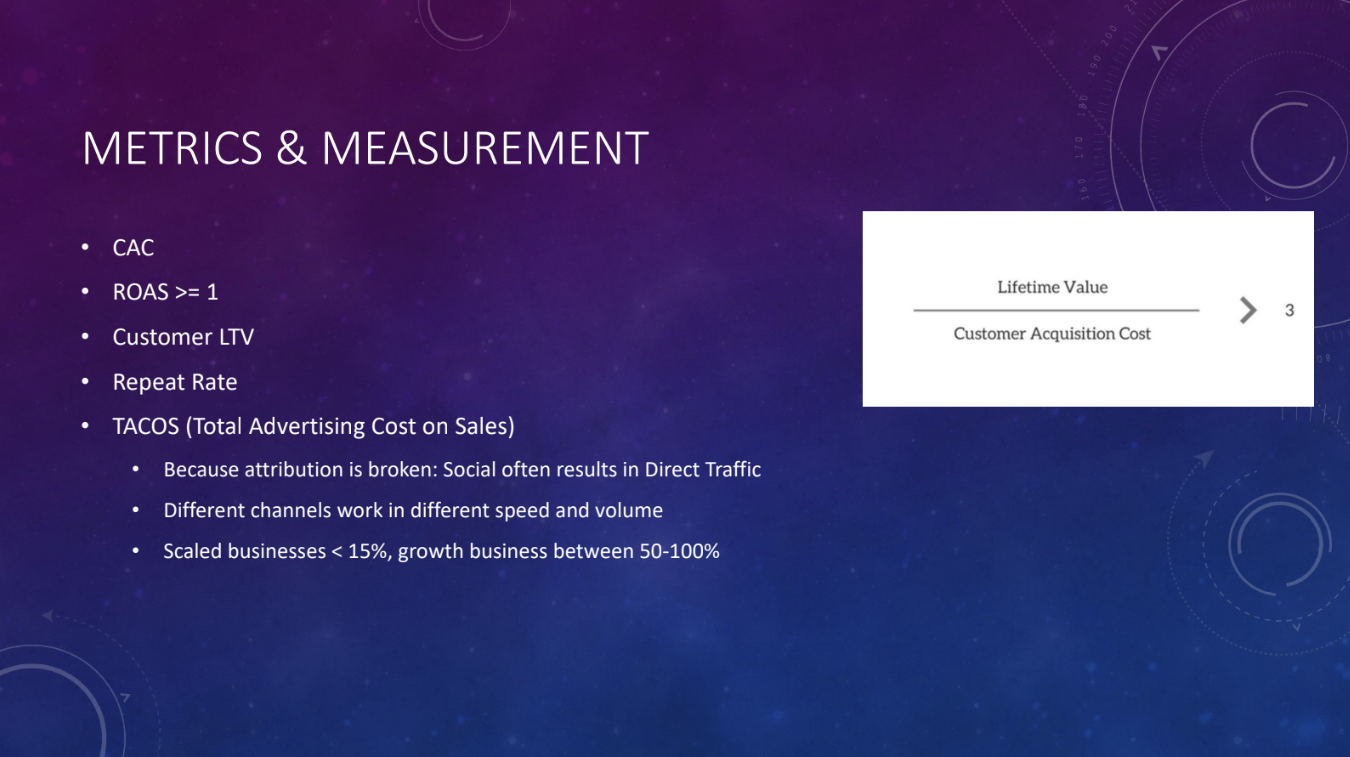
While there are several metrics for marketing plays, as founders and CMOS, these are some of the top ones that you should absolutely keep in touch with.
- Customer Acquisition Cost (CAC)
This is the cost you are paying for one conversion.
- Return on Ad Spend (ROAS)
This is how much revenue you’re generating per your ad spend. Generally, you should aim for ROAS greater than or equal to one in modern B2C and B2B. Best in class would be somewhere around 8 or 10.
But in the early stages, if you’re focusing on scaling, anywhere between one and three is a good number.
B2C largely tapers at about three or four. But for services, you can get about seven or eight; the best in class is about 10. That gives you a range.
- Customer Life Time Value (LTV)
Investors always ask about this. You must monitor LTV to identify the customer cohorts on which to spend more.
Say for example, your CAC is currently 200 rupees for up to 1000 rupees of sales. If you know your LTV from each customer is 5000 bucks, you can return to the board and say that you will increase your CAC to 900 because your LTV is high.
High LTV means you can spend more on marketing which means you can achieve scale faster and you can outdo your competition.
- Repeat Rate
This is closely linked with your LTV. Unless your repeat rate is high, your LTV will not be high. The CAC that you can play with is always going to suffer.
Therefore, it’s essential for co-founders to actually look at the drivers behind the repeat rate for their business and think about how to improve it. Building strong CRM funnels and product tags are some tactics to improve your repeat rates.
- Total Advertising Cost of Sales (TACOS)
This is your budget spend, divided by sales. This helps you look at your total advertising spend and sales and how they move.
It gives you a good overall P&L view of your marketing performance and if you are able to scale your spending proportionately with your revenue.
For scale businesses like HUL or very, very large consumer businesses, TACOS is less than 15%. At UpScalio, we operated between 5 to 10%. For growth businesses, TACOS are often at 50 to 100%.
With TACOS, you can also determine how much money to spend on marketing. As you improve from 50 – 60% today towards this holy grail of under 15%, your P&L will start improving, and your profitability will look within sight.
Looking at TACOS is more comprehensive than just ROAS. When you focus only on ROAS, you compare the returns from various channels. You end up saying, “Google has given me five ROAS; Facebook gave me two ROAS," and focus only on your highest ROI channel. That is very early-stage thinking. It leads to erratic decisions about channels to focus on.
True magic happens when you use all the important marketing channels and have a healthy mix. Different channels work at different speeds and volumes.
For example, Google will give you instant results. Insta and R&F will slowly start giving you results. But you need to have those in your mix.
Moreover, different channels bring in different kinds of customers. Google only gives you customers who are already interested in buying new services.
But you also want to create interest. You also want to make a product category. You also want people to become brand endorsers of your product. Therefore, Facebook is just as important.
Looking at TACOS over just ROAS gives you a more complete picture.