
8. Defining Rules and Accountability in Partner Relations
- Anand Venkatraman Co-founder & CEO, Happysales.ai
You need to define your goal with your Partnerships program clearly on paper to execute it. You must know what kind of markets you focus on and prepare some gives and gets for the partnership.
You need to know what the partner will make per lead. Partners will stay if they see financial value. You must understand their costs and spending. Where are they spending? How many people are they deploying into the sales team for them to build the pipeline, and how much money are you offering when you work with them?
Most people fail here because they are focused on predicting the money they will make after bringing in a partner and not enough on how much money the partner will make. If their numbers don't add up, you shouldn't be surprised to see that the partners don't care.
They will keep you on the hook and tell you they are working on it, but month after month, you will get the same response and no business. This is super critical. And when you’re starting, it is good to give away a little money here to build velocity.
The second one will be the rules of engagement between partners themselves. Because when you open up the market to partners, they don’t report to you.
Establish clear rules of engagement to define acceptable behavior, unacceptable actions, and their repercussions because discipline is very important in an ecosystem. Without discipline, it can very quickly come apart.
The number one thing that can go wrong while building a partner program is a mismatch of expectations.
You need to think very clearly about who will handle which accounts, how opportunities will be distributed between partners and the internal team, how the deal will flow, whether it will be collaborative with sales, and whether channel partners will run it alone.
In our experience, we’ve had separate swim lanes. The partner swim lane was completely different from our regular Sales swim lane. We had our own pre-sales team and CSM, so when I was running the partner program, I was effectively running another huge shadow organization. But beyond a point, that gets hard to scale.
You end up with duplicate resources for everything. The economies of scale that should kick in when you start scaling start to take a beating when you build an overlay model.
I recommend, and I’ve seen this work in most companies, that you should have the partners bring in opportunities. They shouldn’t be with you through the sales process.
In most scenarios, if you’re running an overlay model, your account executives carry a territory target, and partners work with channel managers. You can also allocate one pre-sale resource to work with the partner.
Partners bring in the opportunity. The account executive and the channel manager can work together on them. This team will take you through to closure. After that, the implementation can be done by the same partner, another implementation partner, or in-house.
The structure entirely depends on how you want to do it, but if you are serious about your Partnerships program, you should have these processes laid out and be ready to terminate partners who don’t follow your rules of engagement. 80% of the partners will not deliver, which is fine.
After establishing clear expectations and rules of engagement, it's crucial to equip your internal team and partners with the right tools to maintain transparency and accountability.
Your partner tech stack will include some PRM. For the rules of engagement to work, your internal and partner teams must have the necessary visibility, and this can only happen through partner relationship management software.
For the partner to follow your set rules, they would need to know what territory to operate in and which particular accounts are acceptable for them to chase. They would always want to see which accounts they’re working on, have a very clear partner view of the pipeline, see which deals are closed, and see how much money they will make and how much money has already come in.
Your PRM tool must integrate with your system, providing partners with limited but real-time visibility. This is key to maintaining partner engagement. The sooner you do it, along with establishing the rules of engagement, the better you are setting yourself up for success.
This is a failure I’ve had in previous companies. We started with a lot of hustle. We got partners and created our own rudimentary PRM apps with three developers, but that doesn’t scale.
Some of the numbers will not add up when you do something like that. The partners get very upset when four of their deals, which are due and they should get paid for, are not showing because there are some bugs. So solve this as soon as you can. Partners will also give you more respect.
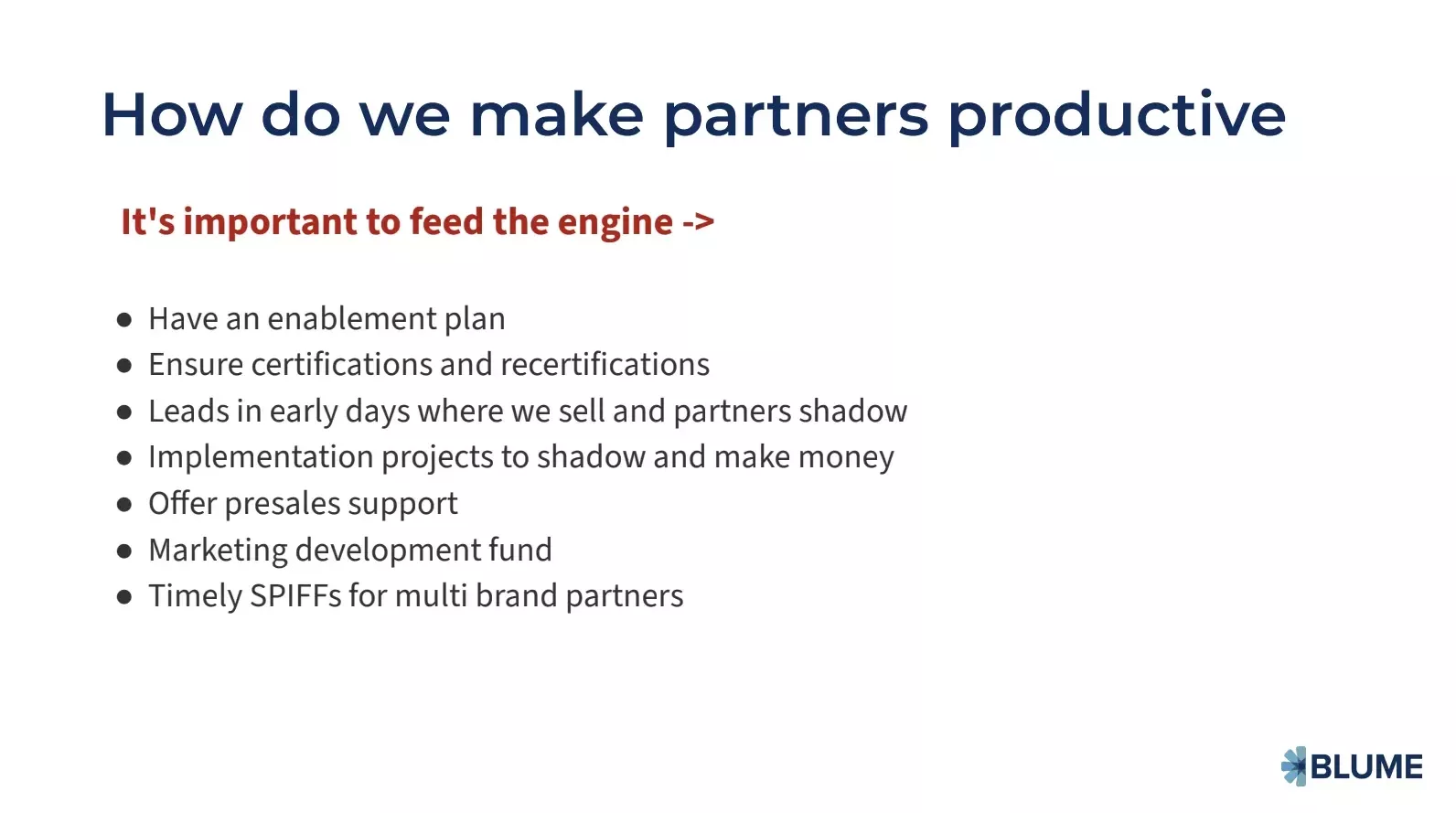
Getting a partner is challenging, but your problems are only starting once you bring them in. Only 10 to 20% of partners will be productive. The rest will slowly fade away because they struggle to close deals or find your product hard to sell. This is why setting your partners up for success in the early days is important.
You need to coach and train them to be your partner. You have to bring them into meetings to shadow your sales process. Let them learn by watching you handle proposals and objections. After a few rounds, they’ll build confidence and be able to pitch independently. They need to go through this process to do it.
You need to bring them along with you, make them a part of your conversations, and give them free deals to start with. It’s about the small wins, really. Once they see small wins and know how much they are making very clearly, they will be willing to stick around and dedicate more resources.