
2. Selecting Segments & Persona-Problem-Impact Maps
- Ravi Kaushik Rajagopal Head of Sales, Adyen India
I split any GTM motion into four segments: SMB, mid-market, enterprise, and large enterprise. In the US, these are defined by revenue earned as: SMB ($0-$50 million), mid-market ($50 million-$1 billion), enterprise ($1 billion-$10 billion), and large enterprise ($10 billion+).
Given the high cost of US lead databases, startups can instead approximate a target company by employee count: SMB (fewer than 200), mid-market (200−1,000), enterprise (1,000−5,000), and large enterprise (5,000+).
Each of these segments is a choice. You can't serve all four segments at the same time. Very few companies can, even a decade after successful PMF and growth.
This is why niching down is crucial. Large competitors in your space have to build large generalist solutions that cater to many stakeholders and segments. As a startup founder you can start small and build a narrow and great solution.
You shouldn’t run multiple segments in parallel unless you’ve raised substantial funding. Even then the risk of inadvertently building a broad average for most product vs a targeted great product for few is high
Once you know which segment you’re targeting, make a list of companies in that segment. This should give you around 600 – 800 companies to approach.
While total addressable market (TAM) is a useful metric for investors, it's not relevant to day-to-day B2B sales. For a founder with limited runway the only market that matters is the one she can speak to today and sell to tomorrow before she runs out of money.
It’s important to get these segments and lists right. The distribution of accounts across segments also indicates the direction of your sales efforts.
Once you understand the distribution and know you have a 10-month runway, you can plan your outreach strategy accordingly.
Now, once you have your company list, what’s next? You create a Persona-Problem-Impact Map. Shown below is such a map for a fictitious AI startup that makes all company documents and knowledge databases available via an LLM interface.
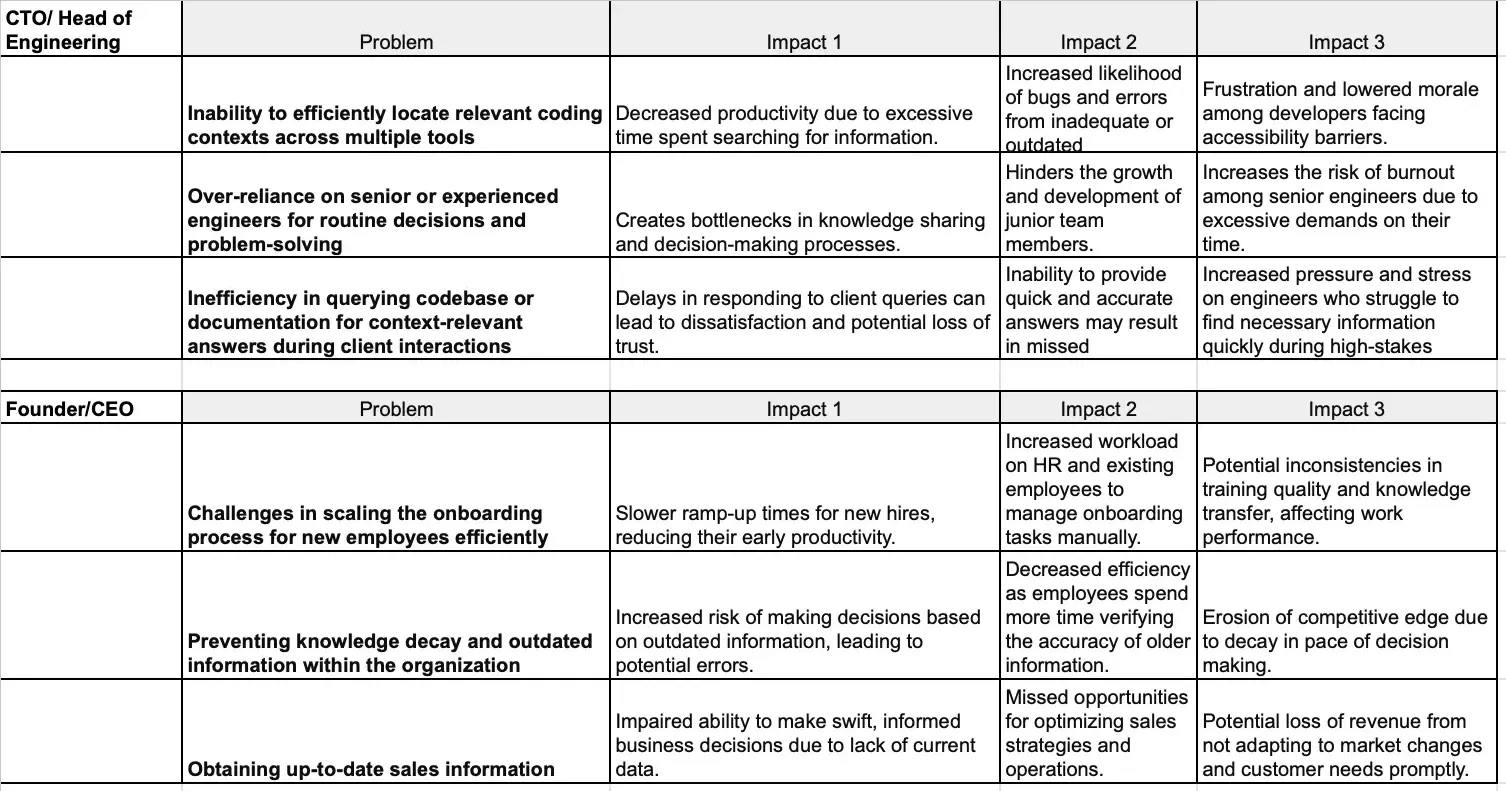
A persona is a designation within the company that will either buy or use your product — not someone who just influences the decision or champions it. The persona either signs the check or uses the product directly.
Knowing your personas is crucial for repeatability. There are typically four stakeholder personas in B2B sales: user buyer, technical buyer, economic buyer, and sponsor.
For SMBs, it’s often the same person, usually the founder, which makes the process faster — direct feedback and quick decisions. For enterprises, you might have an IC using the product, a team lead or IT might be the technical buyer, a finance purchaser or business lead might be the economic buyer, and a C‑suite sponsor — often in different countries, complicating the sales process.
Figuring out the right combination of Average Contract Value (ACV) and segment is key. If you're targeting mid-market and your persona isn't fixed, it's a big red flag—you're burning enterprise sales resources for mid-market pricing.
Do the exercise: define the problem and then write the impact of that problem on the persona.
If you have multiple founders in your startup, creating persona-problem-impact maps can be a valuable exercise. Each founder takes two personas and lists three problems they solve for each. Compare notes — you’ll likely find 80% disagreement on the key problems being solved. This is a common issue, especially between technical and non-technical founders.
Late-stage B2B sales is about problem-solving — it’s like consultancy. Early-stage sales is a transfer of enthusiasm from a passionate founder to a client who didn’t know this problem could be solved in this way. Understanding the impact of the problems you solve is crucial.
This is also protection against falling too much in love with your own product/technology. Nobody cares about your product or the technology you invented. They care about the impact. The classic saying is that nobody wants a drill; they want a hole in the wall. But really, they want the family pictures on the wall.
Whether the family pictures go up with help from an Ikea DIY product, an Urban Company carpenter setting it up, or a 3M sticker, or some other method it doesn’t matter. The customer just wants the end result.