
1. Event-Led GTM Frameworks from inFeedo & Whatfix
- Nishchal Dua VP Marketing, inFeedo
- Prakhar Jain Regional Sales Head, New Business - NA/EMEA, Whatfix
Nishchal explains how event-led growth integrates events at various stages — discover, engage, and grow — while focusing on defining ideal attendee profiles and ROI metrics.
The whole idea of event-led growth is that it helps you discover, engage, and grow customers through immersive and integrated events across their life cycle.
The two keywords here are immersive and integrated. Your events must be immersive and engaging because I will tune out if they’re boring.
They must be integrated into your customer’s journey because you can’t just do random events without knowing your ICP and what type of content you will share with them pre‑, during, and after. You only crack event-led growth when you integrate everything.
Your event has to tie in with the functions of your Sales and Marketing team pre- and post-event. There are three stages to this: discover, engage, and grow.
Discover is to help you unlock new markets, problems, prospects, ICPs, use cases, and trends. You do a discover stage event if you want new prospects for your pipeline. These are also some of the best ways to enter new markets and learn what’s on top of your ICP’s mind.
Engage events are for your prospects and leads. They are usually designed to address objections, build social proof and other objectives to accelerate your pipeline.
Grow events are events for your existing buyers and customers, like customer conferences, where you discuss new products, user groups, customer showcases, and expansion.
These are three parts or stages of your overall event-led growth framework.
There is also the concept of IAP, or Ideal Attendee Profile. This is similar to how we have ICPs for our company.
You have to understand that your ICPs don't translate to your IAPs. You might be selling to a company's CXOs, but you cannot just invite them to a webinar. They won't show up. The same goes for trade shows and other in-person events. Executives often send their L2s and L3s to these events to collect brochures.
Defining your IAP means understanding the ideal attendee profile for your event format and stage. If you sponsor a tradeshow with the goal of meeting five CEOs, I can tell you now that it’s not going to work.
Then instead of ROI, we use a term called ROE, Return on event. For each type of event, there could be brand returns, demand returns, and advocacy returns.
If I’m getting all of these other benefits, I need not only talk about my demand generation from events. People look at one thing, which is the number of leads, and they forget that events also have other impacts.
You can literally measure the potential ROI of an event with social media impressions, along with pipeline and revenue targets. If after doing a customer conference, my overall impressions go up drastically, that’s a benefit that I have.
Building on Event-Led Growth, Prakhar highlights the importance of events and live engagements to gain market insights quickly.
Event-led growth means building a comprehensive GTM engine with an integrated strategy. We have a pre-event strategy, an at-event strategy, and a post-event strategy to ensure that we don’t ‘show and throw up,’ as we call it.
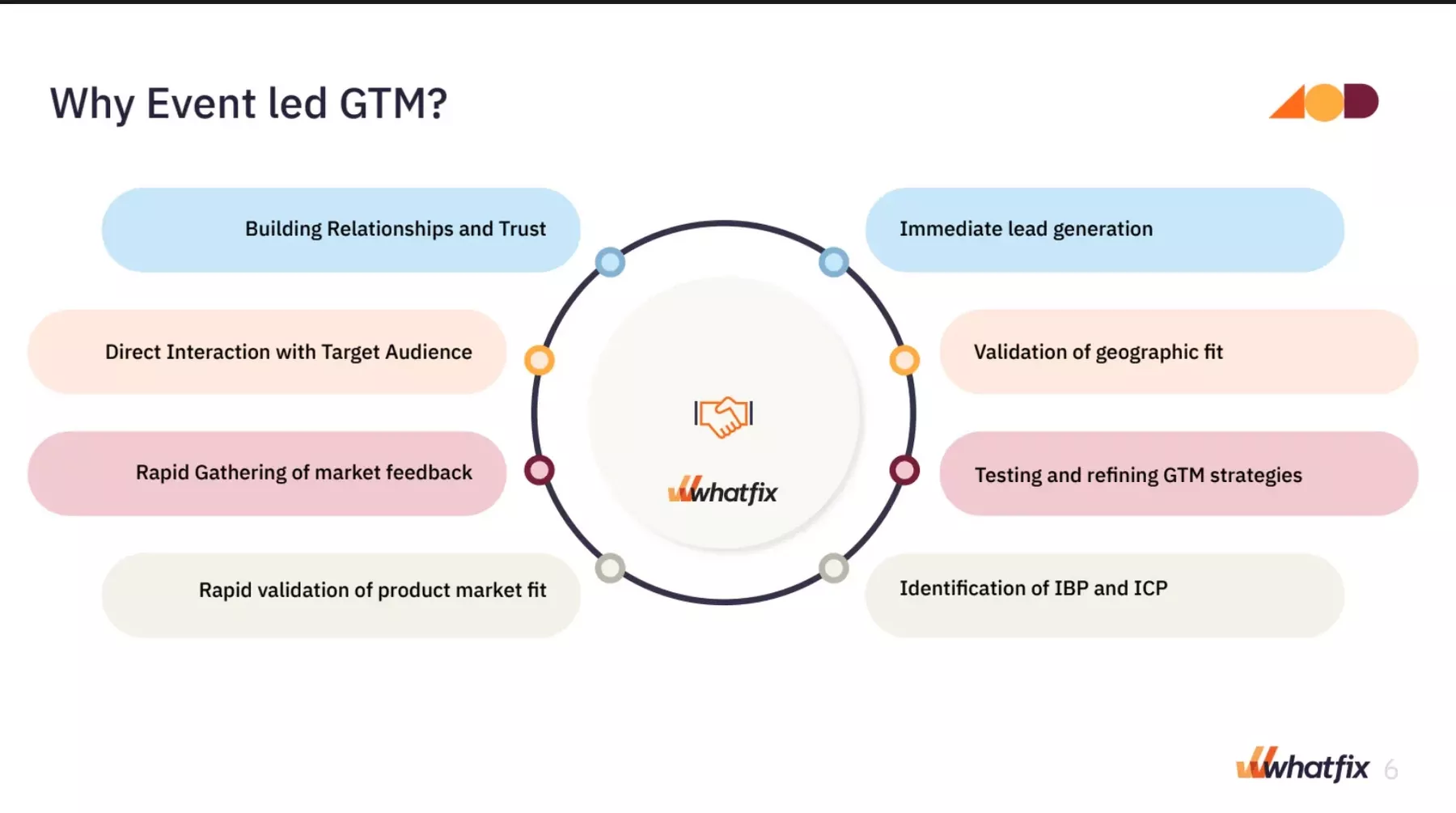
Figuring out your event-led growth strategy includes high-level details like what types of events work best with the personas and industries you are targeting and tactical details like knowing exactly what you will do with the leads post-event and what types of rooms work best for lunch and learns for the number of people you’re inviting.
It might sound like a lot, but it is very important today. Traditional marketing relied heavily on multiple marketing-led channels. Companies would bid on keywords to try to get leads, but that approach is less effective now, especially for new-age technology companies where search volume is often lower. Potential buyers first need to become aware of the problem the company solves.
With events, the best part is that you don't need to worry about following up or chasing your leads if executed well, and a future meeting is set up at the booth. You can conduct the demo, understand requirements, and gather feedback— all within the same conversation.
Also, the number of conversations you can have at in-person events in a two-day span is amazing. You cannot do that online. Your keyword and cost per lead keep increasing.
Being there and talking to people helps you quickly understand what kind of GTM would work for that persona. This approach opens up new channels for engagement that competitors may not be leveraging effectively.
Nothing shows this better than the story of Whatfix at Dreamforce. We attended the conference for the first time at a very early stage. The minimum booth cost was 25K. We were five people at the company and four of us were at the event, essentially shutting shop here while we were there.
A significant portion of our GTM budget was allocated to this single event because we believed, “This is where we should invest if we have to make an impact.”
At that time, we had realized that our product was strong but the perceived problem wasn’t critical enough to drive purchases. The problem didn’t keep our buyers up at night. We were excited to be at Dreamforce because we really wanted more feedback on our product.
When we started having conversations and telling people what we do, people were surprised by our offering. Everybody was falling from the chair and wondering why they hadn’t heard of us yet. This was very confusing for us. The feedback highlighted unexpected market interest.
The most memorable encounter happened on the third day, with a senior VP from a Fortune 500 company. They found our product very useful, and asked us the cost. At that time, our annual subscription was 8K USD, but when I quoted this amount, they thought I was quoting a monthly price and were still very pleased with it.
This was a pivotal moment for us and the company; we realized that we could not sell, not because the problem wasn’t big enough, but because we were selling to the wrong market segment and persona.
Everything changed after this event. It was a big pivot for us. Within the next few days, we started thinking about how to change our website and messaging to support enterprise sales.
Events provide a lot of such immediate, unfiltered, and real-time feedback. As you scale, events also become a great way to get feedback from your customers, not just your prospects. You can ask them how you’re doing and what you can do better. There are always ways to get this feedback online, but in-person experience is unmatched.
This is why many companies now center their entire GTM around events — for all the reasons we discussed — quicker validation, real-time insights, and cutting through the noise to reach their target segments.