
3. Whatfix Playbook for Pre and Post Event Success
- Prakhar Jain Regional Sales Head, New Business - NA/EMEA, Whatfix
Events can be categorized based on the AIDA model — Attention, Interest, Desire, Action — or by awareness stages such as problem-aware, solution-aware, and brand-aware. You can do different things at different stages.
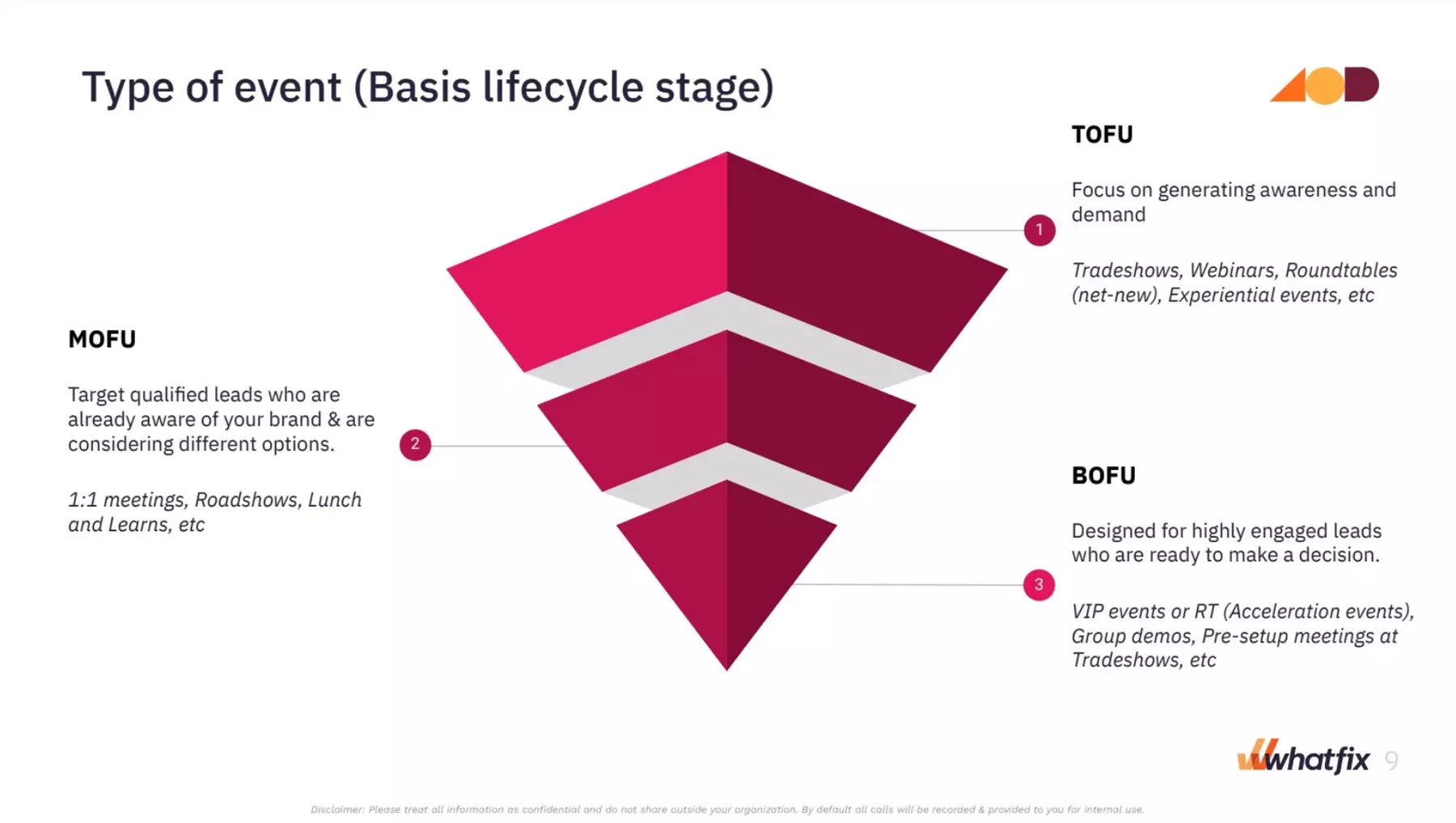
At our current stage as a company of 1,000 people, we classify events into three categories: TOFU (Top of Funnel), MOFU (Middle of Funnel), and BOFU (Bottom of Funnel).
In the early stages, it’s crucial to identify the type of event that aligns with your company’s stage. Avoiding unnecessary events saves money.
We invest heavily in events. For instance, our Dreamforce booth costs a quarter of a million dollars, plus travel expenses for 20 team members. Currently, our return on investment is justified by closing just one or two deals. However, in the early days, this was not the case.
We learned that many other events can yield more impact, which has stuck with us. For example, we organize ‘Lunch and Learn’ events to provide our Fortune 500 customers with special treatment and a unique experience.
We also include regional prospects. In our recent Chicago Lunch and Learn, we invited ten customers and about five prospects at different stages of the sales cycle. The idea was peer-to-peer networking and thought leadership.
As WhatFix sponsors these events, customers naturally discuss how WhatFix has helped them achieve specific outcomes.
This often results in one customer indirectly influencing 2 – 3 others to convert, without us actively selling. We focus on peer-to-peer learning, which is appreciated for the value it brings to the community.
Roundtables are also particularly effective. In the banking sector, where there are only 20 major banks, inviting 10 means you’re covering half the market.
I remember this one time we were trying to get in touch with a CXO-level prospect but were not able to get through in any way. What we did was invite her to a roundtable as a thought leader through the marketing team instead of the sales team. She immediately responded positively.
We invited six other individuals with similar roles — all Chief Learning Officers (CLOs). I hosted the roundtable, which focused solely on industry topics without any direct reference to WhatFix. The session was highly engaging and well-received
This helps create brand recall for WhatFix, providing indirect influence and giving us an advantage over competitors through the event channel.
You should also consider that different markets and geographies have unique nuances that influence the type of event suitable for each stage.
I always tell founders that even before doing an event, test waters. Don't sponsor an event at first. Just go to it as an attendee and judge its relevance. A $500 attendee pass can be a cost-effective first step compared to a $20,000 sponsorship.
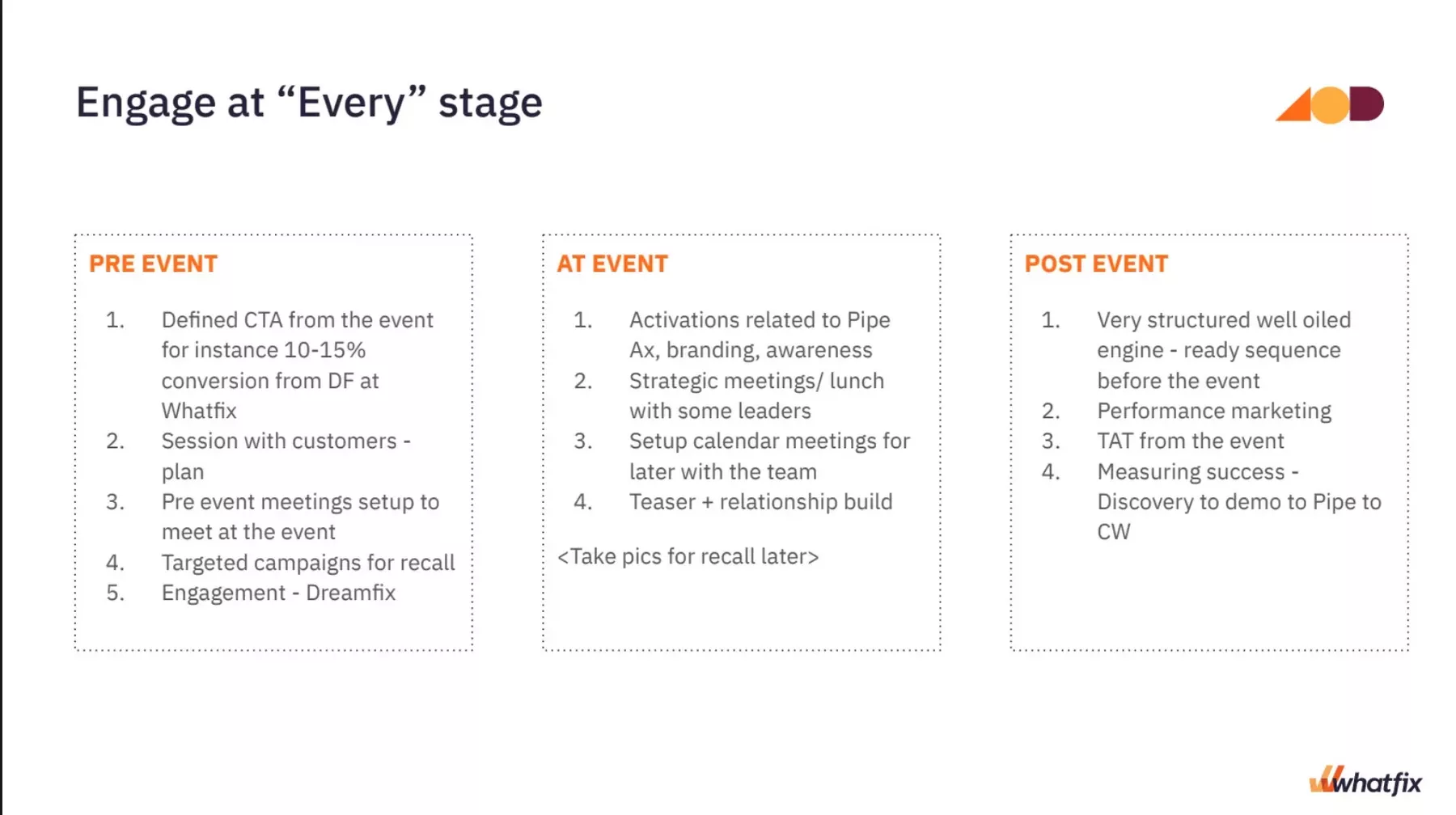
But if you’re absolutely sure a specific trade show event is the right event for you, the next step is doubling down and doing it. At this stage, your pre-event strategy becomes crucial. Trade shows are large. The key question is: What are you doing pre-event to stand out and capture attention?
After ten years, Dreamforce remains the largest and most significant event for WhatFix, making it essential for us to attend. But now, the significance of Dreamforce has evolved for us — not only is it important for demand generation, but it serves as a platform to meet existing customers and accelerate pipeline opportunities.
One thing that we do is offer simple incentives and grab-outs, such as a lucky draw for an Apple Vision Pro, or any other prize within your budget. We build a targeted campaign around this incentive.
For example, if attendees visit our booth and have a five-minute conversation with a representative, they become eligible for the incentive. This campaign is targeted specifically to the intended persona.
We initially did it at one Dreamforce event. We contacted potential attendees within the Salesforce ecosystem, informing them that registering and visiting our booth would make them eligible for the lucky draw. We offered multiple giveaways — three to four prizes.
We saw it as just one of many campaigns, but it worked better than our expectations. Even before attending, we received approximately 1,500 registrations.
Giveaways and incentives are often a significant draw for attendees at a large trade show. These seemingly small items have a bigger impact than most would expect. This approach reduces the cost per lead, even with the giveaway.
Of course, not everyone who comes to your booth can win a prize, so filtering is essential from a processing standpoint. Even folks who might not win will remember that they received an email from your brand about a giveaway.
Choosing the right event type and engaging the right persona is crucial. Still, the success of your events also depends on effectively executing each aspect, especially these pre-event activities.
Let me tell you a very quick story of a million-dollar deal we landed at an event.
We found that this one prospect that we had takes only about 3 – 4 new meetings a year. We found out that he is going to be a speaker at Dreamforce. We chased him down and got to his EA but had no responses. Then we found out his session, attended it, and ran after him as he was leaving after finishing it.
This was totally worth it because we had a conversation with him. I told him that I didn’t need him in the process, only his blessings for the next steps. And it was awesome because everybody relevant to that project was at the event, and we grabbed a meeting with them the next day.
This was very inspiring for us because often, when attending large events, people think that it will lead to little since you are always only one person amongst many. This gave us the validation that if we were deliberate about our pre-event and at-event efforts, we could capture a lot of value for the business at these.
Post-event follow-up is crucial. Many teams lose momentum during this phase due to competing priorities or fatigue right after returning from the event.
Establishing a defined post-event process should be part of your preparation. Determine your follow-up strategy well in advance.
For us, the goal of most events, especially where we are attending, is to get New Business Meetings (NBM). In the early stages, we set a clear goal: to convert 10 – 15% of the total conversations held during the event. These conversions aren’t necessarily into customers, but rather into NBMs.
Talking to somebody doesn’t qualify them. NBMs are just to understand customer requirements. If aligned, NBMs can convert to Sales-Accepted Leads (SAL). We have follow-up sequences for all potential NBMs we set up at the event.
A quick turnaround is crucial. If it takes three weeks to reach out after the event, the initial excitement may have dissipated. The quicker, the better, but don't do it immediately the next day because some events are three days. If you meet them on the second day, you don't want to send anything the day after.
The reality is that you want to automate it even before the event. Once the event is done, segment contacts by personas, and send through the necessary marketing materials prepared in advance.
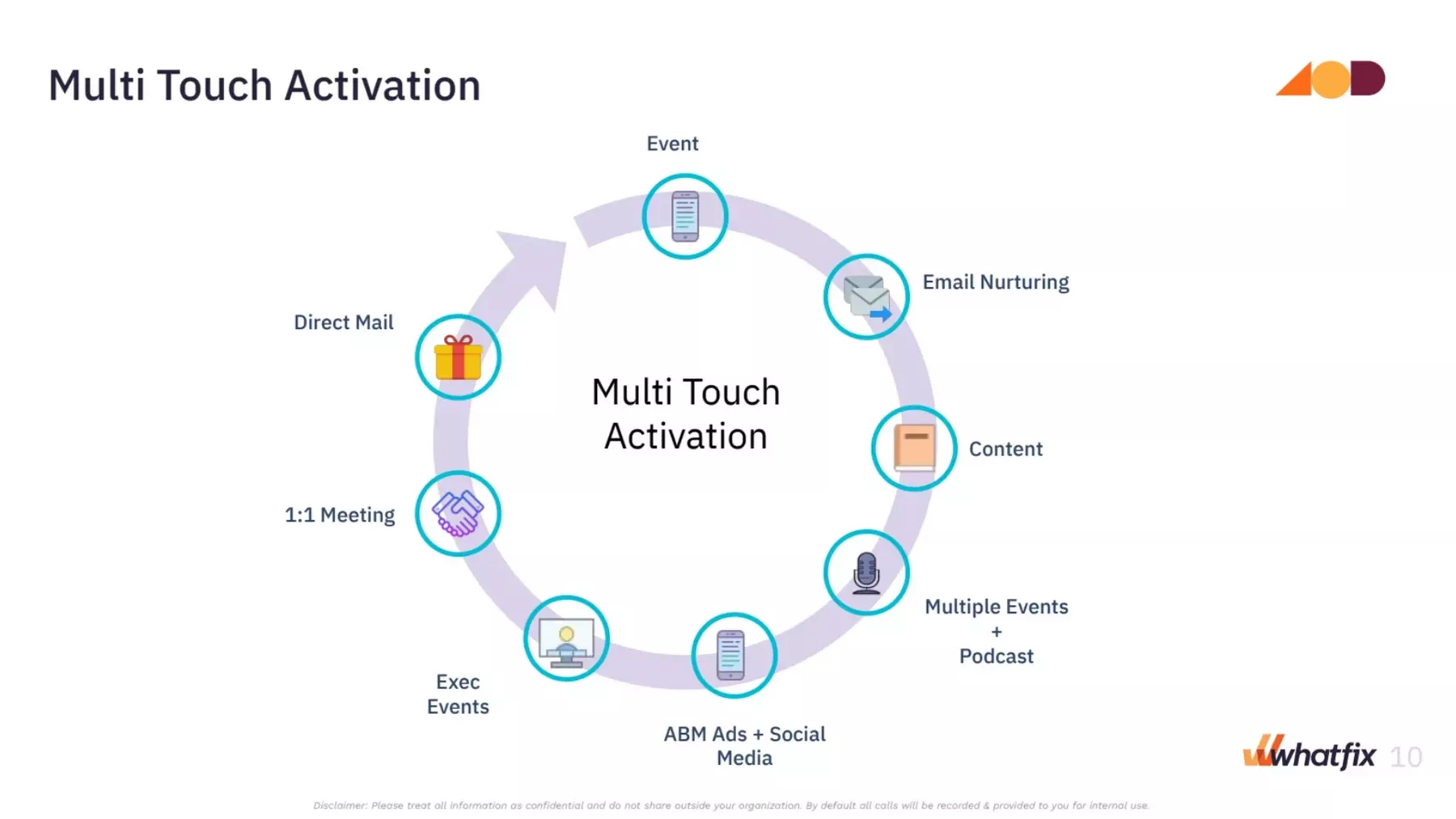
Also, we realized that simply attending an event and sending follow-up emails is insufficient. You need to take a multi-touch activation approach here, too.
Follow-up must be supported by blogs, podcasts, LinkedIn ads, and other ABM campaigns, as just sending emails is not enough to do, even after you’ve met them. Everybody else will also do the same.
To create consistent engagement, don’t limit yourself to the event you’re attending; be everywhere your audience is.
For me, this after-event work is very important because we do very good jobs at events to have these conversations and get everything in place, and then later, it all fizzes.