
4. Leveraging Customer Success to Land & Expand
- Khadim Batti Co-founder & CEO, Whatfix
Khadim explains how Whatfix’s land-and-expand success hinges on embedding services into their offering, enhancing user engagement, driving ROI, and creating opportunities for upselling and cross-selling.
Initially, I estimated that only mature SaaS companies would pay an average of $10,000 for this solution, leading to a total addressable market (TAM) of $180 million.
Several VCs told us, “Why are you wasting your time?” But we proceeded with the same solution, adding a different spin. We identified additional use cases for large enterprises, and today, the market potential exceeds $20 billion. So there’s always a good, solid interest market, if you are ready to learn, pivot and make adjustments.
To understand why this strategy of having a services-led land and expand approach has been effective, consider how instrumental customer feedback has been in our success.
Customers, including Fortune companies, have praised us as the best vendor they’ve worked with, not just the best adoption vendor. Our Customer Success has become a big differentiator for us.
In my early discussions with US companies, I realized that most companies there focus on software but overlook the 'service' aspect of SaaS. By offering both, we gained a significant advantage. Because of this, we've won many deals against local incumbents in the global market.
One major takeaway from our customer interactions was the need for stronger implementation support. This insight led us to develop the Digital Adoption Consultant (DAC) offering to address those needs.
Our account managers observed that many Whatfix customers faced implementation issues due to a lack of resources or dedicated effort. They would buy Whatfix and seven or eight other software, but they couldn’t maximize their ROI because of the resource shortage.
In response, we developed an implementation service called Digital Adoption Consultant (DAC), designed to support customers more effectively.
The Digital Adoption Consultant (DAC) serves as a dedicated resource from Whatfix, working as a full-time advisor for the customer, working closely with them to understand requirements and iterate on implementations.
There were two offerings— DAC full-time and DAC lite, which is like four hours a day. So they can work for two customers. We started with $70,000 — $80,000 a year and then increased to over $100,000 a year, and it still worked. Most importantly, because of this DAC’s presence, they became our eyes and ears for years and started giving input to my Account Manager.
Building on the success of the DAC offering, we expanded our service offerings further to ensure scalable support for our customers.
There is a general mindset in India that if you are SaaS, you should not enter services. Most US companies know that you can't go live without the services in large enterprise deployment.
Sometimes, we cut the services element short early on, fearing that our percentage of revenue from services should be at most 20%, which hurts us in terms of implementation and ROI. Don’t worry too much. Just get that ROI delivered.
In the case of an enterprise SaaS, make sure the customers become raving fans or champions. Whatever it takes — you don’t have to even make it profitable; you can absorb some costs.
Scaling through these services highlighted the importance of having a solid service component in SaaS businesses, especially during the early growth phases.
In the early days, you don't need to solve for the percentage of revenue from services. You need to solve the issue of whether it will be the same forever. If I have 50% of my revenue coming from services today, and it looks the same at 200 million, 500 million, or one billion revenue also, Then it's a problem.
You can reduce it to 20% over some time because the SI ecosystem has to be built. But that path has to be clear and most investors understand this.
I also want to share that as you grow, more and more of your revenue comes from existing customers. This is the Salesforce revenue philosophy, and I think there’s a similar one from UiPath: 70% of SaaS revenue should come from existing customers, from selling more seats or products.
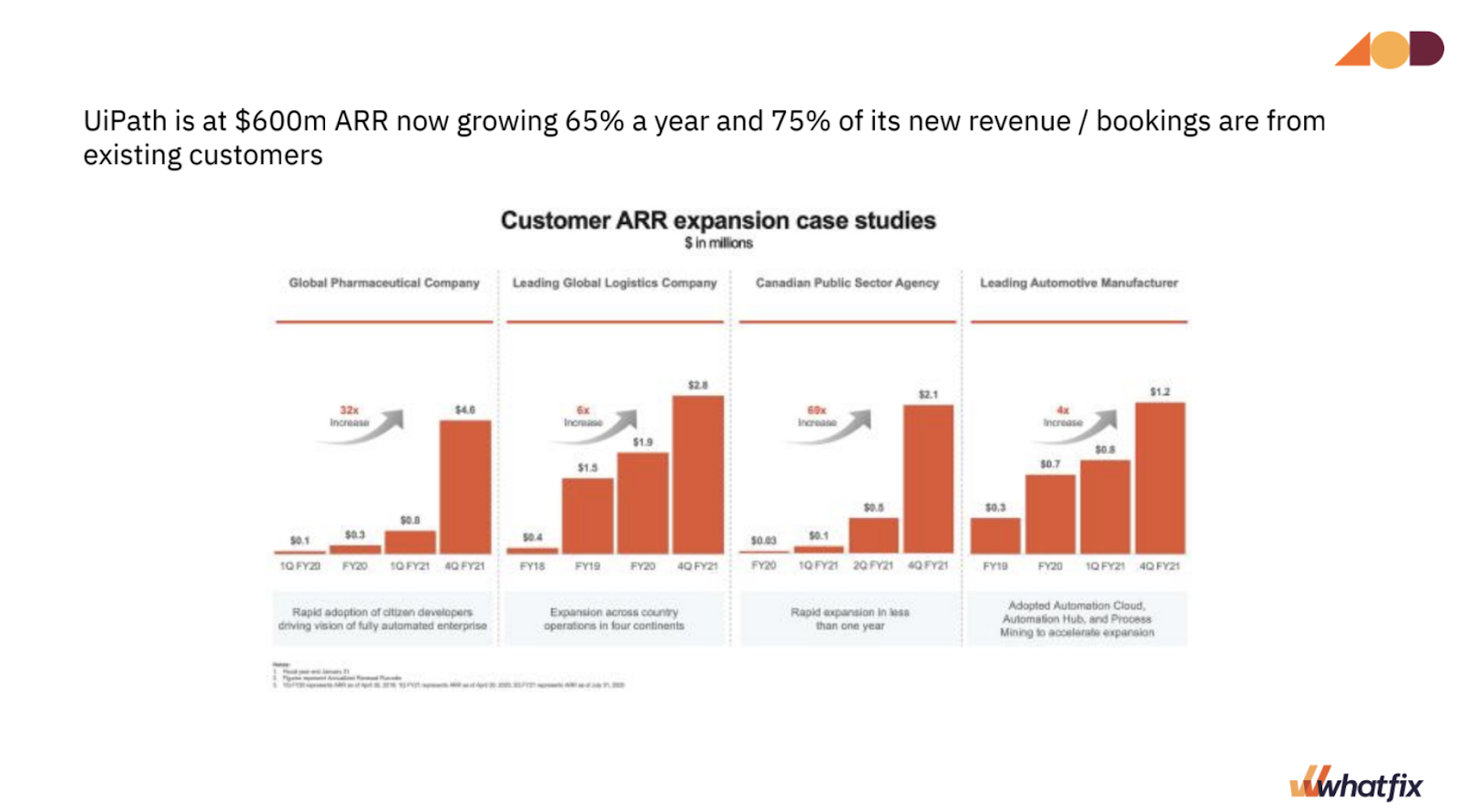
This is important because today, you might feel like you are only losing a $10,000 client if they churn, but they could have become a million dollar account. Moreover, if one customer has a bad experience in enterprise sales, it takes three times the effort, or even more, to win them back.
To reach 70%, you need to start laying the foundations early. We delayed investing in services for success by 12 to 18 months, and saw a lot of churn. You should start as soon as possible.
Now, we’re getting almost 10 to 15% of our revenue every quarter from competitors’ displacement because of our services. This is all because we differentiated ourselves with services, actively upselling, and focusing on retention metrics.