
The vertical SaaS Secret Playsheet: Inside gyan from elite vertical SaaS companies


- Published
- Reading Time
- 8 minutes
- Contents

The B2B software landscape has evolved significantly over time. Initially, on-premises solutions dominated. Then, the tide shifted to horizontal cloud-based software built by Salesforce and Microsoft. As software use by businesses became more common, it gave rise to verticalized solutions that solved for deep industry workflows and use cases that horizontal software couldn’t solve.
Vertical software is not new but has experienced rapid growth over the last decade. As vertical software companies embedded financial products like payments, companies such as Toast and Zenoti have seen rapid growth.
We believe vertical software will grow even faster over the next decade.
In a post-AI world, vertical solutions stand to leverage AI capabilities by building workflows with deep industry data and insights, utilizing vertical-trained LLMs to provide unparalleled value faster than horizontal SaaS. This adds to existing strong levers such as the system of record advantage, the difficulty of replacing established solutions, growing software needs in industries, and increasing ARPU through embedded fintech.
Interestingly, we see a unique advantage for India in building vertical domain solutions. The high customization and support requirements common in vertical software are better served by India’s abundant, affordable engineering and customer support talent, creating a competitive edge. Since word-of-mouth is one of the strongest go-to-market strategies for vertical SaaS companies, focusing on product building rather than selling proficiency benefits Indian companies.
To go deep into the world of vertical software, we interviewed founders and operators from Uolo, WizCommerce, Toddle, Classplus, PetPooja, Spyne, Zenoti, PowerPlay, FleetX, Innovaccer, and Vymo. We also deeply studied Toast, Shopify, SiteMinder, RateGain, PlanGrid, Procore, Veeva, and AppFolio, along with other companies we encountered when investing in this space. (If we haven’t already, we would love to speak with you if you are building in this space.)
This article distills our conversations into 12 key learnings on how to build a successful vertical SaaS (vSaaS hereafter) company, which founders building in the space would benefit from, including:
- Find a wedge instead of selling a platform solution.
- Limited TAM is a feature, not a bug.
- SMB-focussed vSaaS companies at scale earn as much as 20 to 25% of their net revenue from transaction-based use usecases (Payments, marketplaces, etc).
- The majority of vSaaS companies have either a sales-assisted or a complete sales-led GTM strategy.
- SMB vSaaS grow via integration, whereas enterprise vSaaS grow via customization.
Let’s go.
Product
1. Become the Operating System of your industry
The best vSaaS companies become the most critical software their customer/industry uses. It does so by becoming the System of Record (SOR), which basically means that it sits at the center of all workflows that the company might need, and is the single source of truth when it comes to any information, generally used across different levels in the company.
Broadly, there are two ways of becoming an SOR.
- Front Office: For customer-facing task / You record it.
- Back Office: For internal operations / You reconcile it.
It’s very hard to replace a current SOR, so new-age companies use two key strategies: either becoming the data interpretation layer ( we will help you make better sense of the data, we will combine data from different places, etc.) or demand generation ( we will help you earn more money).

2. Find a wedge; don’t sell a platform
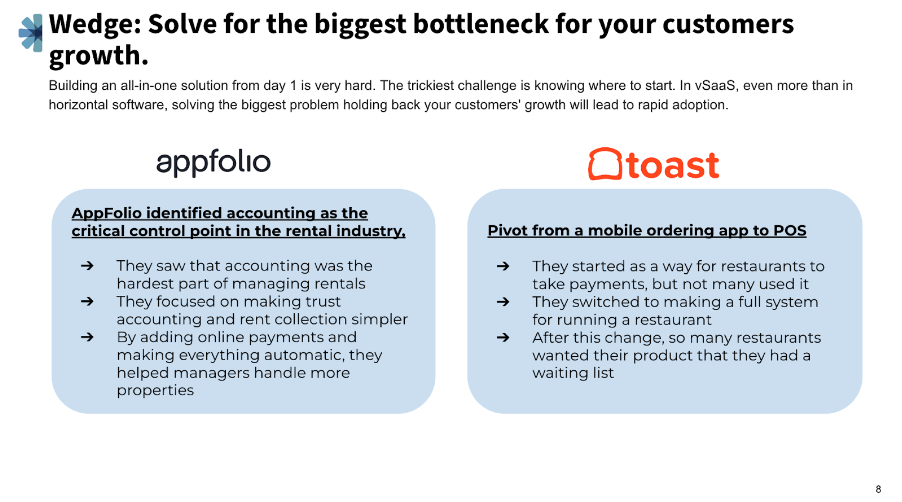
Building an all-in-one solution from day one is challenging, and replacing an existing solution is difficult. vSaaS companies are best served by identifying and addressing the most critical pain points for customers. This strategy, known as finding the right ‘wedge’, involves solving the biggest bottleneck hindering customer growth. An early sign that you are moving in the right direction is your demo-to-sale conversion cycle has become faster.
3. Your early customer/design partner should be as close to your ideal customer as possible
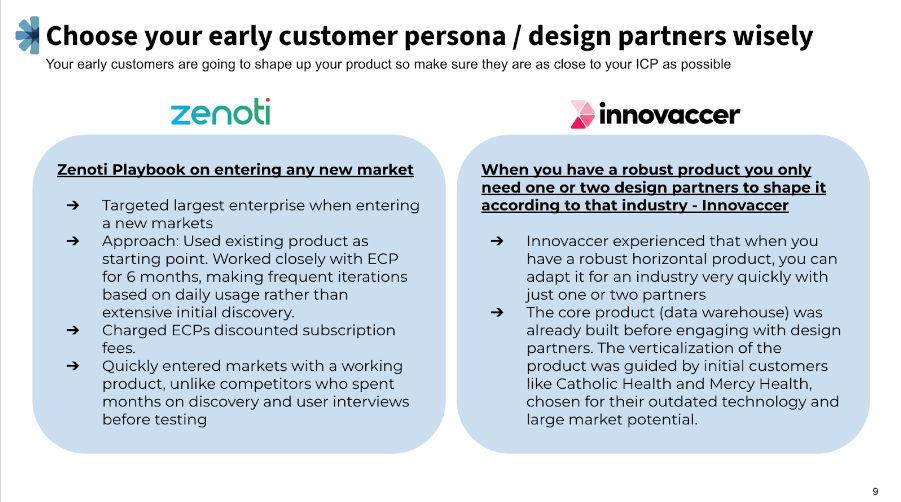
Selecting the right early customers for vertical SaaS companies is crucial as they significantly shape product development. The ideal approach is to choose customers who closely align with your Ideal Customer Profile (ICP). The right design partner, early on in your journey, can change your trajectory.
Zenoti, an all-in-one solution for the wellness and fitness industry, uses a repeatable playbook when entering a new industry. They target the largest enterprise customer in that category, using their existing solutions as a starting point. Working closely with this customer for 6 to 8 months, they understand the problems experienced on a day-to-day basis and develop a desired solution for that industry. After refining the product, they use this new base layer solution for that category to sell to other customers.
4. Limited TAM is a feature, not a bug
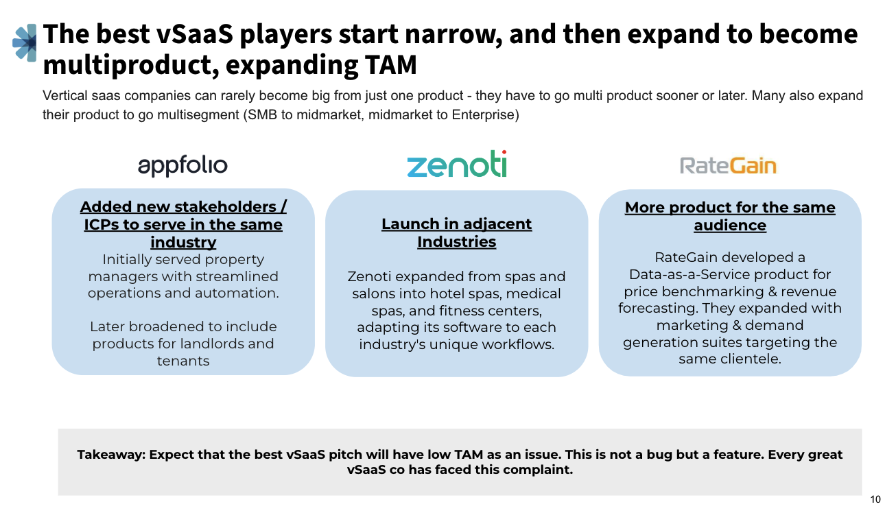
One of the biggest criticisms vertical SaaS players receive is their small Total Addressable Market (TAM). This results from their sharp but narrow focus early on. However, most successful vertical SaaS companies often start with a narrow focus and gradually expand their offerings through three routes:
- Adding new stakeholders / ICPs to serve in the same industry: Appfolio started by serving property managers to streamline and automate their operations, and later broadened its offerings by launching products for both tenants and landlords.
- Launching in adjacent industries: Zenoti initially started by serving spas and salons. As the product matured, they expanded into adjacent industries like medical spas, pet spas, and fitness centers.
- Developing more products for the same audience: Rategain started as a platform providing data for price benchmarking to the hospitality industry. Over time, they built upon this foundation by launching products that help the hospitality industry generate more demand and improve marketing.
Most vertical SaaS companies expand their TAM through these three axes. For example, consider Bessemer’s investment memo on Toast. They initially estimated the TAM for the restaurant POS market to be between $5 – 10 billion. Today, Toast’s revenue alone in 2023 was $3.9 billion, and it shows no signs of slowing down.
5. The need for customization will not go away; the best vertical SaaS companies build their architecture in a modular way to support customization while not losing speed
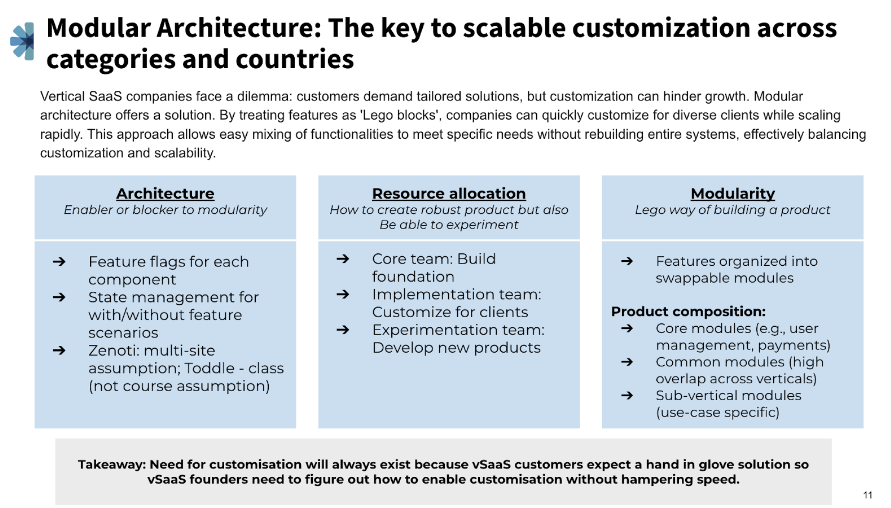
Each customer has slightly different needs, so customization will always be necessary for vertical SaaS. Companies must adapt to serve customers better without hampering scalability. Systems should be built like Lego blocks, where each function can be configured without impacting the rest of the system. This approach increases customization speed and helps in launching different subverticals.
6. Good customer experience leads to referrals, and bad experience leads to reputation loss; When serving verticalized use cases the best companies overinvest in customer success
The best vertical SaaS startups prioritize customer success. As the most important software a company uses, even small problems become critical and must be addressed quickly, or they can lead to business loss for the customer. Since vertical software companies serve an industry where people know each other, a bad customer experience can quickly damage the reputation, and a good one can lead to more referrals coming toward you.
Petpooja, a restaurant POS focused on the Indian market, treats customer support as a core part of the product experience. They dedicate half of all direct costs to it and define metrics such as less than 15 minutes response time and quick issue closures. This approach stems from the realization that when serving SMBs, even a slight delay can cause business loss and bad experiences, which would eventually result in fewer renewals.

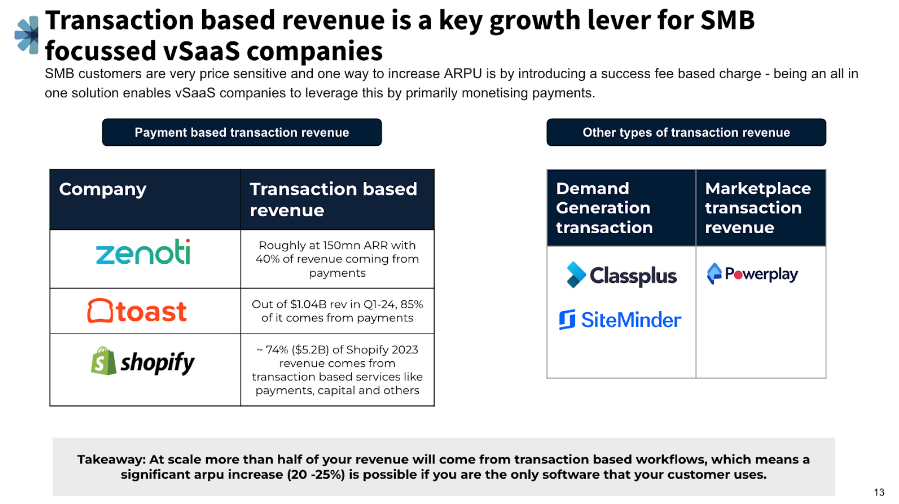
7. SMB-focused vSaaS companies at scale earn as much as 20% to 25% of their net revenue from transaction-based use cases (Payments, marketplaces, etc.)
Transaction-based revenue has emerged as a critical growth lever for increasing Average Revenue Per User (ARPU) in vertical SaaS companies serving SMBs. Three types of transaction revenue include:
- Payments: Most common and profitable, prevalent in the US with high interchange rates (Unfortunately in India, this is not a significant revenue pool as interchange rates on transactions are practically 0 when it comes to UPI and very low for other digital payment methods as well.)
- Demand generation: Finder’s fee for customer acquisition.
- Marketplace: Emerging use case of verticalized marketplaces.
At scale, over half of a vertical SaaS company’s revenue can come from transaction-based workflows, potentially increasing ARPU by 20 – 25%.
GTM
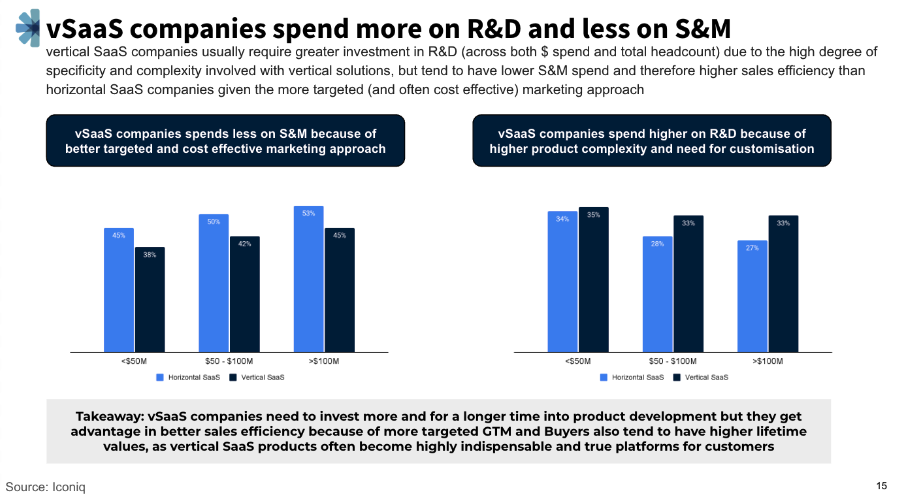
8. vSaaS companies spend more on product vs. hSaaS companies but end up spending less on acquiring users and retaining users
Vertical SaaS companies spend more on product development (as a percentage of overall revenue) due to the need to launch multiple products, accommodate customization requirements, and manage increasing feature complexity. However, they spend less on acquiring customers due to referral-led growth and a more targeted potential customer base.
vSaaS companies need to invest more and for a longer time into product development, but they get an advantage in better sales efficiency because of more targeted GTM, and Buyers also tend to have higher lifetime values, as vertical SaaS products often become highly indispensable and true platforms for customers.
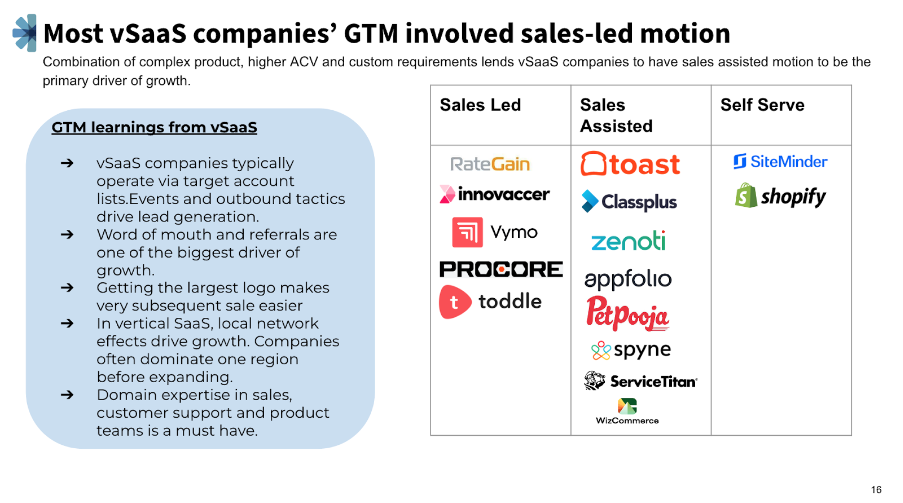
9. Majority of vSaaS companies have either a sales-assisted or a completely sales-led GTM motion
Most vertical SaaS companies employ a sales-led or at least sales-assisted go-to-market strategy. Complex demands especially on customisation and integration, and the higher pricing this necessitates, as well as early limited TAM (which expands later), makes selling entirely via a PLG motion difficult.
10. You can charge a premium compared to your peers if you are the only solution a company will ever need
Contrary to popular belief, vertical SaaS buyers value quality over price and are willing to pay a premium for the best product. As the only critical software they use, companies can charge higher prices without losing sales. At Blume, we joke that some vSaaS products are akin to luxury SaaS. Using the software proves they have ‘made it’ as a company. ServiceTitan is the canonical example.
Examples:
- Zenoti is more expensive than its peers, yet customers are more than happy to pay for it. This is because no other offering provides as much value to multi-store locations as Zenoti does. When businesses use Zenoti, they don’t need any other solution, which is something customers are willing to pay a premium for.
- Using ServiceTitan is seen as a mark of pride for contractors, signaling to the world that they have ‘made it.’ By becoming the best product in the market and not competing on price (ServiceTitan is generally 3x more expensive than an average solution), ServiceTitan has become an indicator of success in the industry.

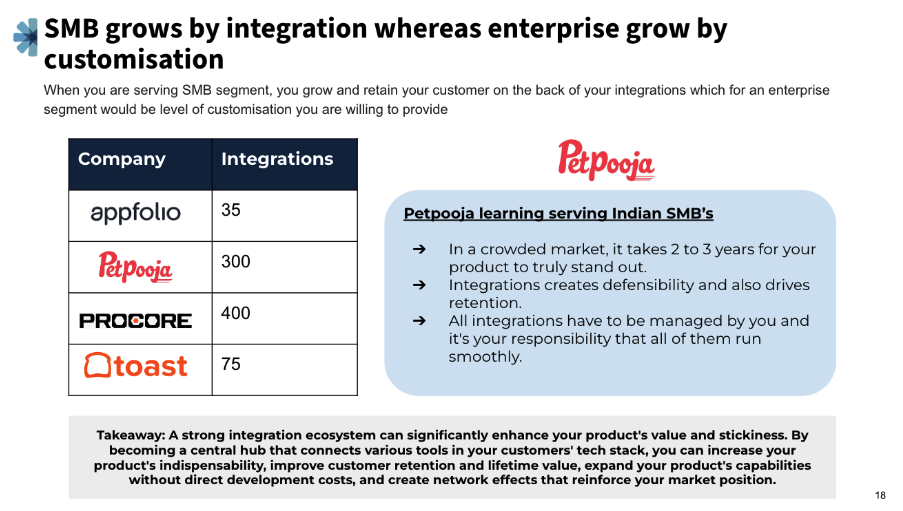
11. SMBs vSaaS grows via integration, whereas enterprises vSaaS grows via customisation
The way you build your product differs for the kind of customer base you serve. SMB and mid-market buyers value integration with other products far more than customisation and also tend to stick around for a longer time based on the integrations you can provide. However, for an enterprise customer, how much you can build it the way they want is all that matters.
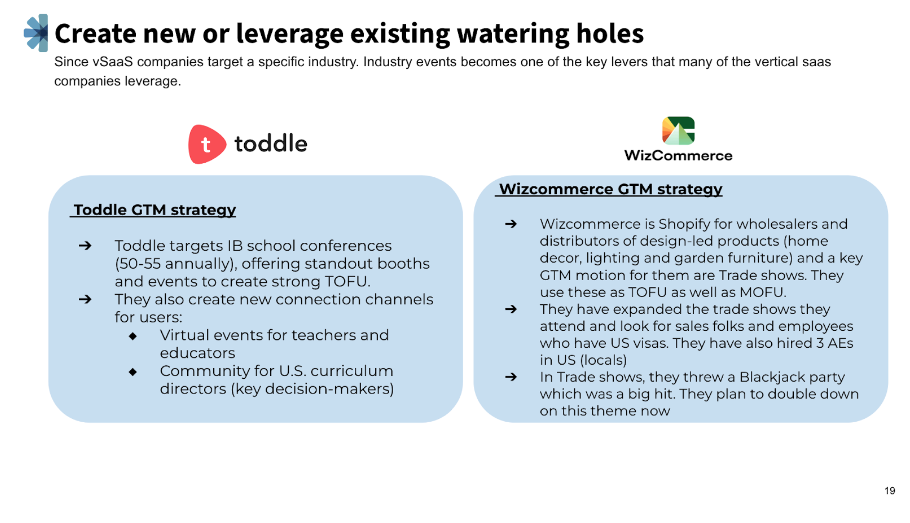
12. Industry events and communities are the biggest growth lever for vSaaS companies
Vertical SaaS companies targeting specific industries often leverage industry events as a key marketing and networking tool. They either participate in existing conferences and trade shows or create their own events tailored to their target audience. These ‘watering holes’ provide opportunities to showcase products, build brand awareness, and foster community within their specific vertical.
Vertical SaaS companies can effectively position themselves at the center of their industry’s ecosystem by targeting these watering holes, by participating in or hosting industry events. This approach drives top-of-funnel marketing and helps build lasting relationships with key stakeholders.
Conclusion
This is not an exhaustive list; different companies and industries will have additional nuances. Our purpose with these insights is to bring it to the attention of founders to help them with additional perspectives, as well as to help them think through some of the challenges.
B2B software, as many have noted, is at an inflection point. We believe this is an opportune time for the next generation of successful companies to emerge. The next decade of SaaS will likely belong to vertical SaaS companies as more industries adopt software and tailored solutions, infused with AI, to better serve their customers. Verticalized solutions stand to gain significantly from this trend. We’re still in the early days, and many more companies will emerge to fulfill this need.
This is the first article in a series breaking down vertical SaaS companies, offering lessons, playbooks, and viewpoints that other founders in this space can learn from and build upon.
If you’re building in or thinking about this evolution, we would love to hear from you! Please reach out to us at email hidden; JavaScript is required or email hidden; JavaScript is required.
Topics
Authors


Anurag Pagaria
Anurag looks at all things B2B at Blume. He has spent over 4 years working in startups, donning various hats from program to product and everything in between.Anurag shares a deep love and admiration for startups and the…- Current Section
- Associate
- Sector
- B2B & Vertical Saas

Sajith Pai
I am greedy to be part of ambitious founder journeys, and help inflect them to greatness. The founders who select me to be part of their journeys, pick me to be their PMF coach, social media cheerleader, sparring partner, 11 pm friend,…- Current Section
- Partner
- Sector
- EdTech, HRTech, ConsumerTech, B2B Commerce & Marketplaces
Commentaries

From Booths to Boardrooms: Mastering Event-Led GTM for B2B SaaS
The clock was ticking at Dreamforce 2015 as Prakhar Jain, head of Sales at Indian SaaS startup WhatFix, watched another potential customer approach their modest booth. While WhatFix is valued at over $900 million today, in 2015,…- Current Section
- Commentary
- Sector
- Infrastructure SaaS & Dev Tools, Horizontal SaaS, B2B & Vertical Saas
- Authors
- Rohit Kaul
- Published

The Outbound Sales Playbook: A Guide for Early Stage B2B Startup Founders
You have an idea and a prototype or a minimum viable product. Now, you want to talk to customers to get them to use or buy your product. What do you do next? Many founders, especially…- Current Section
- Commentary
- Sector
- B2B & Vertical Saas, Horizontal SaaS, Infrastructure SaaS & Dev Tools
- Authors
- Ravi Kaushik Rajagopal
- Published

Roshan Cariappa, VP-Marketing of Vymo, on Building a High Growth SaaS Marketing Team from First Principles
Roshan: “Hire generalists without any baggage, who are hungry, enthusiastic, and who would roll up their sleeves, figure things out and execute hard. In (early-stage) marketing teams, my first order of business is to make sure the…- Current Section
- Commentary
- Sector
- SMB & Vertical SaaS, Horizontal SaaS
- Authors
- Rohit Kaul, Vignesh Jeyaraman
- Published

Shashank Bijapur, Co-founder and CEO, Spotdraft on not being lazy, the importance of outbound sales, real challenges after closing deals, and building guardrails as you scale
Shashank: “You can't take back any features that you've already given. For example, if I said support is free, unlimited support tickets because my UI is bad, my product is still in development, but I can offer unlimited…- Current Section
- Commentary
- Sector
- Infrastructure SaaS & Dev Tools, SMB & Vertical SaaS, Horizontal SaaS
- Authors
- Rohit Kaul
- Published