
From Booths to Boardrooms: Mastering Event-Led GTM for B2B SaaS

- Published
- Reading Time
- 15 minutes
- Contents
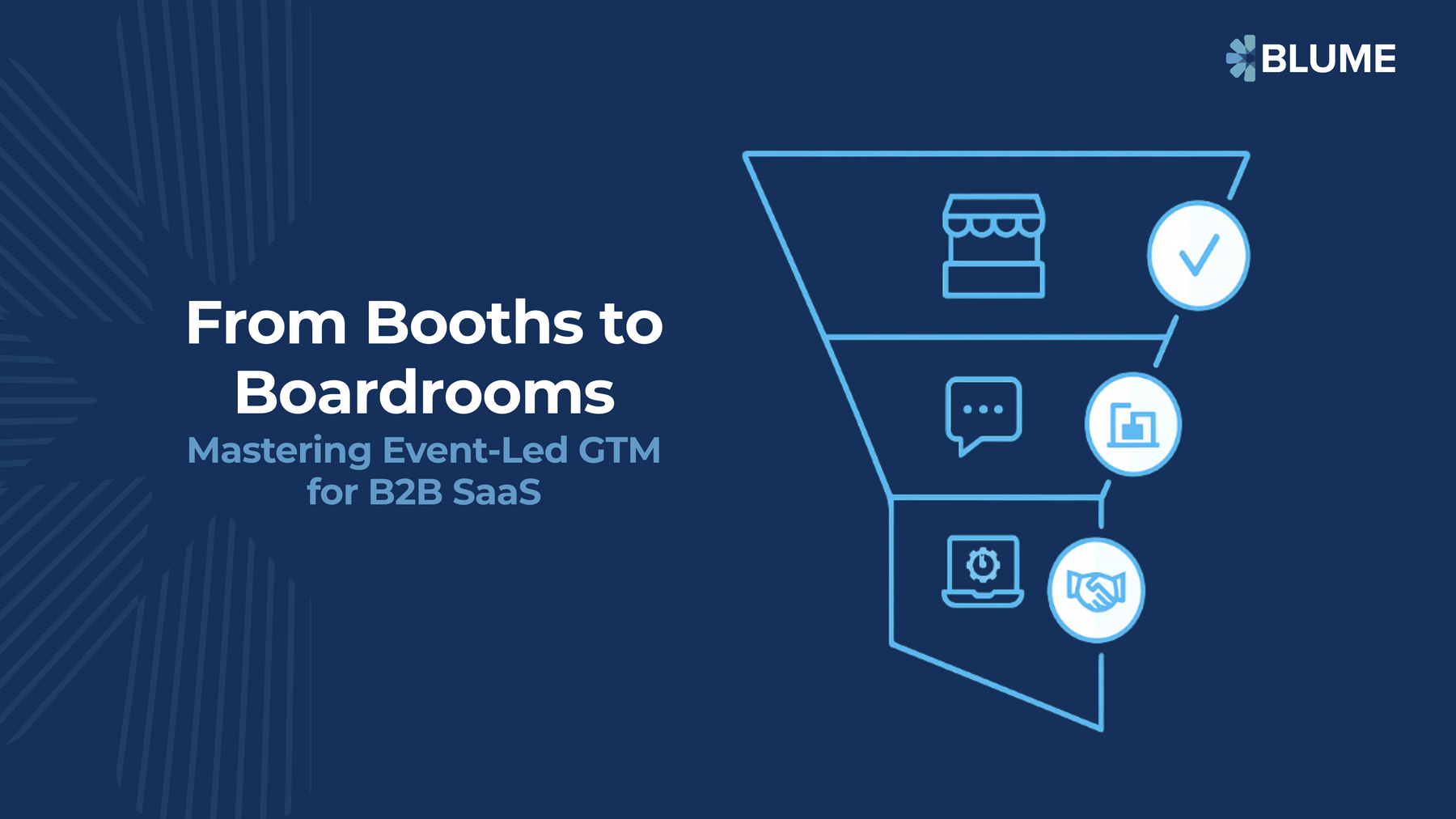
The clock was ticking at Dreamforce 2015 as Prakhar Jain, head of Sales at Indian SaaS startup WhatFix, watched another potential customer approach their modest booth. While WhatFix is valued at over $900 million today, in 2015, it was a fledgling startup, and attending Dreamforce was a boom-or-bust move for them.
Prakhar recalls, “We invested $25K for the booth. 4 of us were there even when the whole company had 5 people. It was a big bet for us.”
The conviction paid off spectacularly. “People were amazed when we showed how our product deployed on Salesforce,” he says.
This event didn’t just generate leads — it gave WhatFix a deep insight into their Product-Market Fit: “The pivotal point was understanding we had to focus on enterprise. We were targeting the wrong market segment and persona.”
WhatFix’s story illustrates a truth in the B2B SaaS world: in an era where cold emails go unanswered and LinkedIn messages get ignored, events are crucial to a B2B SaaS company’s GTM.
In this article, we decode the art and science of event-led GTM motion, based on insights from two experienced practitioners: Nishchal Dua, VP of Marketing at InFeedo, an HRTech startup, and Prakhar Jain, Global Sales Lead at WhatFix. You’ll discover:
- Why traditional GTM approaches fail with enterprise decision-makers — and how events solve this.
- Tactical approaches for pre-event planning, at-event execution, and post-event follow-up.
- How to measure event ROI beyond cost-per-lead.
- Practical starting points for early-stage companies.
We understand that reading a 3000-word commentary is not for everyone. Click here to skip directly to the end and get the TLDR for all three case studies.
And that’s not all. There’s an AI-generated podcast that covers the best-earned secrets shared by our guests that you can enjoy during your commute, run, or weekend. Check it out in the ‘Listen to this article’ button at the top of the page.
Happy reading/listening/TLDRing.
Match Event Formats to Your Business Challenges
Events often feel random or disconnected from business goals, resulting in a poor return on investment (ROI). The key to event-led GTM is mapping each event format to a specific business challenge. As Nishchal emphasizes, “Start with the problem, not the type of event.” Here are some examples:
C‑Suite Access
To connect with hard-to-reach C‑level executives, in-person roundtables are the most effective approach. Nishchal explains their approach: “We do in-person, closed-door, invite-only roundtables with a core learning session followed by networking.”
The key is exclusivity: “We get a maximum of 10 CHROs. Often they know each other, so they’re likely to talk to each other informally.”
Pipeline Acceleration
When prospects meet your existing customers, it provides the peer validation needed to move the deals forward.
Nishchal suggests a ‘power hour’ format: “We invite 10 to 20 bottom-funnel prospects. They’ve seen the product, taken demos, and tried a test version, but have doubts. It’s a one-hour virtual session with a customer champion discussing their experience — benefits, stakeholder feedback, and future plans.”
“These events work because questions come from the prospects themselves. Hearing the responses from a peer helps overcome objections.”
Prakhar describes a variation called “lunch and learn.” “We have several Fortune 500 customers. We want to give them special treatment and also make our prospects meet them. For example, we invited 10 customers and 5 – 6 prospects to one in Chicago. This ratio is crucial.”
He advises against any selling at these events. “We’ve invited them for peer-to-peer learning. They love us because there’s no selling. It’s only for community connections.”
Revenue Expansion
Larger-scale online customer conferences are effective in educating current customers and setting them up for revenue growth.
“We have about 300+ global customers, translating into 5000 – 6000 admin users of our product. I want them updated quarterly on the latest in my product. I can’t get them all to meet in person, so we do this quarterly online customer conference.”
“First, we do a product update fromour CEO about the amazing stuff we shipped last quarter. Then there’s a segment by our marketing and sales team on the latest capabilities and how they stack commercially.”
These events include customer recognition: “Then we have a 10 – 15 minute customer spotlight session to award customers who are maximizing benefits from our product.”
Brand Awareness
Both experts agree that trade shows primarily serve brand awareness, with lead generation as a secondary benefit. Nishchal explains: “We attend trade and industry shows, set up a booth and have speaking slots. The primary goal is consistent visibility to our core ICP, to build brand awareness. Leadgen is a secondary objective.”
Prakhar cautions early-stage companies about trade shows: “I wouldn’t recommend trade shows, booths, or sponsoring in-person events in 2025 because A, it’s a crowded market, in India and the US. You’ll be lost among 100s of SaaS companies.”
He suggests instead attending the events. “The only reason to attend a trade show, if you’re sub-million dollars in ARR, is to learn what others are doing. Go for intel, not new business.”
Build a Pre-Event Playbook
An event’s success is largely determined before it begins. Both Nishchal and Prakhar emphasize the importance of nailing your pre-event tasks for the success of your event-led GTM motion.
Getting the Right People in the Room
For C‑suite events, securing attendance from high-level executives requires careful planning. Nishchal shares two proven methods:
Partner with Credible Organizations
“You need credibility to get two minutes of their time,” Nishchal explains. “Credibility comes from two sources: a referral, which we maximize, or a bigger industry partner like a media house or an industry body.”
“When we do a roundtable with Economic Times, the communication is ‘ET with InFeedo is doing a roundtable and is inviting you.’ When the invite goes from ET, they’re more likely to consider it because it’s a popular brand.”
Leverage Second-Order Referrals
“The second way is referrals, which works brilliantly for us,” Nishchal continues. “To get 10 people at my event, I need 5 – 6 confirmed attendees and a list of another 10 – 15 people whom I don’t know right now. I’ll ask the confirmed attendees to help me contact them as the event will benefit them. A warm introduction increases the odds of getting a yes.”
Leverage Anchor Speakers’ Popularity
Nishchal adds, “The second reason for them to attend the event is to have an anchor speaker. Someone whose name can be on the graphic that says, ‘Hey, this person is coming to the event.’ And that person is popular enough to attract attendees.”
These strategies yield impressive results: “To organize an event with 10 CXOs, I usually have a list of 25 to 30. From those, we get 12 to 14 confirmations, and usually 10 always attend.”
Cutting Through the Noise at Trade Shows
For larger trade shows, pre-event campaigns are essential to stand out. Prakhar explains: “Dreamforce, even after 10 years of WhatFix, is still our largest event. What are you doing pre-event to cut through the noise? It’s not just signing up and being there.”
WhatFix runs dedicated pre-event campaigns: “We host Dreamfix before Dreamforce to drive booth traffic on the days of Dreamforce. It helps us cut through noise. We also do simple grabs outs, like a lucky draw for an Apple Vision Pro or whatever budget allows. If you show up at my booth and have a 5‑minute conversation with a representative, you’re eligible. And we do it in a focused manner, only for our core ICP.”
“This campaign was very successful for us. We recieved 1500 registrations for booth visits even before Dreamforce started.”
Setting Clear Objectives and Metrics
Both experts stress establishing precise objectives before investing in events. Nishchal takes a problem-first approach: “Don’t think of this as an event ROI. Of course there is an event ROI. Think of the problem this event is solving, the cost of solving it through other GTM approaches, and compare the two.”
For instance, if the problem is demand generation, Nishchal suggests focusing on outcomes, not activity: “My objective is clear: an opportunity. I don’t care about attendance or leads. I care about the number of opportunities sourced from an event.”
For this benchmarking, Nishchal compares event costs to digital channels: “If it costs say 1 lakh rupees to source one enterprise opportunity from my LinkedIn ads, emails, etc., then I can spend up to a lakh rupees per opportunity. My event must do better than this to be successful.”
Prakhar shares how WhatFix set explicit conversion targets: “In early stages we had a clear goal that 10 – 15% of total event conversations should convert to New Business Meetings.”
Executing with Impact: At-Event Best Practices
A strategic pre-event plan is crucial, but execution during the event makes or breaks your return on investment (ROI).
In-Person Event Tactics
Book Meetings On-the-Spot
A key tactic at physical events is to secure follow-up meetings before prospects leave. Prakhar explains their approach: “We book calendar meetings immediately after a deep conversation at the booth. If the visitor is keen to engage — they want to understand more, want a demo — we ask for 30 minutes on their calendar and book the time slot before they leave.”
This simple tactic yields impressive results: “We’ve started booking 50 – 60% more meetings even if the event is still going on.”
Be personal
Prakhar shares another tactic: “We take selfies with booth visitors and email it to them. The subject line shouldn’t be tied to your product, as they may not remember, but to the conversation you had. Make it personal.”
These personal touches boost response rates: “Maybe you talked about their dog, the weather, or something they’d recall. So your subject lines can even be a bit tacky and you’ll still get responses, and with that selfie in the email, they know it’s not from an automated mail sequence. This is personal.”
Leverage Customer Presence
Both experts recommend involving existing customers in your event strategy. Prakhar advises: “If you’re in India and have Indian customers, invite one of them to talk to visitors. Everything a company does has sales attached but anything from an industry peer is seen as ‘Hey, this adds a lot of value.’ ”
Virtual Event Excellence
Virtual events require different tactics to maintain engagement and deliver impact. Nishchal provides guidance on creating compelling virtual experiences.
Be Crisp
“Be as crisp as you can,” Nishchal advises. “Some of my most successful events have been only 25 minutes long. When you force yourself to be shorter, you cut unnecessary content and activities.”
He recommends keeping sessions short and dynamic: “The ideal time is 25 to 40 minutes. Any session over that and people will drop off. Assume you can’t keep their attention for more than 5 minutes on a screen.”
Visual engagement is essential: “Even with a 10 minute session, your screen needs to keep moving. Show a deck, run polls, or display statistics and say, ‘Hey guys, focus on the screen now, this is a super amazing statistic.’ If I was scrolling through my email, I’d quickly come back to see the interesting bit. So show not tell!”
Be Memorable
“If you’re not surprising or shocking people with content at an event, it’s a waste of time,” Nishchal states. “It’s not just about learning or thought leadership; it’s also about something fun and different.”
He shares creative engagement tactics: “At our online events, we have a virtual roulette table where people guess what will show up. Whatever comes you win an award. It could be as simple as a $10 pizza coupon. But it keeps people excited.”
He emphasizes the importance of creating a lively atmosphere: “In-person events aren’t just about the venue. There’s chatter and music, then someone comes on stage to applause. But a virtual webinar, is generally boring. I’m waiting, then suddenly someone is on screen. There’s no excitement.”
“We’ve had a virtual DJ and 10-minute virtual standup comedy sessions. You could have a great virtual event for under $1000.”
The Post-Event Engine: Conversations to Contracts
Both experts emphasize that post-event follow-ups are just as important as the event itself. Prakhar states bluntly: “Most people drop the ball after the event. You’ve had great conversations, but now you’re tired. You’re back in the office with 20 other things on your plate. Chasing those conversations isn’t your top priority.”
Build a Nurturing Process
The key to post-event success is having a predetermined process ready to execute. Prakhar advises: “Have a set of workflows that kick-off after an event. Your martech tools should automate outreach, segment visitors by personas, and send relevant marketing material. Everything has to be pre-set up.”
Prakhar emphasizes being patient with results: “Unless you’re lucky and God’s favorite, you won’t get a response on the first email. It’s a 6 – 7 step cadence across emails, LinkedIn, and calls. We have a 3 – 4 week sequence. In B2B, we see responses only after 6 or 7 touch points.”
The timing of follow-up is crucial. Prakhar advises: “Quicker is better, but not immediately the next day because some events last three days, and you met them on the second day, so no follow-up on the third day. That breather is okay, but it should be immediate, so it’s fresh in their minds. If you wait 2 – 3 weeks before sending an email, you’ve lost the opportunity.”
Nishchal describes their approach: “There’s a marketing sequence and a sales sequence. Post-event, for nurturing accounts, marketing will pick those accounts and say, ‘Hey, I wanna do a podcast interview with you, feature you in our report, take a quote from you for our LinkedIn posts.’ ”
“We have a six-month nurture plan and at each touch point, whether it’s a quote, podcast, or LinkedIn posts, the AE is tag teaming with marketing. So the AE’s name and email are always in the CXO’s inbox.”
“That AE will send one email every quarter about ‘Hey, something we think you should learn because it’s great market insight, updates, or learning.’ It’s not a newsletter, but a collection of 2 – 3 exciting things from our ecosystem. It could be a new AI capability, a report, or a podcast video from another CHRO.”
Multi-Touchpoint Follow-Up Strategy
Both experts stress that email alone isn’t sufficient for effective post-event follow-up. Prakhar explains: “Being at the event and sending emails isn’t enough. You’ll need to support it with performance marketing like LinkedIn ads and ABM campaigns.”
A post-event ABM approach might involve creating custom audience segments for event attendees to target on LinkedIn and display advertising. Companies often develop event-specific retargeting campaigns referencing the event conversations and topics, creating continuity in the prospect’s experience.
These campaigns can deliver case studies, white papers, or product demos addressing the specific pain points discussed during the event, increasing conversion rates compared to generic follow-up emails.
Maximizing Event ROI Through Content
Events hold untapped potential as content generators, a point both Nishchal and Prakhar emphasize for driving lasting audience engagement.
Creating a Content Ecosystem from Events
Prakhar describes how WhatFix built a content ecosystem around their events: “We did Scale last year, an online thought leadership event, where we invite many industry people. The event is not about WhatFix. You’re coming to talk about a topic you love, and others are learning from you. We have 60+ speakers which generated 1400+ hours of content. All of their sessions become part of our content marketing to our prospects. Now we’ve made it a process. We do it just every year because it’s just that good.”
Event-generated content should feed multiple marketing channels. Prakhar explains how they maximize content value: “Content from our events becomes a part of our marketing campaigns. For instance, we take video bytes from a webinar or roundtable and turn it into an ad campaign. Why not? It’s all available. It’s yours.”
Nishchal introduces the ‘content confetti’ concept. “I believe every event generates a content confetti. You can chop the content into so many different pieces. A 1‑hour panel recording should become 10 one-minute snippets. They should become LinkedIn posts and a client newsletter.”
Building Ongoing Engagement Channels
The goal is to treat events not as isolated occurrences but as opportunities to spark multi-channel conversations and amplify visibility beyond immediate attendees.
Nishchal says, “You can’t limit yourself to just the event but be everywhere where your audience is. We are super active on Twitter. We encourage event attendees to share on social media, do a lucky draw, or just try to drive that engagement.”
This creates a virtuous cycle of engagement: “This encourages attendees to consistently tweet about the event, driving engagement beyond just the primary platform. While your event might be a webinar, having discussions on Twitter and LinkedIn amplifies your presence and maximizes overall visibility.”
Measuring Event ROI: Beyond Cost Per Lead
Traditional marketing metrics often fall short in evaluating the multi-layered impact of an event. Nishchal and Prakhar have developed approaches to measuring event ROI that go beyond simple cost-per-lead calculations.
Different Metrics for Different Event Types
Nishchal emphasizes that ROI measurement must be tailored to the specific business problem each event addresses. He outlines metrics for different event formats:
For Top-of-Funnel Events (Roundtables)
“If my digital channels’ cost per opportunity is X, and I can at least meet that cost, it’s better to do an event,” Nishchal explains, “as it also provides me with visibility benefits.”
He acknowledges the value goes beyond the direct cost of opportunities: “Events also let you create deep relationships, which create opportunities down the road. In an in-person roundtable, you get FaceTime with CXOs. Even if it shows an opportunity to build a future relationship. We’ve done events where the opportunities didn’t come for a year and a half, but we’ve remained in contact.”
For Bottom-of-Funnel Events (Power Hours)
For pipeline acceleration events, the metric shifts to conversion rates: “The BOFU event has negligible spent because A, we are inviting our prospects. B, it’s virtual. C, the speakers are our customers. So the cost is zero, but my ROI is the percentage closure of that pipeline. If I get 20 prospects on my custom power hour, my benchmark is 60 – 70% should close.”
The metric’s timeframe is specific: “In the next quarter… Bottom of the funnel event, the timeline is one quarter. We usually do this at the start of the quarter so that 60%+ closes in the same quarter. It can be closed won or closed lost but we want a decision.”
For Customer Events (Conferences)
For customer expansion events, Nishchal sets a different benchmark: “My tolerance for the customer event would be 2 lakh rupees per opportunity. Why? Because that’s not the only output I’m educating customers, preventing churn, improving product NPS, and improving product usage and adoption.”
“The measurable benefit is cost per expansion opportunity. It can go much higher because these are accounts we’ve already landed. There’ll be expansion opportunities.”
For Trade Shows
For industry sponsorships, Nishchal uses a blended metric: “When I do industry sponsorship events, there’s a 40% component of brand awareness, 60% cost of demand generation, which gives me a tolerance level of what my cost per opportunity should be. It is naturally higher than my LinkedIn ads but the tolerances are acceptable because I’m getting the awareness benefit.”
Beyond ROI: Return on Event (ROE)
Nishchal introduces a broader concept called Return on Event (ROE): “Instead of ROI, we use ROE, Return on Event. For each event type, there could be brand, demandgen, and advocacy returns. Maybe because of this I get word of mouth and my G2 reviews go up.”
He argues that this broader perspective is essential: “If I’m getting these other benefits, I need not only talk about what is my demand generation from events. People look at one thing, which is number of leads or pipeline, forgetting that events have other benefits as well.”
Prakhar’s NBM Framework
Prakhar offers a sales funnel framework: “NBM for us is New Business Meetings. When we talk to somebody, they’re not necessarily qualified to sell at the outset. We’re just understanding their requirements. Then it converts into a sales accepted lead where we said, okay, there’s a requirement and we can serve you.”
He explains that tracking these intermediate steps is crucial: “With scale, you can measure how many new business meetings are generated from the event conversations, because often people just measure lead to closure. That’s not right.”
Starting Small: Entry Points for Early-Stage Companies
Both experts offer practical advice for early-stage companies to incorporate events into their GTM strategy without massive budgets or established brands.
Start with a Masterclass Series
For companies under $1 million ARR, Nishchal recommends starting with a virtual masterclass series: “First, create a 6 to 8 episode masterclass series, either weekly or monthly, depending on your capacity. If you can host a weekly series, do it.”
Nishchal details their approach: “We call it season 1, with 10 episodes. From a psychology standpoint, when someone attends episode 1 or 2, they’re eager to see episodes 3, 4, and 5. You create a ton of content with each episode, convert it to snippets for LinkedIn posts, videos, and newsletters, and publish it on social media. That gets you more attention and awareness, leading to more sign-ups for episodes 2 and 3.”
He explains the snowball effect: “In 2 months, when you look at the Google Analytics graph, your organic will be trending up because the word of mouth is spreading. People are sharing those videos. A lot of ripple effect is happening.”
The key is consistency: “People do 1 or 2 masterclasses and say, ‘It’s not working out for me. It’s too much effort. It’s not worth it. I got zero pipeline.’ You’ll get pipeline from the masterclass series as a campaign, not from one event.”
Attend Before You Sponsor
Prakhar cautions against jumping straight into expensive sponsorships: “Identify the right event. I’ve suggested some founders test the waters before sponsoring an event. Just attend the event first.”
This approach provides valuable intelligence at minimal cost: “So that will tell you what kind of people are there, and you can still network and get a sense of relevance. The cost of attending will be a $500 pass versus a $20K investment.”
He’s particularly cautious about trade shows for early-stage companies: “If you’re sub-million dollars, this will work only maybe 10% of the time.”
Targeted ABM Approach at Events
Prakhar shares a clever alternative to booth sponsorship: “Instead of sponsoring their industry trade shows, a company figured out which event their ICP was sponsoring. For example, if I’m a Martech product, instead of attending a Martech event, I’d find where my ICP, a marketer, is setting up a booth.”
This allows for highly targeted outreach: “I’ll create a custom deck for each of my prospects who are sponsoring the event. I’ll go as an attendee to their booth and show them the custom deck. I have a product just for you. Here’s a deck I made for you. Spend 5 minutes on it.’ ”
The approach offers significant cost savings: “I’m not sponsoring. I’m not setting up a booth. I’m going there already. My ICP exists and I’m selling to them as an attendee.”
Go Virtual When Budget Is Tight
For companies with limited resources, Nishchal recommends online events: “You can have a really good online event for under $1000.”
He emphasizes that execution matters more than budget: “It’s not about which platform you use for hosting your online event, it’s about your strategy and tactics. You can have great events with great ROI on Zoom, the worst platform, or a crappy event and ROI with Airmeet.”
Events are no longer just marketing line items; they are strategic GTM engines for B2B SaaS companies.
The experiences of Nishchal and Prakhar demonstrate how a well-executed event strategy can address the most challenging aspects of B2B SaaS GTM: accessing decision-makers, accelerating deals, expanding customer relationships, and validating product-market fit.
But success requires systematic execution across pre-event, at-event, and post-event stages. Whether you’re an early-stage company starting with virtual masterclasses or an established player optimizing ROI with sophisticated metrics, the right event strategy can be the difference between a thriving vs. stalled GTM.
TL;DR
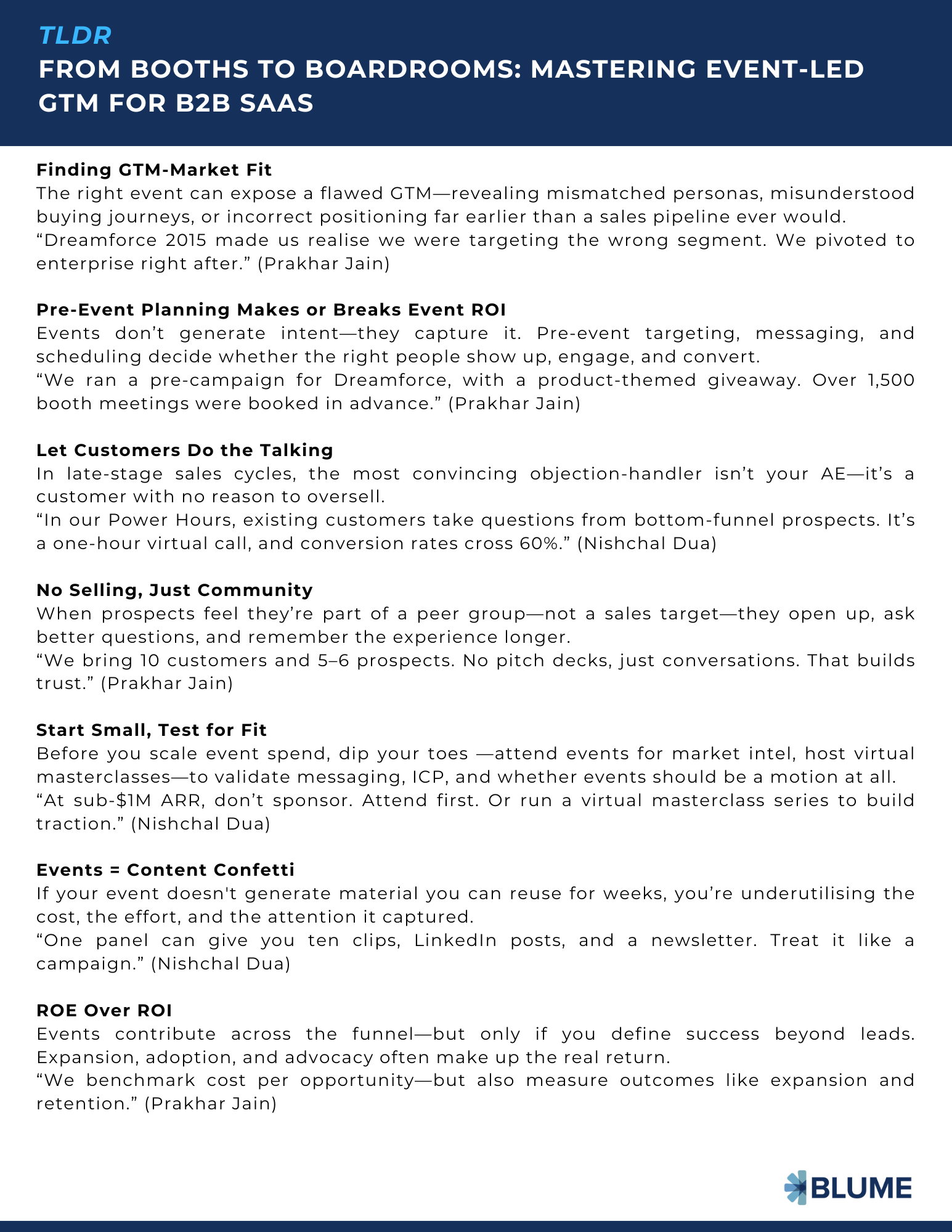

Commentaries


The vertical SaaS Secret Playsheet: Inside gyan from elite vertical SaaS companies
The B2B software landscape has evolved significantly over time. Initially, on-premises solutions dominated. Then, the tide shifted to horizontal cloud-based software built by Salesforce and Microsoft. As software use by businesses…- Current Section
- Commentary
- Sector
- B2B & Vertical Saas
- Authors
- Anurag Pagaria, Sajith Pai
- Published

The Rough Guide to Building an Enterprise SaaS Dhandha in India
Imagine you're pitching your cyber security software to a large Indian bank. You've prepared a detailed ROI analysis, cost-saving calculations, and competitive landscape. But the CIO barely glances at it. Instead, she…- Current Section
- Commentary
- Authors
- Rohit Kaul
- Published
Selling Smart: The Insider's Guide to SaaS Success in India
Selling SaaS in India requires a nuanced understanding of local market dynamics, emphasizing the importance of face-to-face interactions over digital communications, leveraging personal networks for introductions, and aligning product…- Current Section
- Commentary
- Sector
- Infrastructure SaaS & Dev Tools, SMB & Vertical SaaS
- Authors
- Vignesh Jeyaraman, Rohit Kaul
- Published