
Here’s to The Crazy Ones | WebEngage's Unconventional Path to Glory

- Published
- Reading Time
- 9 minutes
- Contents

“There were times when we didn’t have money for payroll. I staggered salaries. We operated like this for almost a year during the 2018 – 19 period,” recalls Avlesh Singh, co-founder and CEO of WebEngage.
When life handed Avlesh Singh lemons, he didn’t settle for a roadside stand — along with his co-founder Ankit, he built WebEngage, a Rs 200+ Cr ARR Indian SaaS company.
WebEngage is an Indian SaaS company that provides a unified customer engagement platform to help businesses automate marketing campaigns across email, SMS, web push notifications, mobile apps, and WhatsApp channels. Known for the strength of its core Customer Data Platform, WebEngage has marquee customers like global giants Unilever, Sony, and Airtel Africa and Indian enterprises like Adani Group, Bajaj Capital, Reliance General Insurance, TU CIBIL, The Association of Mutual Funds in India (AMFI), and several digital natives such as Acko, Groww, Pepperfry, Myntra, and Spinny among others.
Since its inception, WebEngage has raised ~$27 M from prominent investors, like SWC Global, Singularity, Blume Ventures, India Quotient, IAN Fund, and others.
Interestingly, while many of its peers have gone far off the Indian shores, WebEngage has doubled down on India and recently expanded to the Middle East and Southeast Asia.
WebEngage’s journey from an idea in 2011 to a blazing success today is full of exclamations(!).
With the “what if this doesn’t work!”; with the “I think this is it!”; with the “where do we go from here!”
But most importantly, the “we’re so back, baby!”
Let’s begin.
Chapter 1: The One Where It All Started
WebEngage’s story starts in Mumbai.
It began with a chance meeting of two engineers, Avlesh Singh and Ankit Utreja, at Burrp, the former restaurant review platform.
Their collaboration at Burrp laid the foundation for WebEngage.
Avlesh recalls their first encounter:
Honestly, I didn’t like him at first. But here’s the tragic thing about my life — people I’ve liked at first have more often than not turned out to be disasters, while those I didn’t like were great.”
Despite the initial lukewarm impression, Avlesh and Ankit’s partnership flourished.
They worked together at Burrp for 3+ years, even after its acquisition by Infomedia, cementing their working relationship and mutual understanding.
“We’ve been working together for 16 – 17 years,” Avlesh reflects. “The comfort you see between us today is the result of the time spent together through many ups and downs.”
WebEngage wasn’t Avlesh and Ankit’s first rodeo together.
Avlesh shares, “We started a web clipping tool — WebKlipper, which will let you highlight different parts of a website and snore snippets.”
This phase was characterized by long nights of ideation and collaboration, with Ankit joining Avlesh after his day job:
“Ankit used to come to join me at our makeshift office by 8 PM. He worked in Matunga (a neighbourhood in Mumbai) at Infomedia, so he’d join me after work and we’d work on it together.”
The internet was very different back then. Bandwidth was a real issue, and load times were measured in minutes.
The real WebEngage story began in October 2011 when they shuttered the web clipping tool. WebEngage 1.0 was an on-site nudging tool.
Avlesh describes it as: “You have a website and can send nudges to the users visiting at the moment. These could be related to the user’s actions like browsing, adding to cart, or trying to convert them in that session with an offer or discount saying ‘please buy’.”
Of course, the internet is notorious for the rapid pace at which things change.
If you don’t adapt, you’re digital toast.
Chapter 2: The Hard Things About Hard Pivots
By 2015, WebEngage had major Indian consumer tech companies as clients, including Flipkart, Ola, Paytm, Jabong, and Snapdeal.
However, they faced a crucial realization that would shape their future.
Avlesh: “Even at our peak, Flipkart would only pay $10,000 annually. And Flipkart was a pretty sizable company by then. Then it became clear to me and Ankit, if we can’t make money from Flipkart, who can we make money from?”
This realization deepened their understanding of customer needs and market dynamics.
Avlesh explains, “Bringing people back was a much bigger problem than converting those already on your website. Mindshare, money, everything was downstream from where we were operating.”
The team spent considerable time researching and speaking with customers to understand their pain points. Avlesh recalls:
“I spoke to 100+ customers/prospects and people from my network in 3 months.”
In 2015, WebEngage underwent a significant pivot. A life-changing event, as it were.
Avlesh emphasizes that a pivot goes beyond merely changing the product:
“People generally associate pivots with product changes. But what most don’t understand is that they involve pivoting an entire organization. It’s about changing the mindset of your product, sales, marketing teams, and more.”
This realization led to a comprehensive transformation of WebEngage.
The company had to re-educate its team, bringing in specialists for sessions with customer success and sales teams.
This shift wasn’t just a change in product offering; it was a fundamental reimagining of how marketing technology should work.
WebEngage was focused on the ‘web’ or ‘desktop,’ but India was gearing up for a mobile revolution, including shopping.
Adapting to this reality and making key product changes were the hard calls the team had to make.
Avlesh: “The core reason for the pivot continues to drive us even today. How can we generate more revenue from existing customers? This has become a significant mission. I believe it’s the primary reason we’ve survived all these years.”
“This drives a lot of our choices — price, product, go-to-market strategy, choice of markets, customer segments. All of this is driven by our core philosophy.”
The dots make sense backward.
But steering your ship at a sharp 90-degree turn while ensuring you didn’t lose people along the way wasn’t easy.
Avlesh admits, “For us, that journey was excruciatingly long. It took us another year to solve our organizational issues after we thought we were ready with the new product.”
Chapter 3: Saying No to Delaware
From the outset, WebEngage decided to build for the Indian market.
Avlesh’s conviction is clear: “My thesis is that American companies making money from Indian customers for marketing tech is criminal. Why should Indian companies be limited to only backend stuff? India should solve for India.”
This decision to focus on India and near Indian markets has remained unchanged for 13 years despite initial skepticism from the venture world.
Avlesh proudly states, “We are an Indian company. We come from an era when incorporating a SaaS company in Delaware was fashionable. But we didn’t do that.”
Avlesh’s key insight was the growing fragmentation of marketing engagement in India. Enterprises will feel the pain and be willing to pay to unify customer engagement channels into a single platform.
Avlesh explains:
“We realized early on that this would be a mess. We need a single platform for orchestration. The goal is simple — you need to increase retention, bring users back, and improve repeat funnels.”
This approach challenged the traditional siloed structure of email marketing, mobile marketing, SMS, and WhatsApp teams within companies. This was a uniquely Indian problem, where organizations had different leaders for different channels.”
Avlesh: “Someone with expertise in, say, email marketing was the gatekeeper of that channel and will not let anyone else from the organization step into their function. This was detrimental to the growth of the organization. No organization should work like this.”
The CMOs agreed that consolidation in marketing channels is required, and WebEngage could help solve this.
Despite initial resistance, the market gradually appreciated this unified approach.
Chapter 4: WebEngage, reborn
The years after the pivot were tough for WebEngage.
From 2017 to 2019, the company faced one financial challenge after the other. Avlesh recalls:
“Those were very difficult years. We were selling to the mid-market, and our Average Contract Value (ACV) rose from $3,000 to $20,000 – 25,000. Imagine the scale up in the team required to service such a product. But we had no cash during that time. So we had to do this on a shoestring budget.”
The company came close to being acquired during this challenging time. Avlesh remembers:
“We came close to being acquired by a company, but it didn’t happen for various reasons. Looking back, we’re glad it didn’t happen, but it seemed like our only option at that time.
Perhaps the darkest time in the company’s history was when Avlesh had to stagger employee salaries.
“We had very difficult years in 2017 to 2019. Not because of lack of business — it was growing — but that’s what made it tough. We couldn’t invest in growing our company. Our competitors had raised substantial funds. In the venture world, we were declared dead.”
The turning point came in late 2019 when Avlesh decided to make one last push for funding.
“In December 2019, IAN Fund called me for an Investment Committee meeting. They promised to invest but wanted us to find a lead investor,” Avlesh recounts.
This led to a fortuitous meeting with Anand from IndiaQuotient.
“It took some convincing, but they are a very different kind of investor. I think they were the only ones who could have invested in us at that time,” Avlesh says.
WebEngage closed a funding round in early 2020, which was pivotal in hindsight.
Avlesh states: “If we hadn’t closed this funding by mid-February 2020, today I’d be sharing insights on how to shut down a company. We couldn’t have survived the COVID jolt without this funding.”
Chapter 5: Riding the Digital Wave
Then the tide turned. The pandemic catalyzed growth as companies, big and small, scrambled to engage with their customers digitally.
In fact you could say WebEngage is a 5‑year old company, that’s when the current version of WebEngage started.
Avlesh: “2021 was like a golden period. In the previous year, we had revenue of about 50 crore rupees, but we were stretched to the limit. In 2021, due to the surge in demand and startups raising capital, we doubled our revenue to 100 crore in one year.”
This isn’t too surprising. After the initial blip that COVID brought, internet companies grew rapidly, catering to a captive Indian audience eager to spend their time and money.
Since 2020, WebEngage hasn’t looked back.
WebEngage perfected the art of scaling an Indian SaaS company during this period. While it’s true that the sales team is the backbone of any B2B SaaS company, WebEngage’s growth came from more than just throwing bodies at the growth problem.
Avlesh emphasizes the importance of brand investment:
“We learned that sales don’t happen just by hiring salespeople. The job of bringing leads and growing the business is not solely the sales team’s responsibility. For demand generation, we have to invest in marketing and become the de facto brand that comes to mind for retention.”
Today, WebEngage has some of the best branded content in the Indian SaaS space, with unique digital IPs like The State of Retention Marketing (SORM) podcast and e‑magazine, a series of large-scale physical events called EngageMint, a learning academy, and more. It has also invested in building a team of demand-generation experts that orchestrate high-quality funnel and in-the-funnel engagement with prospects.
Compounding is clearly at work with these efforts over the years.
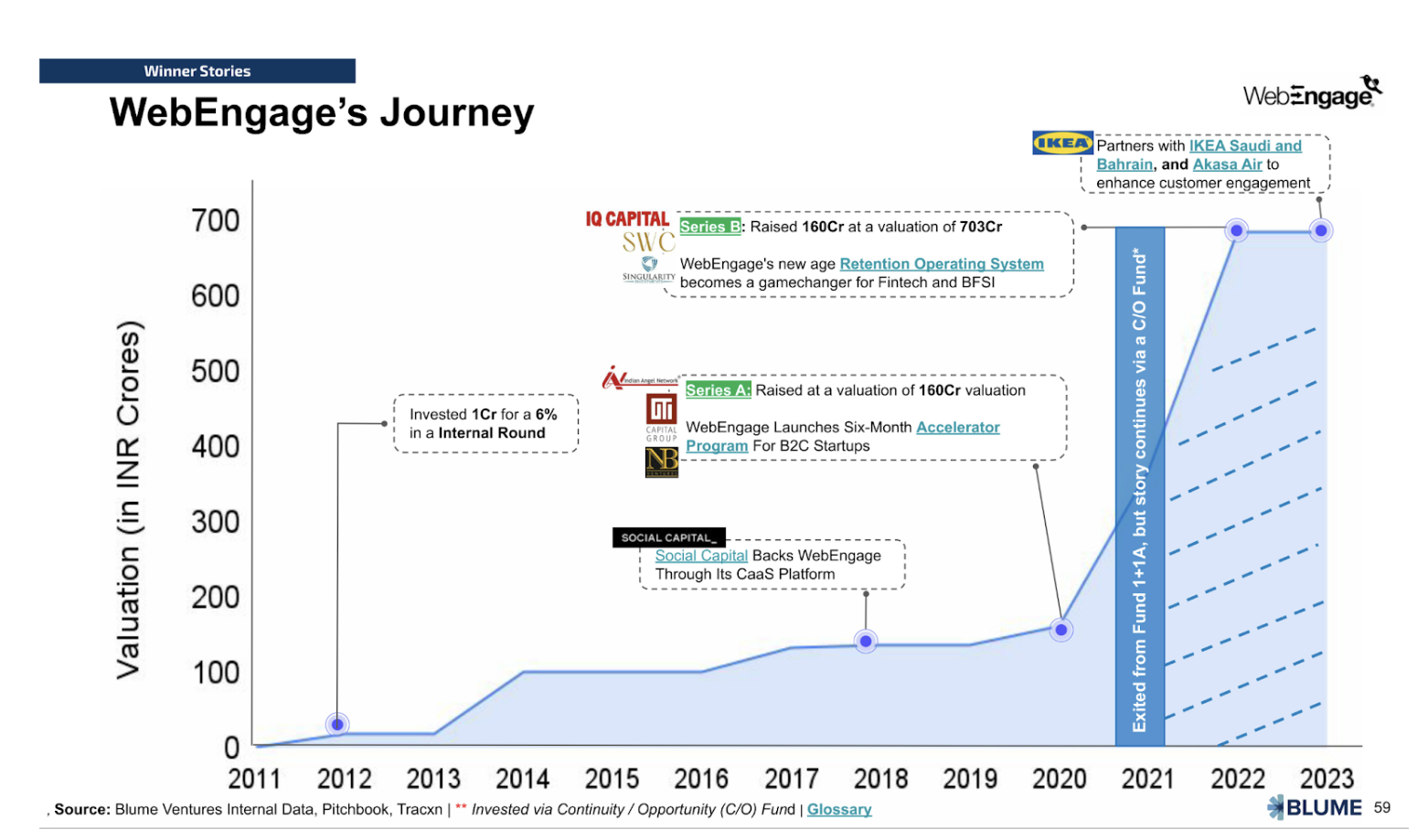
From 2020 to 2023, WebEngage’s ARR has 4Xed from Rs 50 Cr to 200 Cr, adding 200+ employees. The valuation has kept pace with the staggering growth since 2020.
Chapter 6: Winning Beyond Boundaries
Recently, WebEngage has seen significant growth in the enterprise segment.
Avlesh: “Enterprise adoption is through the roof. Contrary to what everyone else in our category is doing, we’re targeting very different segments.”
The company has expanded its reach to companies that are not considered typical customers for a martech product, such as pharmaceuticals, CPG, and restaurants.
For instance, WebEngage now counts tenured giants like Cipla, Pidilite, and Kansai Nerolac as customers.
The key differentiator for WebEngage, driving enterprise adoption, is its focus on developing a robust Customer Data Platform. Avlesh explains:
“The hardest part of marketing automation is getting the data right. It’s a big problem in our category. Marketing team is the user of our product, but they don’t understand the intricacies of data.”
WebEngage has invested heavily in solving complex data problems for traditional enterprises with legacy systems.
Avlesh envisions a future where WebEngage replaces global giants in the Indian market.
“60% of our business is from India. The opportunity in India is larger than anyone in our category thinks. There are 2500 listed companies in India. In the top hundred companies by market capitalization, we already have seven customers. Imagine our growth when, in the next three years, this number alone becomes 25!
Outside India, WebEngage is rapidly growing in the Middle East and Africa, eyeing a sizable chunk of the market. It already serves large enterprises like Airtel Africa, Black Box, and SAT. MEA contributes to ~30% of WebEngage’s business and is growing rapidly.
Vikram, from Blume’s growth investments team, believes WebEngage is on track to be one of India’s greatest SaaS IPO stories. “Their strength is orchestrating customer engagement journey across multiple channels. They have successfully served the Indian enterprises and near India markets. We believe that the company can be a formidable marketing software player built out of India, serving India and near India markets. This could be a great IPO story, given the paucity of new-age Tech product companies listed on the bourses.”
Avlesh hits the same notes as he concludes:
“As far as I’m concerned, it’s only the past that makes me emotional. All the hits and misses. I’m super sorted about the future. We’ve built a strong foundation, and our trajectory is clear. There is no business for Adobe, Salesforce, or Oracle marketing cloud to sell to Indian companies. They have to go home. And if anyone will make the most of it, it will be us.”
We believe WebEngage is on its path to achieving $100 million in ARR, which may seem distant now, but WebEngage’s journey has never been about following conventional wisdom.
As Apple’s landmark campaign ‘Think Different’ once proclaimed, “The people who are crazy enough to think they can change the world are the ones who do.” And if there’s one thing that Avlesh, Ankit, and the WebEngage Team are known for doing, it is reinventing their path to success, one crazy idea at a time.
Topics
Author


Shreevar Chhotaria
Shreevar Chhotaria is an independent creator & consultant, based out of Mumbai. Previously, he was the host, writer, & producer of the top-rated business podcast 'Cost to Company' by The Ken, and has worked full-time with brands like…- Current Section
Commentaries

From Service Engineer to Servify: How Sreevathsa Prabhakar Is Transforming the Boring After-Sales Service Industry into a Billion-Dollar Opportunity
Servify, founded by Sreevathsa Prabhakar, has built a win-win platform that connects brands, retailers, insurers, service centers, and logistics providers to deliver seamless after-sales service. The company manages the entire journey—from…- Current Section
- Commentary
- Authors
- Elton Coelho, Rohit Kaul
- Published

Bridging the India-Bharat Divide: Jai Kisan's Journey to Empower a Billion Indians
“Rashida, my house-help in Mumbai, lives in Dharavi, just one kilometer from the largest HDFC Bank branch. But it took Bajaj Finance and various other players like it to cater to her. Today, she can get many financial…- Current Section
- Commentary
- Authors
- Shreevar Chhotaria
- Published

The Rough Guide to Building an Enterprise SaaS Dhandha in India
Imagine you're pitching your cyber security software to a large Indian bank. You've prepared a detailed ROI analysis, cost-saving calculations, and competitive landscape. But the CIO barely glances at it. Instead, she…- Current Section
- Commentary
- Authors
- Rohit Kaul
- Published

Championing 'Mohalle ka Shahrukh Khan': How Classplus is Transforming Creators into Entrepreneurs
“Have you watched the web series Panchayat? I love it! That’s the core audience creators and educators on Classplus cater to. Almost 80% of our student base is from…- Current Section
- Commentary
- Sector
- EdTech
- Authors
- Shreevar Chhotaria
- Published

The Road Less Taken: How IntrCity Combines Data and Hospitality to Reshape Bus Travel
Imagine being a mother of two young kids, taking a bus from Bengaluru to Chennai, one of the busiest inter-state routes in India. The seats are smelly. There’s an old film playing on a ragtag TV. The brakes…- Current Section
- Commentary
- Authors
- Shreevar Chhotaria
- Published

The Beauty Unicorn Rises: Purplle's Tale of Grit, Growth, and Glory
“I always wondered, 'Who copies someone else's makeup or look?' Then I spoke to 18-year-old Gudiya (name changed) from Calcutta. This call opened my eyes. She said women over 25…- Current Section
- Commentary
- Sector
- Commerce & Consumer Brands
- Authors
- Shreevar Chhotaria
- Published

BITS and Atoms: GreyOrange's Quest to Build First Indian $1 Billion ARR Deep-Tech Company
Imagine a startup with millions of dollars in ARR. Now, make a hard pivot because you are convinced the future is starkly different from what you see today. Give up almost all revenue.…- Current Section
- Commentary
- Authors
- Shreevar Chhotaria
- Published
Startups


WebEngage
Active investmentWebEngage is a marketing automation suite that helps consumer tech enterprises and SMBs drive greater user engagement as well as retention. The platform enables brands drive more revenue from their existing customers and anonymous users…- Current Section
- Portfolio
- Sector
- B2B Services, Commerce Enabler, Horizontal SaaS