
From Service Engineer to Servify: How Sreevathsa Prabhakar Is Transforming the Boring After-Sales Service Industry into a Billion-Dollar Opportunity


- Published
- Reading Time
- 12 minutes
- Contents
The year is 1998.
A young Sreevathsa Prabhakar returns to Mangalore for a break after getting a job in Mumbai. Everyone was waiting with bated breath to hear what he had to say.
When he mentions securing a job at BPL (a renowned Indian electronics manufacturer at the time), their eyes widen with envy. “Software Engineer?” they ask.
“No,” Sree replies. “I’m a service engineer.”
“What does a service engineer do?”
“I fix TVs.”
“Arre, tu Bombay jaake mechanic banega?” they scoffed. (You’ll be a mechanic in Mumbai?)
“Service was never seen as sexy or rewarding,” Sree tells me, with a wry smile, over Zoom from his Mumbai office. “Who wants to listen to customer complaints all day? If you’re ambitious, most believe service isn’t the place for you.”
But Sree saw opportunity where others saw a convoluted mess. That insight led him to create Servify (Blume Fund II portco), which transformed after-sales service from a cost center into a revenue center for brands.
Today, Servify manages service operations for tech giants like Apple and Samsung across 12 countries, processes over 8 million service transactions annually, co-ordinates with 18,000+ service centers, and generates nearly $100 million in revenue, projected to hit $1 billion in the next five years.
How did he convince Apple to take a bet on him and build out their first service center in India?
How did he sense an opportunity where everyone saw sunk costs, turning blind spots into billion-dollar opportunities?
How did he manage to thread the needle between different players in the painfully disorganised after-sales service sector?
Sree’s journey is a testament at how old-school business smarts paired with relentless execution can transform a boring industry into a goldmine.
This is Sree’s story of chasing his destiny.
Of Corporate Ladders and Entrepreneurial Leaps
Sree started his career as a service engineer at BPL before advancing to leadership roles at Samsung and Tata. His career gave him deep after-sales operations and partner management expertise, culminating at Nokia, where he oversaw 740 service partners under the “Nokia Care” brand.
He saw a major customer pain point: inconsistent after-sales experience due to fragmented service operations.
“Every center had different processes, parts, and people. There was no consistency. That bugged me.”
While at Nokia, tragedy struck — his father fell critically ill. Sree rushed home to Mangalore, spending months with his family during this difficult time and through the aftermath of his father’s passing. After taking some personal time, he returned to Mumbai.
Walking into the office early that morning, his supervisor spotted him and casually remarked: “Arey, tu wapas aagaya, bahut chutti le liya yaar tune, abhi toh nahi lega na.” (Oh, you’re back. You’ve taken many leaves, you won’t take more now, right?)
The words hit like a physical blow.
“That was it,” Sree recalled. “I opened my laptop and resigned. I was going through a terrible loss, and here somebody thought I was on vacation.”
The supervisor apologized later, but something fundamental shifted in Sree. After years of working “like an entrepreneur as if it was my own company,” the disconnect between his commitment and how it was perceived became unbearable.
During his three-month notice period, Sree began laying the groundwork for his venture. He realised he knew after-sales service better than 99% of the population. The inherent “unsexiness” and complexity of the business meant very few people were interested in the murky after-sales sector.
That’s how his first company, Service Solutions, was born.
The First Act: Building Service Solutions
Sree’s years at Nokia showed him how fragmented the service experience was across centers.
“If you walk into any of those centers, you’d get a different experience because they were run by 700 different people with 700 different processes,” he explains. This inconsistency frustrated customers and damaged the brand’s reputation.
During his US travels, Sree observed Apple’s approach: “I went to Apple stores and saw the same stellar experience everywhere.” Apple viewed service not as an obligation but as an important part of the customer experience.
This insight became the foundation for Service Solutions. His big break came when Apple agreed to let him build India’s first AppleCare center in Mumbai in 2009, a significant bet for both parties.
It was a different India then. Apple sold only 10,000 phones annually in India, but given the brand’s status, Sree punted everything on this opportunity.
“I invested all my money in building the first AppleCare location — exclusive setup, great experience, and the entire Apple aesthetics,” he recalls.
Getting Apple as a client was one thing, but building a scalable, profitable business with no external funding was another.
“We did an interesting franchise model like Marriott and McDonald’s,” Sree explains. “We partnered with small and medium businesses, and worked on a profit-sharing model. They invested the capex to build the service center, but people were on our payroll. They would pay us to run the business and we’d give them a profit for running it.”
“With a small investment — Rs10 lakh to Rs 15 lakh — they got great ROI. It was a win-win for both of us.”
The model worked remarkably well. Service Solutions expanded to 385 centers across India, developing proprietary technology to deliver consistent customer experience.
Not only this, but it also became Apple’s best-performing partner in the Europe, Middle East, and Africa region for customer satisfaction, attracting other major brands like Samsung, OnePlus, and Xiaomi.
The Second Act: From Service Solutions to Servify
As Service Solutions flourished, it caught the attention of B2X, a German after-sales service company. What began as discussions about a joint venture evolved into a 2014 acquisition, with Sree selling a majority stake while staying to run the business.
The acquisition created tensions, though.
Sree’s vision was evolving beyond just standardizing service centers. He wanted to create an “Uber for service” — a unified interface connecting all brands’ service ecosystems.
“Why should I follow three different processes for my Samsung TV, LG fridge, and Apple phone? Why not a unified interface?” he wondered. He saw an opportunity to transform after-sales service from a cost center into a revenue generator through warranties and charging for support.
B2X’s founder Karim Barkawi was enthusiastic about Sree’s vision, but the B2X leadership team had different priorities. They dismissed Sree’s idea, saying it was “for insurers or the brands to solve.”
Sree gave an ultimatum to Barkawi: Either let him implement the new model within the existing company framework or buy his remaining stake completely so that he could build out his idea afresh. Barkawi chose the latter with a twist: “I’ll be your first investor if you do something like this because I love the idea.”
In 2015, after fulfilling his obligations to B2X, Sree launched his new company with Barkawi as one of its first investors alongside Blume Ventures.
Karthik Reddy, Founder and Managing Partner at Blume Ventures, remembers their first meeting vividly: “We met at a coffee shop in BKC, Mumbai. I loved the idea. He showed me the idea on the back of a book.” Karthik’s question was simple: “What is the next step?” Sree’s candid response: “I don’t know. But I will figure it out.”
That exchange marked the start of a partnership that would help transform Servify from concept to reality. “Karthik was the first believer,” Sree says with evident gratitude. “That’s why I respect Blume and Karthik, because he believed in me when I just had a vision.”
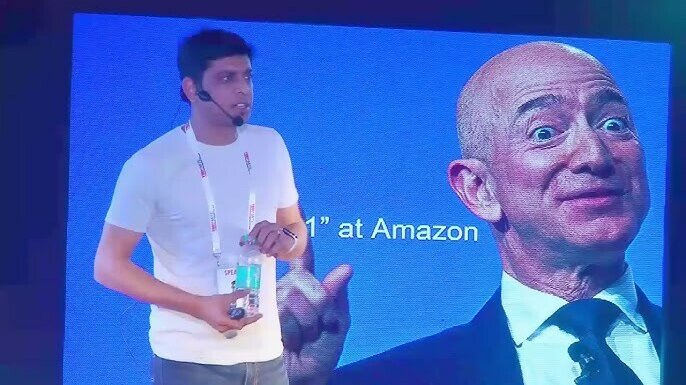
Image source: TEDxMITE (2019)
Envisioning a Billion Dollar Business Opportunity
When I asked Karthik why he invested in Servify, he highlighted Sree’s indomitable spirit and ambition to build a generational company.
“Unlike many founders, Sree put his money where his mouth is. He invested his own capital because he believed deeply in the mission and serves his customers like his life depends on it.”
That conviction proved prescient. Here’s a glimpse of how Servify has been on a tear.

But how did it get here?
Servify began with an ambitious vision: a unified interface for customers to manage after-sales service across all devices, regardless of brand.
“When I pitched brands, they loved the idea but asked who would pay,” Sree explains. “When I said ‘you,’ they balked: ‘We don’t have money. Service is our cost center.’
Sree flipped the model. Instead of asking brands to pay for his platform, he showed them how to transform service into a profit center through extended warranties and protection plans.
“That’s when brands understood, ‘there’s money here,’ ” Sree explains. “They said, ‘somebody is taking this headache and on top of it we get royalty and service money.’ ”
His platform became the conductor of a complex ecosystem, orchestrating interactions between manufacturers, retailers, insurers, service centers, and customers.
Here’s how the model works:
When a customer buys a premium smartphone, they are offered a care plan at the point of sale. The revenue from the care plan is shared between the stakeholders in the after-service supply chain.
The retailer gets a part for selling the plan.
The insurance partner gets a portion as premium since every plan is bundled with insurance from a licensed provider. That’s foundational to how this model works.
The device manufacturer also gets a share as a royalty for allowing access to their service ecosystem.
Servify keeps the rest. This becomes their gross revenue that is used to cover operations, tech, customer support, and more.

This win-win model creates value for everyone: brands earned royalties, retailers get commissions, service centers receive business, insurers gain premiums, and customers receive quality service.
Servify controls the entire process, from when a customer pays for a protection plan to when they raise a support request, fixing their device, and shipping it back; every part of the chain has been meticulously planned.
And that’s precisely why Vikram Gawande of Blume’s growth investment team is bullish on Servify’s growth.
He says, “by connecting different stakeholders in the after-sales ecosystem, Servify’s ‘moat’ is the cost and time it would take to replicate something similar. Sree painstakingly built robust systems that connected Original Equipment Manufacturers(OEM’s), brands, insurance providers, retailers, service centers and logistic providers to respond seamlessly to customer support requests.”
While this model is elegant, turning it into a billion-dollar reality would test Sree’s resolve in unexpected ways.
Patience and Tenacity: Sree’s Winning 1 – 2 Combo
If your head is spinning trying to understand Servify’s business model, you’re not alone. Even investors couldn’t figure it out. Was it SaaS? Insurance? E‑commerce? A marketplace? This categorization challenge made it hard for VCs to apply benchmarks and valuation multiples.
With gross margins around 30% — much lower than the 70 – 80% typical of pure SaaS businesses — many investors questioned if Servify could be profitable at scale. “We’re not a typical SaaS business,” Sree would explain repeatedly, “we’re a platform business with different economics.“
However, perhaps the biggest speedbreaker in Sree’s vision for Servify is its long sales and implementation cycles.
“It’s a long, long sales cycle,” Sree explains. “Six months convincing various teams, three months for RFPs, three months for contracting, then another six to eight months of technical integration before you see a single dollar. That’s 18 months from the first meeting to seeing the first revenue.”
This reality required a founder with unusual tenacity and a long-term perspective.
“Some businesses take years of groundwork before reaping returns. Servify is that kind of business,” notes Karthik, acknowledging that in Servify, Sree found the founder-company fit that is most crucial to scale a startup.
The Operating Leverage Path to Profitability
The marathon build explains why, five years ago, Servify’s revenue was just $7M compared to $100 million today.
“Once you sign up one customer, and their business booms, the next year, it’ll double,” Sree explains. “In three to four years, we’ll be a much larger account because that’s how our business scales.”
Scale also brings its friend for a ride — profitability.
“Even at the start, if I eliminated my corporate or product costs, we were profitable from day one,” Sree notes.
This dynamic of ‘operating leverage’ explains why Servify’s path to profitability accelerated as it scaled. “If my 100 million business has 30% profit, that’s 30 million, against which my extra cost is probably just 1 – 2 million.” While revenue might grow by 150 – 200%, operating costs typically increase by only 5 – 7%,” says Sree.
Building an organization that scales as a Solo Founder
Though Servify has a single founder, Sree has created a distinct ownership culture that distributes responsibility and rewards. “I have many co-founders,” he remarks, explaining that almost everyone at Servify — from leadership to office staff to security guards — is a shareholder through the company’s ESOP program.
“Our security guard outside and our office boys serving coffee and tea are Servify shareholders,” Sree exclaims proudly. This approach, pioneered by Infosys, is creating meaningful wealth for employees at all levels. “Today, many of our team members are crorepatis,” he notes.
This democratic approach to equity contrasts starkly with many startups, where ownership is concentrated among founders and senior executives. For Sree, this distribution reflects his belief that everyone contributes to the company’s success and should share in its rewards.
However, equity alone doesn’t solve the challenges of being a solo founder. “There are moments you can’t discuss with your team,” Sree admits candidly. “If you’re worried about making payroll, you can’t share that with a young team member without creating panic.”
For the strategic sounding board that co-founders typically provide, Sree turned to key investors. “For a long, long time, I treated my investors as partners with whom I can discuss some pains,” he explains. “In many Blume sessions, I’ve told Karthik is my co-founder, if you ask me who is my co-founder. Because at one am at night, if you have to call and talk openly, these are the people I always found.”
Riding the Indian Growth Tailwinds
Servify’s model benefits from India’s growing consumer electronics market. With rising smartphone penetration and disposable incomes, more Indians are buying premium devices that need protection.
“We call that an ‘attach’, its an important KPI for us,” Sree explains, referring to the percentage of device buyers who purchase protection plans at the point of sale. “A few years ago, it was low single digits. In the last couple of years, we reached double digits. We are close to hitting a 20% plus attach rate.”
Servify also benefits from the shift toward premium handsets. Servify focuses on the premium segment where these economics work best. “Typically, our customers buy products above Rs. 25,000 to Rs. 30,000,” Sree notes.
“Three years ago, the blended Average Selling Price (ASP) of smartphones in India was under $125. Now, we’re at $170-$180. This premiumization trend is evident in Apple’s performance in India, where annual iPhone sales doubled from 5 million to 10 million units.
As the average selling price of devices rises, the relative cost of protection plans decreases as a percentage of the device value, making them more attractive to customers.
While the Indian market presents tremendous growth opportunities, Sree’s ambitions extend beyond borders.
“India will still grow. It will become a ₹2,000 crores market for us in 2 – 3 years. But in the US, one can reach ₹1,000 crores in one year. From ₹1,000 to ₹3,000 crores, it takes 6 months. That market is much bigger and very deep.”
Winning Beyond Boundaries (and Categories)
With a proven model and strong foundation, Servify is positioned to grow into its billion-dollar revenue vision. Here’s how it gets there.
First is geographic depth over breadth. The US market alone represents a massive opportunity, and is on track to generate $50M in ARR this year. Sree believes they are just scratching the surface. “In the US, we can do a half-billion dollar business in the next 3 years,” Sree explains. “So why go elsewhere?”
Focusing on the US makes strategic sense. “In America, everyone buys devices above $400,” Sree explains, compared to India’s average smartphone price of around $170 – 180. The economics of device protection work better with premium devices, where repair costs justify the protection plans and deliver higher margins.
The second is customer-led global expansion. Global customers like Samsung and Apple provide natural pathways to new markets. “We get to land and expand,” Sree notes. “With Samsung and Apple, we expand in multiple countries because we’ve proven ourselves in one or two.” This creates a virtuous cycle where success in one region leads to invitations from the same partners in other regions.
The third is diversification beyond electronic device makers. Sree sees telecommunications companies as a large segment to break into. “Right now, our biggest customers are OEMs,” Sree acknowledges. “Samsung is 40%, Apple is 40%. We see an opportunity to grow into telecommunications where it becomes 40% of our revenue and OEMs are 40%.”
Vikram from Blume’s growth investment team shares this view about Servify’s trajectory: “There is a strong potential for Servify to reach $400M — $500M in the next 4 years,” he says. “Expansion to international markets will increase revenue, possibly overshadowing Indian revenue.”
Sree is also thinking of some moonshots. “We’re still in early thinking stages, but there’s so many personal artifacts that matter to customers beyond smartphones,” Sree muses. Eyewear particularly intrigues him: “In India, close to 400 million need spectacles. If your glasses break today, there’s no coverage. Why can’t we offer protection?” Other personal items like watches, jewelry, or even sports equipment could eventually fall under Servify’s protection — all ideas worth exploring.
A Mechanic’s Destiny
Twenty-seven years after being called a “mechanic” by his relatives, Sreevathsa Prabhakar has transformed the very field they dismissed. While others mocked him for fixing broken TVs, it was precisely this understanding of service from the ground up that gave Sree his edge.
In many ways, Servify is the ultimate expression of what Sree was destined to do — not just fix individual devices but repair and reimagine an entire industry from the ground up. He took after-sales service — long treated as an obligation, a cost center, an afterthought — and transformed it into a strategic asset that creates value for brands, retailers, service providers, and customers.
For founders, Sree’s journey offers a powerful reminder: sometimes the path to building something valuable doesn’t start with a glamorous idea but with the courage to embrace your destiny, even if it means being called a “mechanic” along the way.


Commentaries


Bridging the India-Bharat Divide: Jai Kisan's Journey to Empower a Billion Indians
“Rashida, my house-help in Mumbai, lives in Dharavi, just one kilometer from the largest HDFC Bank branch. But it took Bajaj Finance and various other players like it to cater to her. Today, she can get many financial…- Current Section
- Commentary
- Authors
- Shreevar Chhotaria
- Published

Championing 'Mohalle ka Shahrukh Khan': How Classplus is Transforming Creators into Entrepreneurs
“Have you watched the web series Panchayat? I love it! That’s the core audience creators and educators on Classplus cater to. Almost 80% of our student base is from…- Current Section
- Commentary
- Sector
- EdTech
- Authors
- Shreevar Chhotaria
- Published

Here’s to The Crazy Ones | WebEngage's Unconventional Path to Glory
"There were times when we didn't have money for payroll. I staggered salaries. We operated like this for almost a year during the 2018-19 period," recalls Avlesh Singh, co-founder and CEO of…- Current Section
- Commentary
- Authors
- Shreevar Chhotaria
- Published
Startups


Servify
Active investmentServify helps leading device brands manage the after-sales service experience, It provides a fully digital, end-to-end tech stack to manage global warranty programs for smart devices. Servify's solutions ensures customer delight…- Current Section
- Portfolio
- Sector
- Horizontal SaaS, FinTech