
Why we invested in Confido Health


- Published
- Reading Time
- 3 minutes
- Contents

It was a cold, stormy April Monday in New York when Sanjay and Chetan met for the first time. While the skies were overcast above the Big Apple that day, much of the same could be said, unfortunately, about the looming healthcare staffing crisis in the United States as well. As Chetan painted a compelling picture of the potential of voice agents in healthcare, we began to see that this was a perfect storm with three converging factors:

1. Structural Labor Shock that won’t heal with hiring
Post-COVID, administrative staff turnover has been insanely high: MGMA data shows 40% turnover for front-office staff and 33% for business office staff in medical practices. Nearly 2/3rd of providers report staffing gaps in revenue cycle/administrative departments, and 100% of surveyed hospital leaders say staffing shortages are hurting their revenue cycle.
To us, this looks like a structural labor shortfall and not a cyclical blip. Even if hospitals want to hire, the supply isn’t there (at a viable cost, at least). That makes “we’ll just staff back up” a non-solution and creates real pull for automation rather than just a “nice-to-have” interest.
2. Revenue and Margin squeeze forcing non-clinical levers
Labor now accounts for 56% of hospital costs, increasing disproportionately since COVID. What makes the pain worse is that understaffed front offices are leaking revenue: up to 30% of calls go unanswered in many practices (from our conversations with providers), with each missed call a $200 – 300 opportunity lost.
This means that CFOs are now looking for administrative efficiency as a big lever. We heard resounding feedback from the market that anything that can recapture missed appointments, reduce denials and phone leakage, and add capacity without adding headcount — will get budget now, not “sometime in the next 3 – 5 years”.
3. Voice AI is finally “good enough”
It is increasingly clear to us that the quality of best-in-class models has passed the threshold where conversational, natural-language phone agents can actually work. These agents could now also integrate directly with Electronic Health Records (EHRs) and Practice Management systems to schedule in real time, follow practice-specific rules, and write back to the record.
This is great in terms of timing because we crossed three thresholds at once: capability (voice AI is accurate, fast, and robust), plumbing (integrations exist or are achievable), and readiness (post-ChatGPT, execs and patients are growing comfortable with “AI in the loop”).
A perfect storm of these three factors means that a vertical-focused voice agent company can now sell into a market that already believes in AI, show hard RoI easily with early pilots, and scale primarily as a software business (not a BPO with linear headcount) across ambulatory chains and hospital systems.
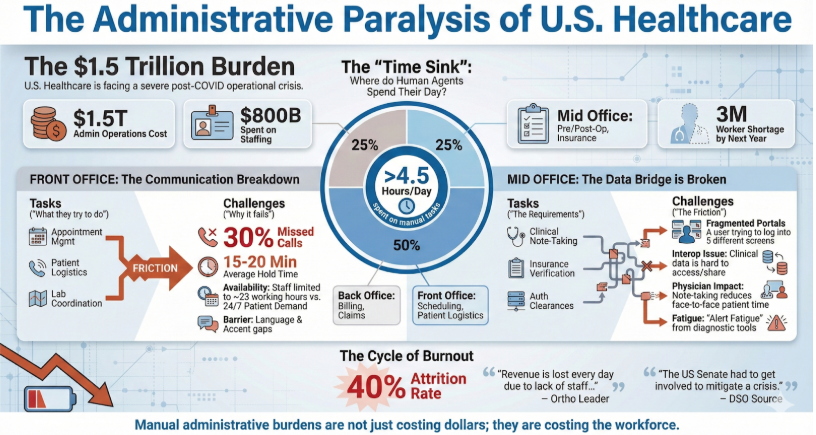
The strong market pull shows in the case of Confido, and how!
Confido already has workflows live with clinics at scale, across:
- Appointment scheduling and rescheduling (the highest-friction, highest-volume front-office workload)
- Patient queries
- Prescription refills
- After-care follow-ups
- Reactivation
- Payment processing and more.
As of October, their platform handles over a million automated tasks monthly and provides better patient access to over 1.7M patients in the US. That’s a meaningful scale for a company that launched just under a year ago; it’s not “three design partners in stealth” that we see more often. It also means that they’re just getting started and have only scratched the surface.
Most voice solutions for healthcare we had benchmarked were still focused on pretty IVR or basic scheduling. Confido, however, is punching way above its weight, solving across the front-office capacity constraint (phones, scheduling, intake, questions) and mid-office revenue leaks (referrals, insurance verification, payments). So when Chetan and Vichar said “we’re solving the admin staffing crisis,” they’re not just hand-waving.. the product roadmap and live usage (upto 70% call success rate across customers) are already sitting squarely in that problem space.
When we looked at the numbers, the product-market fit was unquestionable — short time-to-value, real cost cut, and clear expansion motions inside accounts with more workflows and a higher AI-handled share of volume.
The Founders
Chetan and Vichar came across to us as incredibly ambitious founders who have a deep appreciation of the problem and the right amount of tech to solve it, after spending many months travelling to every corner of the US and meeting thousands of providers across sizes and specialties to understand what ticks for them and what doesn’t. It was clear to us that this is the right team to back, to go after this opportunity.
The admin staffing crisis in ambulatory care is a multi-billion-dollar opportunity. Confido is already functioning as a scaled digital admin workforce across 50+ customers and 1.7M patients, with PE/MSO channels that give a clear line of sight to a 100X+ business from here. The combination of macro tailwind, product depth, and execution maturity is why we feel Confido is best positioned to be the category leader in voice AI for healthcare, and we are excited to lead their $10M Series A fundraise.


Topics
Authors


Sanjay Nath
Sanjay Nath co-founded Blume with Karthik Reddy in 2011. Sectorally, he focuses on cross-border AI and SaaS investments and also oversees Blume’s Go To Market platform initiatives. Sanjay has overseen investments in some of Blume’s…- Current Section
- Co-founder & Partner
- Sector
- DeepTech

Sumangal Vinjamuri
Sumangal focuses on Enterprise/SaaS investments within Blume and is based in Bangalore. He has spent over 5 years as an operator in the SaaS space, in various roles across growth, product management and customer success. During his…- Current Section
- Vice President, Investment
- Sector
- Infrastructure SaaS & Dev Tools, SMB & Vertical SaaS, Horizontal SaaS

Shrey Shah
At Blume, Shrey specialises in SaaS and Enterprise investments. He holds a Bachelor's degree in Electrical and Electronics Engineering and a Master's degree in Physics from BITS Pilani. He has completed his MBA from FMS…- Current Section
- Senior Analyst
Commentaries


Why We Invested in BIDSO
We are thrilled to announce our $4m investment in BIDSO, an Original Design Manufacturer (ODM) for outdoor toys and baby hardlines. This is part of a larger $5.5m equity round. BIDSO previously raised a $1.5m round led by Peer…- Current Section
- Commentary
- Sector
- Commerce & Consumer Brands
- Authors
- Sajith Pai, Anurag Pagaria
- Published
Startups


Confido Health
Active investmentConfido Health is an AI-driven platform for automating healthcare operations and patient communications, helping providers reduce administrative tasks and enhance patient engagement. Its voice AI agents streamline tasks like…- Current Section
- Portfolio
- Sector
- Artificial Intelligence