


Artificial intelligence is rapidly becoming the operating system of revenue. Whether you build something from scratch in-house or buy a third party platform, AI-native software is reshaping how companies sell, retain customers, and scale growth across every level of the revenue organization.
This BluPrint is a comprehensive view on where revenue AI stands today, where the biggest pain points remain, and where the next wave of opportunity lies.
To read the full Bluprint, click here.
The Current State of Revenue AI
Modern revenue organizations are structured around four core functions:
- Pre-sales, which entails the identifying and closing of deals
- Post-sales, which focuses on driving retention and expansion
- Revenue Operations, which concentrates on enabling efficiency across the engine
- Marketing, which generates customer demand and results in deal pipeline.
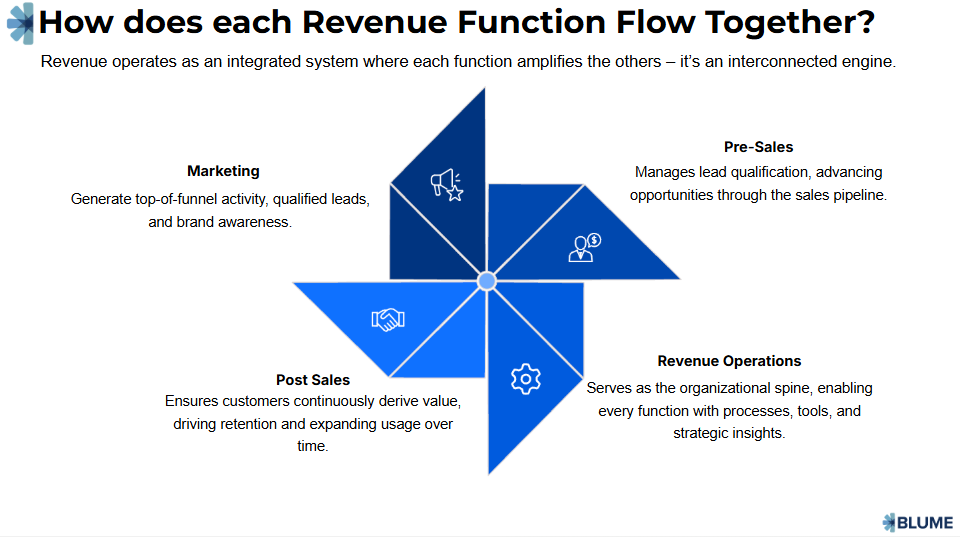
These functions don’t operate in isolation, as pictured in the diagram above. Marketing feeds qualified leads to pre-sales, which hands closed deals to post-sales, while revenue operations serves as the organizational spine connecting it all together with processes, tools, and strategy.
While different in their key functionalities, the appetite for AI across all four divisions is enormous. According to Gartner, over 80% of revenue technology vendors are expected to embed AI capabilities directly into their applications, and six in ten sales leaders plan to hire dedicated generative AI roles.
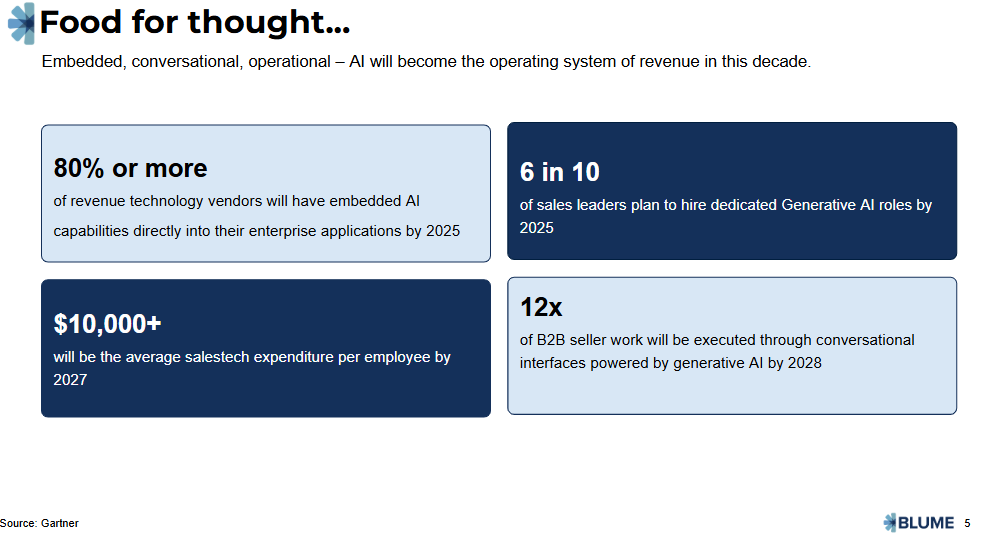
Yet despite the dollars invested in GTM software, average user satisfaction remains low. Even among the 59% of companies that have implemented generative AI in their GTM workflows, satisfaction hovers around the same modest level.
Additionally, the current revenue stack is sprawling. A typical GTM team might run five or more tools stitched together with five integrations, five separate contracts, and limited operational support. Founders and early-stage sales leaders often lack the budget or headcount to manage such complexity.
With the revenue AI landscape saturated with players of all shapes and sizes, where does an early stage builder – or an executive buyer looking for the best platform to invest in – even start?
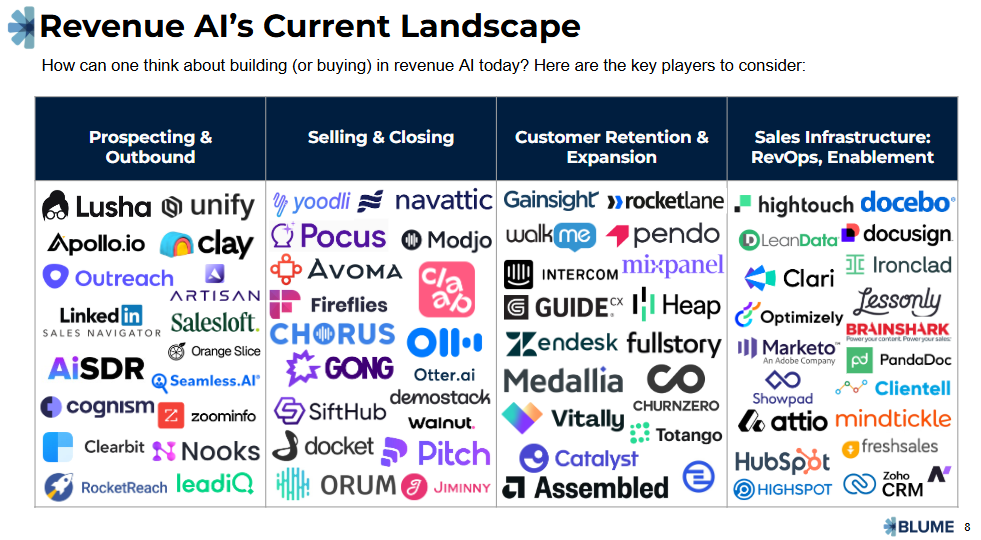
Where AI Fits In
This BluPrint maps AI solutions to persistent pain points across each revenue function. In pre-sales, teams struggle with personalized outbound at scale, lengthening sales cycles, and fragmented lead qualification. AI-driven outreach systems, proof-of-concept automation, and predictive lead scoring are emerging as answers. In post-sales, customer success teams face capacity constraints as customer volumes outpace headcount, while retention efforts remain under-resourced and adoption tracking is largely manual. AI-powered churn analytics, health scoring, and conversational agents are stepping in to fill these gaps.
Revenue operations contends with poor data quality across multiple tools, siloed departments, and inaccurate forecasting. AI offers solutions through automated data enrichment, cross-functional alignment tools, and multivariate forecasting models. Marketing teams, meanwhile, face pressure to adopt AI for content creation and campaign testing, while struggling with misalignment with sales and inconsistent lead quality.
Where the Next Wave Wins
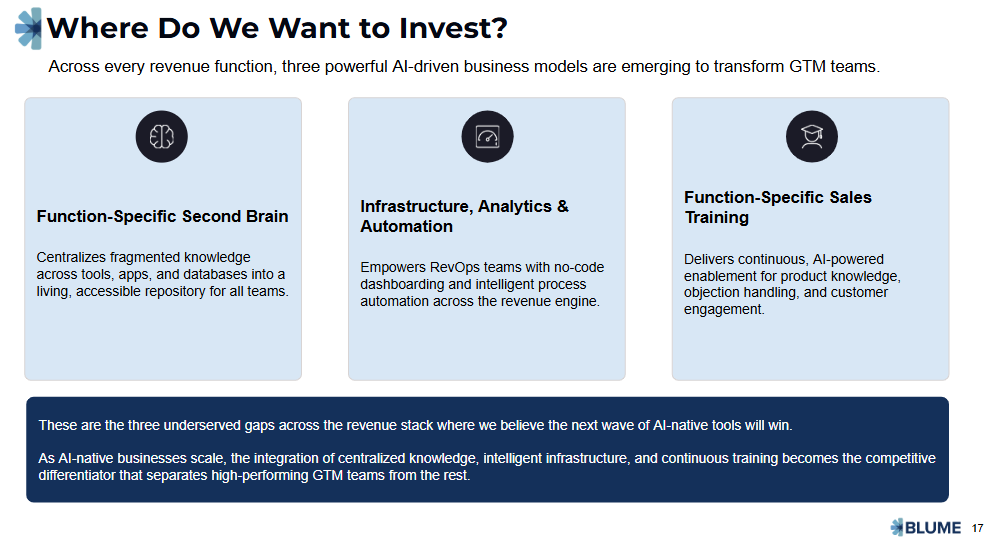
Three investment themes emerge as the most promising areas for AI-native startups. First, function-specific “second brains” that centralize fragmented knowledge across tools and databases into a living, accessible repository. Second, infrastructure and analytics platforms that empower RevOps teams with no-code dashboarding and intelligent process automation. Third, function-specific sales training tools that deliver continuous, AI-powered enablement for product knowledge, objection handling, and customer eng.
The overarching message is clear: AI in revenue is moving beyond point solutions and copilots toward deeply embedded, autonomous systems that don’t just inform decisions but actively execute. The companies that integrate centralized knowledge, intelligent infrastructure, and continuous training will be the ones that separate high-performing GTM teams from the rest.
If you are (or know someone who is) building in this space, we would love to chat. Reach out to email hidden; JavaScript is required
Author


Sameera Pant
Sameera works on Blume's SaaS and AI investments, having made the move to venture after almost four years working in the startup space. After exploring entrepreneurial opportunities at the University of California, Los Angeles –…- Current Section
- Analyst