
Travel Technology Bluprint


- Published
- Reading Time
- 3 minutes
At Blume, we’ve been increasingly intrigued by travel as a sector. Over the last few years, the industry has fundamentally changed, not just in how people book trips, but in terms of how they think about travel itself.
Today’s platforms are largely transactional. They help you book, not discover. The discovery mantle has quietly moved to Instagram, WhatsApp groups, and creators. Personalisation still feels shallow. The user experience ends once the ticket is booked, even though the real journey starts after.
Meanwhile, consumer behaviour has shifted meaningfully. Travel is no longer a once-a-year family vacation; it’s becoming a lifestyle. Long weekends, weddings, spiritual circuits, concerts, and blended work-leisure trips are now part of the Indian routine. Rising discretionary incomes and airport expansion across Tier‑2 and Tier‑3 cities are accelerating this shift.
On the supply side, the sector continues to evolve rapidly. Offline travel agents, once the backbone of the industry, still command a large share in international travel, especially where visas, forex, and itinerary complexity remain high, but their relevance is steadily reducing. The ecosystem has moved from agents → online booking platforms → and now, increasingly, towards AI-driven travel assistants.
What’s even more interesting is the emergence of India-centric travel models. Spiritual tourism is scaling as a uniquely Indian category a major share of domestic travel today is spiritual in nature. India is also becoming a global hub for medical tourism, driven by a strong cost – quality advantage. And while the late 2000s and 2010s were dominated by OTA-led innovation, the next wave is moving toward fintech-led travel, wellness and medical travel, Experience tourism and cross-border mobility areas where India has both scale and structural strengths.
In this thesis, we attempt to dissect the current environment, understand the behavioural and structural shifts, and outline the parts of the travel stack we’re most excited about, from discovery and planning to experiences, spiritual tourism, and outbound mobility.
To read the full thesis, please click here
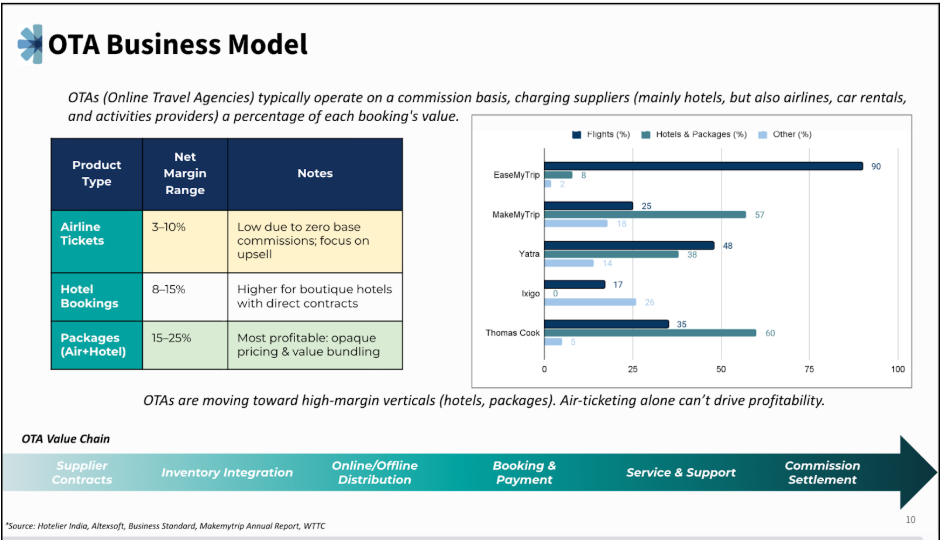
Online Travel Agencies (OTAs) earn commissions across flights, hotels, and packages, but profitability is highly skewed. Airline ticketing remains a low-margin business (3 – 10%), forcing players to focus on upsell and ancillaries. In contrast, hotels (8 – 15%) and bundled packages (15 – 25%) offer significantly higher margins, making them the real growth engines. Hence, OTAs must diversify beyond air-ticketing to unlock sustainable profitability.
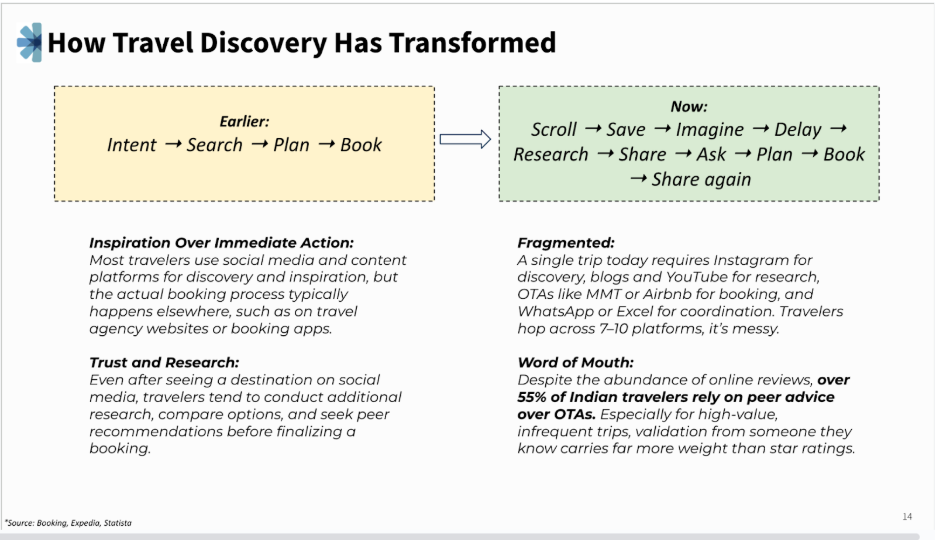
Travel discovery has shifted from a linear funnel (intent → search → plan → book) to a far more fragmented, iterative journey. Today, travelers scroll through social media for inspiration, save destinations, delay decisions, and return multiple times to research and validate through peers before booking. A single trip often spans 7 – 10 platforms, from Instagram and YouTube for discovery, to OTAs for booking, and WhatsApp for coordination.
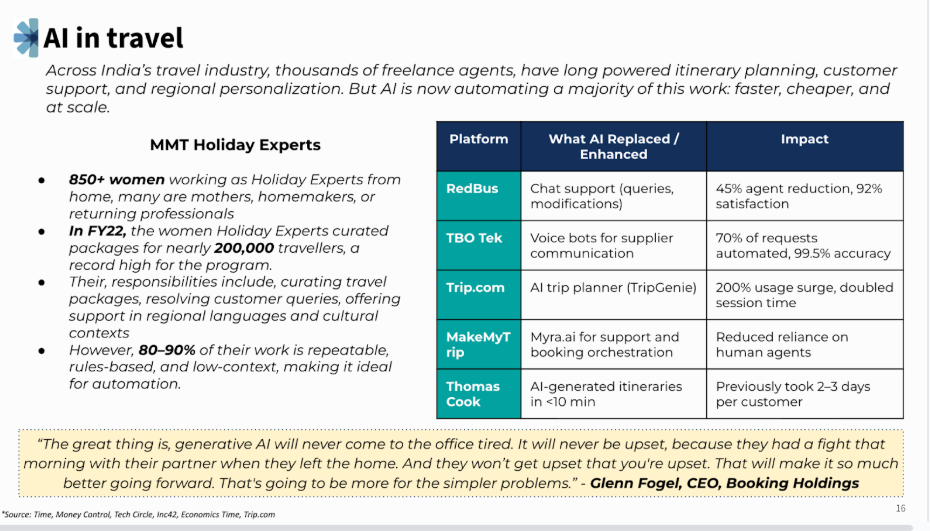
AI is reshaping travel by automating tasks once handled by agents, from itinerary planning to customer support. Platforms like RedBus, Trip.com, and Thomas Cook now deliver faster, cheaper, and more accurate services, cutting agent reliance by up to 45% and reducing days of work to minutes. With 80 – 90% of travel queries being repeatable and rules-based, AI is becoming the default engine of scale in the industry.
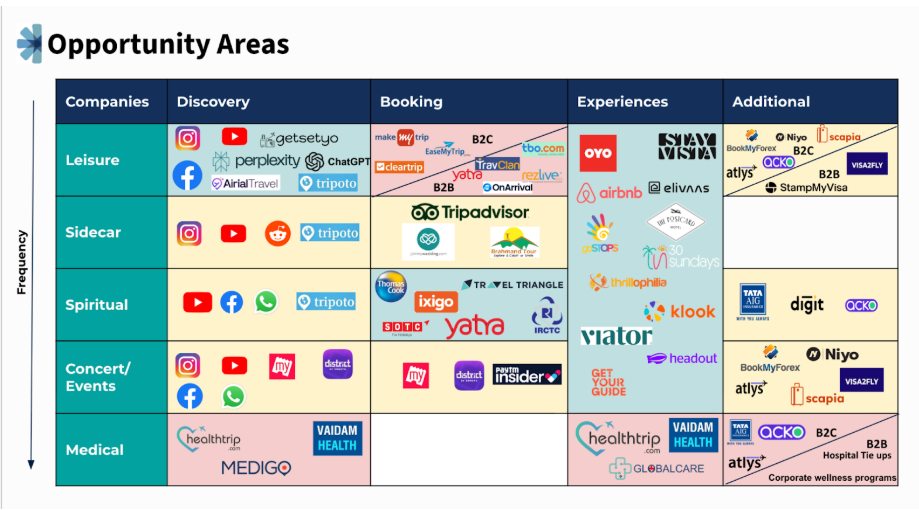
Travel demand is diversifying beyond leisure into spiritual, medical, and event-led journeys, each spawning new platforms across discovery, booking, and experiences. While OTAs dominate core bookings, specialized players are emerging in niches like visas, forex, and insurance. This creates a fragmented yet high-potential landscape where verticalized solutions (medical, spiritual, concerts) and ancillary services (visa, fintech, insurance) represent the next big growth frontiers.
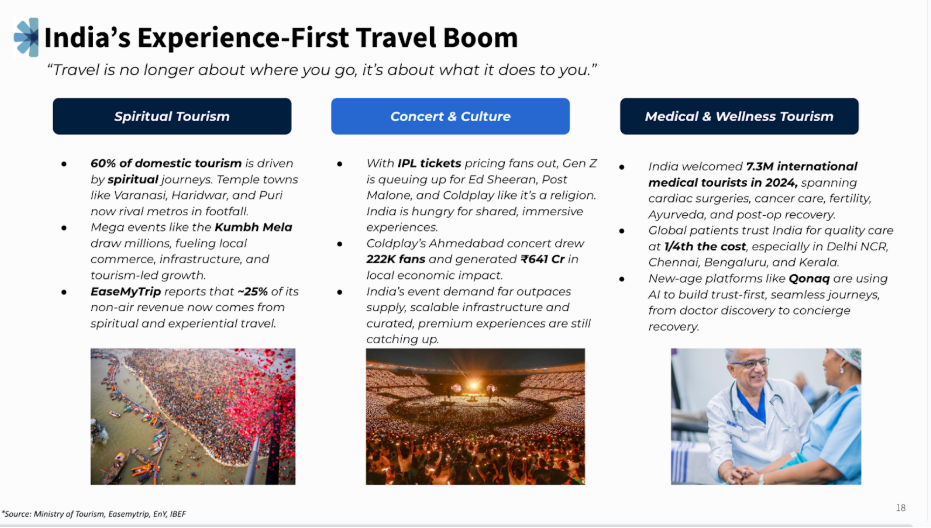
Travel in India is increasingly driven by experiences over destinations, from spiritual journeys that account for 60% of domestic tourism, to concerts that generate hundreds of crores in local impact, and medical tourism attracting 7M+ international patients at a fraction of global costs. As demand outpaces supply, India’s next wave of travel growth lies in scalable, curated, and trust-first experiential platforms.
Authors


Marmik Mankodi
Marmik is excited about opportunities in consumer tech, consumer apps, consumer services & ed tech.He has spent 9 years working at startups & scaling up notable brands in India & Southeast Asia. Marmik was an early…- Current Section
- Vice President, Investment
- Sector
- Domestech

Muskan Gupta
Muskan supports the Consumer investments practice at Blume. She is a graduate of BITS Pilani, holding a degree in Electrical and Electronics, with a strong passion for startups and innovation.Muskan brings diverse experience from…- Current Section
- Analyst