


India’s healthcare financing landscape represents a complex intersection of public policy and market opportunity, particularly highlighted by the significant gap in government healthcare spending at just 1.3% of GDP compared to other BRICS nations.
This underinvestment, coupled with the fact that 58% of households face catastrophic health expenditures, has created a “Missing Middle” — approximately 400 million Indians who are neither covered by government schemes nor can afford private insurance. However, this challenge has spurred innovation in financing models, particularly in blended finance approaches that combine public, private and philanthropic capital.
Recent trends show substantial private equity interest, with hospitals receiving the lion’s share of healthcare investments. The emergence of specialized financing models and technology-enabled solutions, particularly in single-specialty hospitals and financial operating systems, suggests a transformation in how healthcare is funded and delivered in India.
Resource
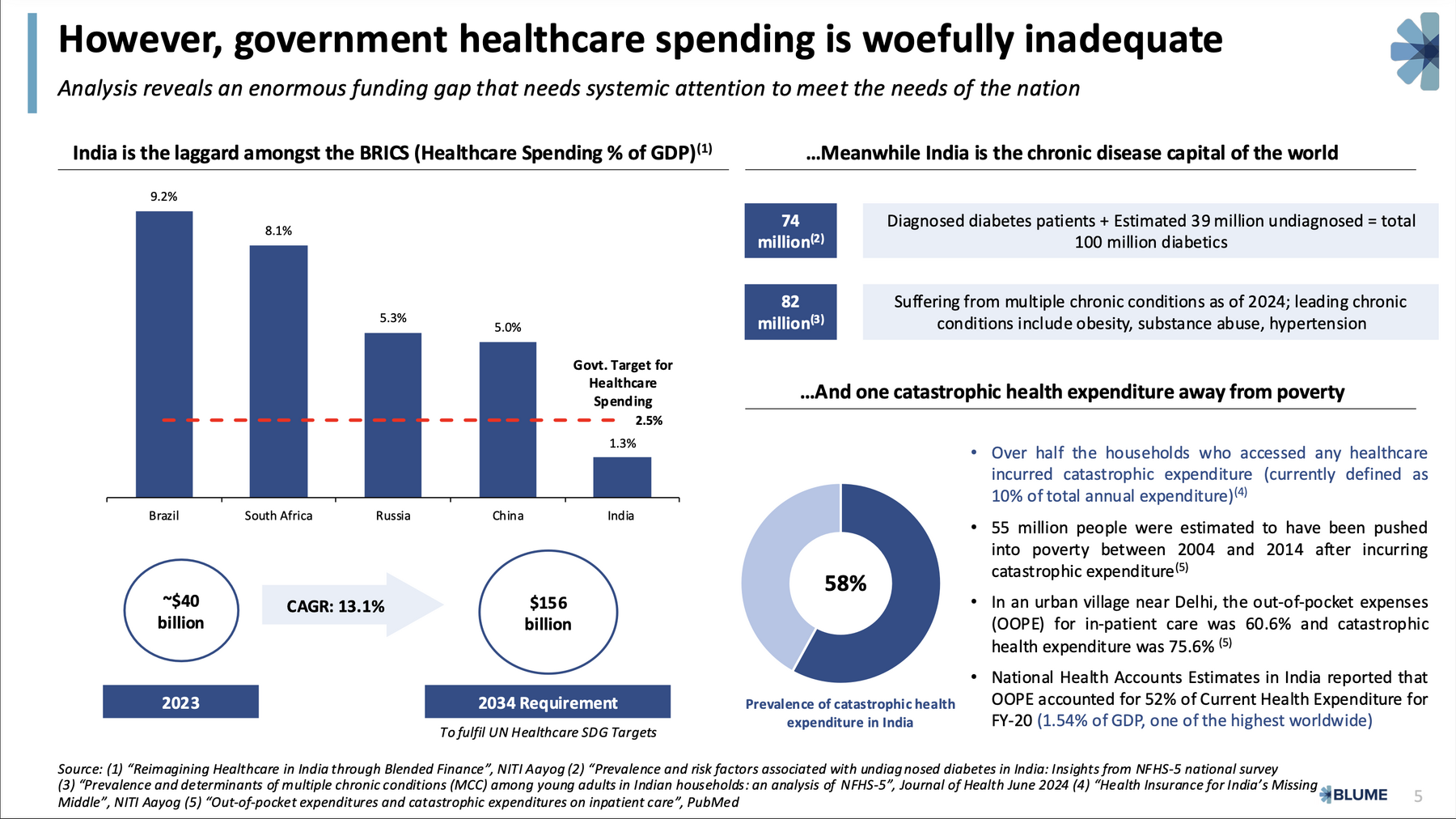
India significantly lags behind other BRICS nations in healthcare spending at just 1.3% of GDP, compared to Brazil’s 9.2% and South Africa’s 8.1%. This gap indicates severe underfunding, requiring a dramatic increase to meet India’s targeted healthcare spending of 2.5% of GDP. Meanwhile, with 100 million diabetics and 82 million people with multiple chronic conditions, the country faces a growing healthcare crisis.
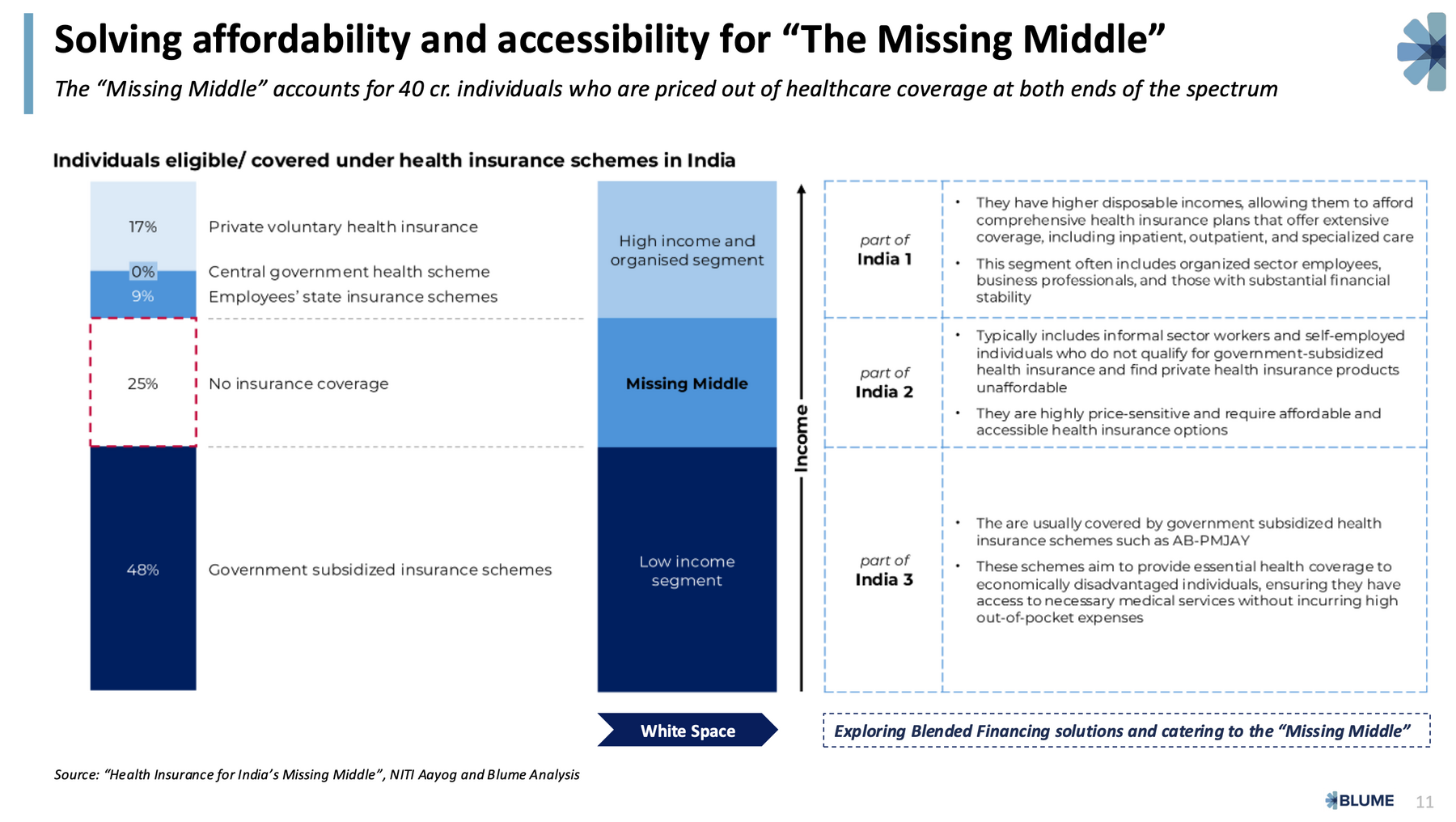
Analysis reveals a critical healthcare coverage gap in India, where approximately 400 million citizens fall into the “Missing Middle” — earning too much for government schemes yet too little for private insurance. While 17% have private insurance and 48% are covered by government schemes, this middle segment, largely comprising informal sector workers and self-employed individuals, remains vulnerable to catastrophic health expenditures, highlighting a significant market opportunity for innovative financing solutions.
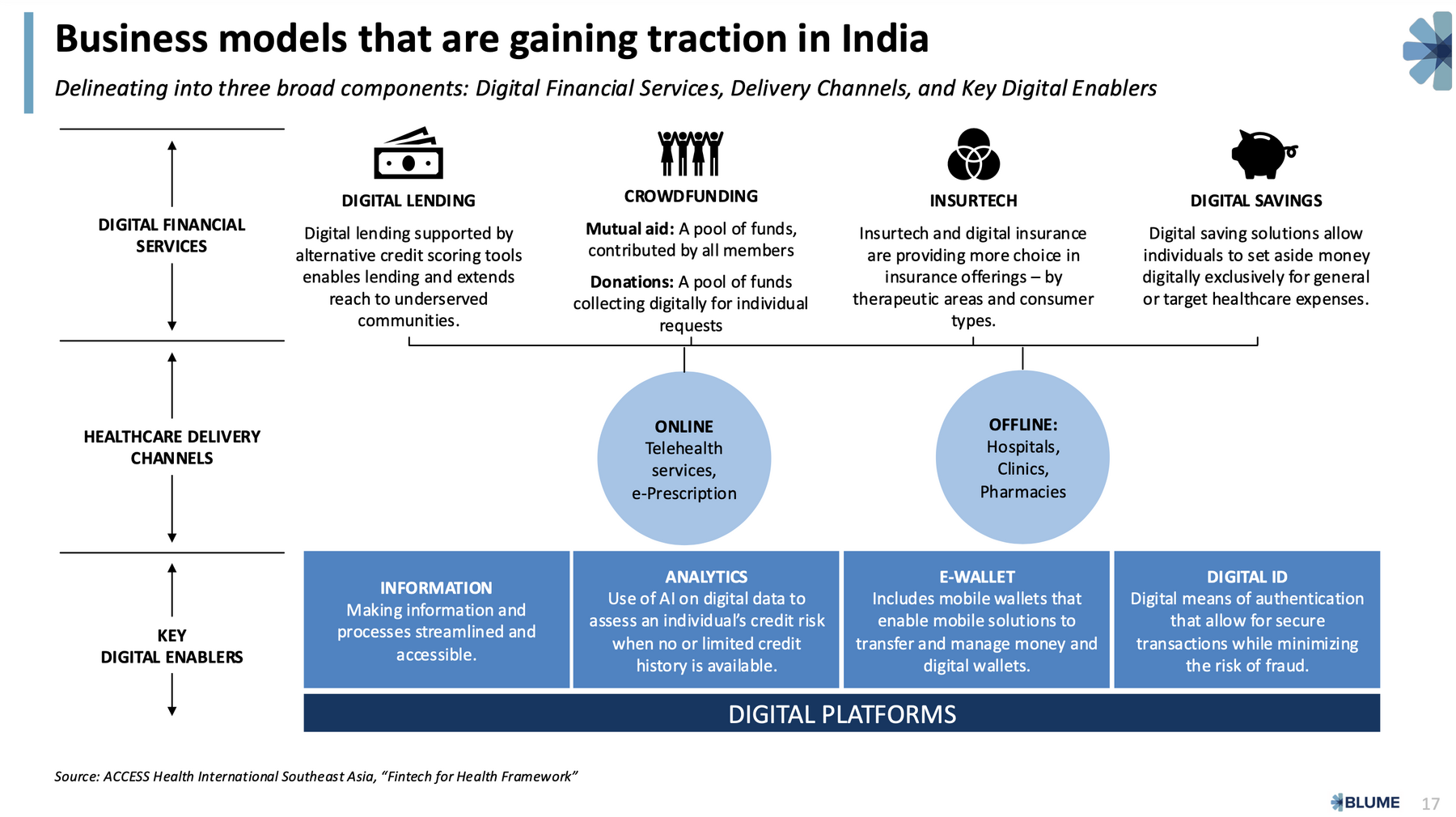
These are some broad business models in the space majorly categorized in digital financial services, healthcare delivery channels and Digital Enablers.
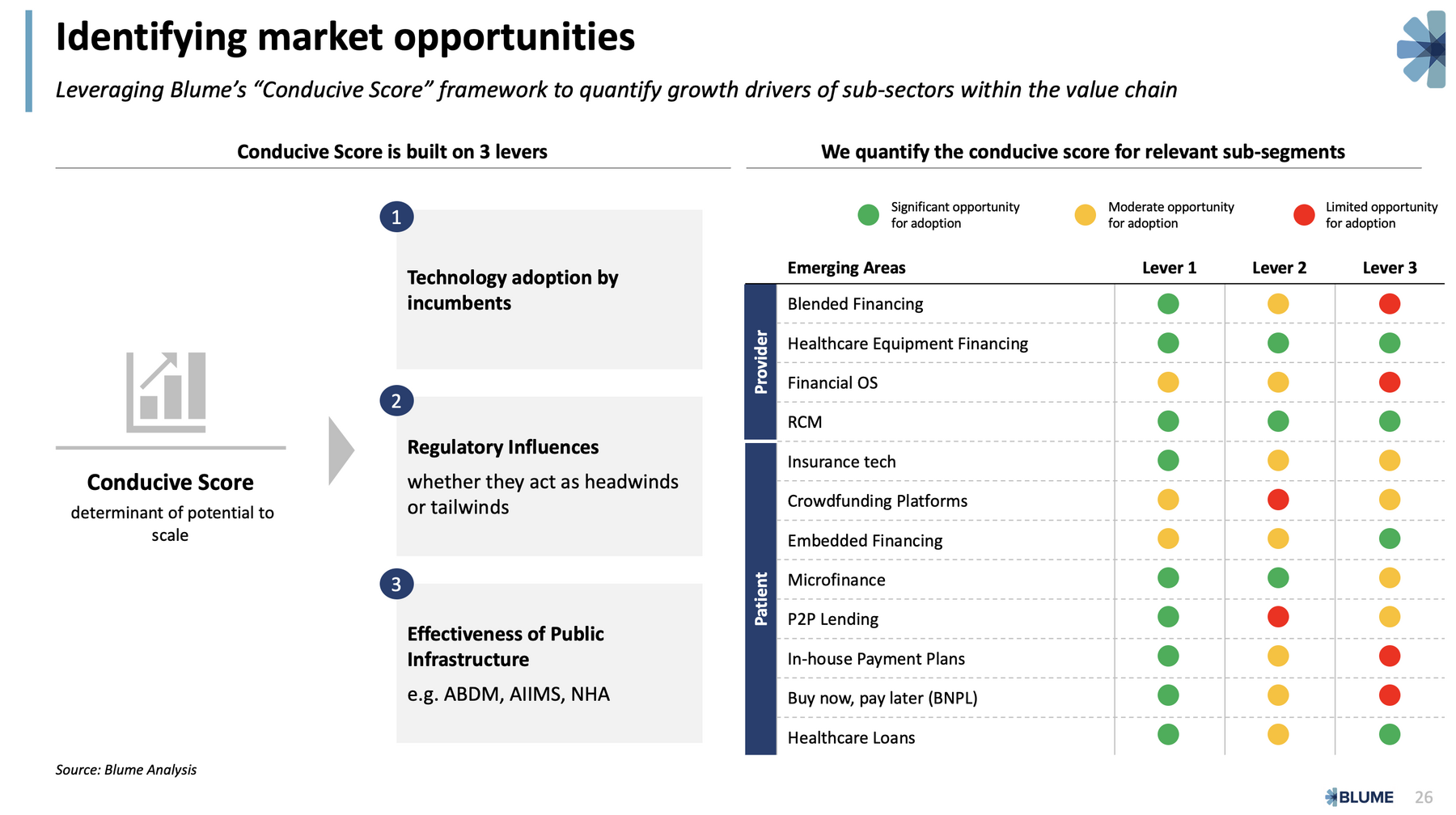
We evaluate healthcare financing subsectors using a novel “Conducive Score” built on three critical levers: technology adoption by incumbents, regulatory influences, and effectiveness of public infrastructure. The analysis identifies Healthcare Equipment Financing and RCM as highly conducive sectors across all parameters, while emerging areas like crowdfunding platforms and BNPL show mixed potential. This systematic evaluation helps pinpoint sectors ripe for innovation and investment.
Our special thanks to Karan Jhaveri, an MBA student at MUN, Delhi, for his help and insights in creating this report
Author


Udayan Pandey
Udayan focuses on Fintech investments within Blume and is based out of Mumbai. He has spent last 10 years in Financial Services space and has a diverse work experiences in EMEA and Indian markets. He is a Founder of a supply chain…- Current Section
- Vice President, Investment
- Sector
- FinTech