
How a champion rebuilt her game after 30 and kept shifting orbits: The PV Sindhu story

- Episode
- Episode 2
- Published
- Reading Time
- 37 minutes
We’re back with an episode of One of One about the orbit shifts a champion chooses, and the ones that get forced on her.
In this episode, Karthik Reddy sits down with PV Sindhu, who has two Olympic medals and is the only Indian woman to win the badminton World Championship gold. They talk about the years behind the medals, the injuries and doubt that followed, and what she is building next: a startup investing portfolio and a multi-sport academy in Visakhapatnam.
If you can’t watch the full conversation yet, here are three highlights that stood out to us:
1) “If you want to stay, just win and show”
As a junior, Sindhu would lose in the early rounds, and her father would take her home the next day. When she asked to stay and play with the other kids, he gave her one rule: win, and you stay until the finals. She says that rule made her want to prove herself. It also set the tone for a career built on discipline and family sacrifice, including a daily 27 km commute to training as a child.
2) From “Silver Sindhu” to world champion
After losing the 2017 World Championship final in a match that ran 1 hour 50 minutes, and another final the year after, Sindhu was nicknamed “Silver Sindhu.” She says she answered with her racket. She won the 2018 World Tour Finals, then the 2019 World Championship, beating the same opponent she had lost to in 2017 by 21 – 7, 21 – 7.
3) Training smarter, not harder, after 30
After a run of injuries and early exits, Sindhu realised she was no longer 20. With her husband’s data-driven input, she built a four-person team, started working backwards from the tournament calendar, and learned that rest days are part of the work. Her rule now is that a rested 100% beats a tired 50%, and she is still aiming for the LA 2028 Olympics.
If you’re playing a long game and wondering how to keep going after the high point, don’t miss this episode.
[00:00:00 — 00:00:35] Karthik
Today’s guest needs no introduction. It’s Pusarla Venkata Sindhu, one of the most acclaimed Indian sportswomen in our history. So nobody who follows sports in the country doesn’t know the name Sindhu. She’s a badminton star and won many world championship medals and two Olympic medals. And her career started at the age of eight, under the famous coach Gopi Chand.
[00:00:25 — 00:00:50] Karthik
And post that, we’ve seen a meteoric rise step after step, getting to becoming the world championship winner in 2019, and in 2021 in the deferred Tokyo Olympics she won a second Olympic medal. And while we haven’t seen an Olympic or a world championship medal, Sindhu’s not giving up. Today, a little over 30, she’s still winning championships.
[00:00:50 — 00:01:15] Karthik
She’s just recently come off a Japan win, and today it’s a pleasure to have her here to hear a little bit about her early story, about her championships, about the orbit shifts in her life, how she’s gone up, has had to come down because of injuries, and then kept persisting to become the world champion that she is and she has always been.
[00:01:15 — 00:01:40] Karthik
And now she’s not just satisfied with that. She’s become a startup investor. She’s building an academy in Visakhapatnam, and we’re just beginning to see not just the finale of her badminton career, but the early beginnings of what P.V. Sindhu will be for Indian sports and for the Indian startup ecosystem maybe sometime into the future.
[00:01:40 — 00:01:50] Karthik
So welcome to the podcast once again, Sindhu. It’s a pleasure to have you. Welcome to the Blume podcast.
[00:01:44 — 00:01:48] PV Sindhu
Thank you.
[00:01:46 — 00:01:50] Karthik
It’s taken a while to get you on.
[00:01:48 — 00:01:50] PV Sindhu
I know.
[00:01:48 — 00:02:20] Karthik
It was quite a coincidence that we connected through LinkedIn.
[00:01:52 — 00:01:55] PV Sindhu
Yes, LinkedIn.
[00:01:54 — 00:02:20] Karthik
Crazy. I thought it was somebody playing a prank on me when Sindhu wrote in to me. And we have to thank this maverick guy called Deepak for this.
[00:02:08 — 00:02:30] Karthik
But it was good to see. I think two, three things surprised me about that particular message. The fact that you’re active on LinkedIn, and you reached out. Second, that you were actively engaged with startups. So maybe that’s a good place to start, because that’s who we are as a firm.
[00:02:25 — 00:02:50] Karthik
For 15 years now we’ve been investing in early stage startups. And I don’t know whether this is your future plan, we’ll come back to it right at the end of the story, but it’s interesting that you’re beginning to lever your brand as well. That was a question for me on post-badminton, what happens in a sports person’s life. But what got you interested in startups, and what have you been doing with them, by the way?
[00:02:50 — 00:03:25] PV Sindhu
Mostly, I was interested, you know, sport, yes, I do play badminton, but apart from badminton, I just wanted to do something else. So I thought, why not? And of course my husband told me a lot more about it, and then I got even more interested, and that’s when I was discussing with him.
[00:03:10 — 00:03:14] Karthik
Is he a startup guy himself?
[00:03:12 — 00:03:40] PV Sindhu
Yeah, yeah. He has his own company. He’s into master data management. His company’s name is Posidex Technologies. So he told me about it, and it felt even more interesting, and I was like, “Why not?” And then I was like, “Okay, let me text you and understand more about it.” Because at the starting stage, I need to learn a lot more and then do whatever it is.
[00:03:40 — 00:03:46] Karthik
How many investments do you think you’ve made by now?
[00:03:43 — 00:03:48] PV Sindhu
Not many, but four, five.
[00:03:46 — 00:03:52] Karthik
And they’ve always been attached to you being an endorser of the brand?
[00:03:50 — 00:04:20] PV Sindhu
Not compulsorily. If I’m doing the endorsement then I invest, but also other brands where, when I feel this makes sense and I really like it, and when I’m connected to it, that’s when we invest into it. It ends up being like, why not try it out? But obviously before doing anything, we do our research on what it is and how it is.
[00:04:15 — 00:04:30] Karthik
Yeah, makes sense, to look at who’s investing alongside. But I think a lot of brands would like you as a brand ambassador, but that’s a different structure. I think you should think about it.
[00:04:28 — 00:04:30] PV Sindhu
Yes, yes.
[00:04:30 — 00:04:35] Karthik
Of course, the cricketers are doing a lot more of that.
[00:04:32 — 00:04:50] PV Sindhu
Yeah, absolutely. And I have done a couple of them as well, where I’ve been endorsing and also investing into it. So I think both ways, here and there.
[00:04:43 — 00:05:15] Karthik
No, that’s how we got connected, so I started there. But obviously our viewers know you, they don’t need an introduction to your life. Maybe some of your fans know you more intimately in terms of your life cycle. But we always try to level the playing field for all our listeners and try to understand what the motivations behind P.V. Sindhu were.
[00:05:03 — 00:05:15] Karthik
How was that child? Did you think you would be, or want to be, a national star? And how did that journey start back in Hyderabad?
[00:05:15 — 00:05:30] PV Sindhu
Well, my parents used to play sport. My parents used to play volleyball, and my dad was an Arjuna awardee in volleyball. So I think sport was already in the family.
[00:05:20 — 00:05:35] Karthik
Deeply embedded in the family. It reminds me of my chat with Mahesh Bhupathi. Same thing. Leander Paes, same thing.
[00:05:32 — 00:05:35] PV Sindhu
I know. Yes.
[00:05:35 — 00:05:55] PV Sindhu
So when I was seven, eight, that time I started playing just for fun. Besides the volleyball court, there was a badminton court. And my dad, when he used to play volleyball, I used to go to the badminton court and just play for fun. That’s how it all started.
[00:05:50 — 00:06:10] PV Sindhu
Back then I never thought I would win an Olympic medal or Nationals. In my age group, I just wanted to do well. I wanted to win a district, I wanted to win a state. At that point of time, I never had those big-term goals. It was all short-term goals.
[00:06:10 — 00:06:20] Karthik
And how does that commitment keep amping up? Who spots that talent in you and says, “Hey, now we need to apply more effort here, there’s potential here”?
[00:06:20 — 00:06:50] PV Sindhu
I think it was not forceful, where they had to push me every single day saying that you have to get up or you have to do this. A lot of people used to ask me why not volleyball, why badminton? I always used to tell them, I liked it. So I just started playing. My first coach near the railway grounds was Mehboob Ali. I never thought I would become a national champion, even at the age of 10 years.
[00:06:50 — 00:07:15] PV Sindhu
When I was doing well, by six months, eight months, I was hitting the shuttle, I was contacting the shuttle really well. And there were tournaments, and my dad took me to the tournaments, and I started doing well, surprisingly. And that’s when they thought, “Okay, let’s see what’s next.” It was always, “What is next?” We never had that kind of big long-term goal.
[00:07:10 — 00:07:15] Karthik
It’s very incremental.
[00:07:13 — 00:07:35] PV Sindhu
Yeah, gradual progression. It was just like a normal person: okay, what is next, what’s next, let’s see where it goes. Because at that point of time, even studies were important.
[00:07:20 — 00:07:27] Karthik
Good South Indian parents. Let’s not forget the studies.
[00:07:25 — 00:07:35] PV Sindhu
Yeah. Even my parents were like, “You’re studying well and you’re playing well. Let’s see how it goes. Just do whatever you can, and later on let’s see where it goes.”
[00:07:35 — 00:07:45] Karthik
And when did the Gopichand interaction happen? Did he spot that this could become much bigger, or did somebody else take you to him?
[00:07:43 — 00:08:15] PV Sindhu
Basically, I started with Mehboob Ali, and after that it was Mohammad Ali at [unclear] Grounds in Hyderabad. And then we went to LB Stadium. In LB Stadium there was Arif sir, there were a lot of kids, and there was also Gopi sir, training one of them. And then from there, I think a lot of people shifted to Gachibowli.
[00:08:03 — 00:08:10] Karthik
Where his new academy is.
[00:08:06 — 00:08:45] PV Sindhu
Yeah. Before the new academy, there was another one, an academy run by the government back then. And they all shifted, but then it was very hard for us because it was almost 27 kilometers for me. So I couldn’t go there. And my dad told, “See, I can’t…” Because we were a middle-class family, like a normal family, my mom and dad.
[00:08:25 — 00:08:32] Karthik
It’s a lot of effort. Parents make a lot of sacrifice.
[00:08:30 — 00:08:50] PV Sindhu
Yes, absolutely. They both used to work in railways. My dad was a sports officer, and my mom also used to work. So it was really hard back then. They were like, “We’ll see, let’s see how it goes, or maybe it’s really hard.”
[00:08:45 — 00:09:25] PV Sindhu
But then there was this one coach called Tom John, who was convinced. Back then there were a lot of kids, and more than going and training hard, I wanted to go and play with them as a group. He convinced my dad, “Let’s see. Just come for one or two days in a week.” And that one or two days in a week became me going daily, far away, coming back in the afternoon, and going again in the evening.
[00:09:20 — 00:09:40] PV Sindhu
It was quite a journey. I used to go 27 kilometers, then come back, go to school, come back, and in the evening again go to the stadium.
[00:09:30 — 00:09:40] Karthik
This is a set of sacrifices that nobody ever understands about sports people, right?
[00:09:35 — 00:09:40] PV Sindhu
Yes, yes.
[00:09:38 — 00:09:50] Karthik
But tell me, if you had good friends from that cohort, and they didn’t become Olympic medalists, how did their journeys go? Not to pick on anybody by name.
[00:09:47 — 00:10:40] PV Sindhu
There were a lot of players, a lot of athletes of my age, and obviously they stopped when they came to seniors. But until under 19, until senior level, they played. And I think they also understood at some point of time that maybe we can’t progress, and they just stopped, and they’re just doing their jobs in the oil companies or in other companies, and got married and are living their life. So I’m very fortunate to come so far and still be there, still winning some tournaments. One is sacrifice, hard work, discipline. I’m not saying they did not have it, they also put in equal effort. But I’m fortunate in a way that I’ve had good people around me who always kept supporting me.
[00:10:40 — 00:10:48] Karthik
What was the biggest breakthrough of those teenage years? What took you to the national stage at that point?
[00:10:46 — 00:11:15] PV Sindhu
I think one was obviously, as parents being sportspersons, that was kind of an advantage. Because even though on court I used to play, off court after practice, my dad used to tell me what mistakes I was making or what needs to be done, and I used to go and play with the railway players out there. So it was kind of an advantage.
[00:11:10 — 00:11:35] PV Sindhu
And the discipline. There’s a joke, I would say. Back then, when I was really young, I used to lose in the starting rounds when I was playing at senior level, and my dad used to get me back home the next day or that evening. And I used to tell him, “Everybody is playing there, everybody is having fun. Why are you getting me back home? I also want to stay.”
[00:11:30 — 00:11:55] PV Sindhu
Then he just told me this one thing: “If you want to stay, just win and show.” That’s all. Just win and then you will be there until the end of the tournament, until the finals. You’ll be there for five days. You can go with them, you can play with them. So I think that hit me, and I was like, I will prove it now.
[00:11:55 — 00:12:10] Karthik
In the startup circles we always say, what chip on the shoulder exists for the entrepreneur? So in your case it is your dad saying, “You need to win to be able to stay there, otherwise I’m taking you back home.”
[00:12:06 — 00:12:10] PV Sindhu
Yes, yes.
[00:12:08 — 00:12:15] Karthik
This was at what age, if I may ask? 15, 16? 14?
[00:12:12 — 00:12:35] PV Sindhu
No, actually every age group, right? We used to have under 10, under 13, under 16, under 19. We used to have tournaments the same way, and when I used to lose under 10, the next day I used to be back. At 13, the same thing used to happen. But then I started winning, and I was like, “This looks nice. This looks interesting.”
[00:12:32 — 00:12:45] Karthik
I don’t know whether people expected you to shine that early. Walk us a little through the journey that got you to the Olympic medal.
[00:12:43 — 00:13:25] PV Sindhu
People tell me that you got success at a very early age. People might say it’s luck or a fluke, but I would say it’s pure hard work. It’s pure discipline, because it wasn’t easy for any of us, our family members. They’ve done a lot of sacrifices. When they were playing, they were already doing a lot of sacrifices, and then I took up sport, and now they’re behind me doing all the sacrifices, taking me for training sessions, being there until my training sessions get done and then taking me back home. So it wasn’t an easy journey.
[00:13:20 — 00:13:40] PV Sindhu
And more than anything, the Olympics was something I did not expect, because it was my first Olympics.
[00:13:30 — 00:13:40] Karthik
But you had tasted some world championship success by then.
[00:13:35 — 00:13:45] PV Sindhu
Yes, I did. In 2013.
[00:13:38 — 00:13:50] Karthik
You were about 18 then?
[00:13:40 — 00:13:42] PV Sindhu
Yes, I was 18.
[00:13:41 — 00:13:50] Karthik
Even that was amazing to see an Indian on that stage. We’ve seen men, but we’ve never seen a woman there.
[00:13:48 — 00:14:20] PV Sindhu
I think 2012 was a breakthrough moment for me, because I was playing the China Open, and I beat the then Olympic champion, Li Xuerui, in the quarter-finals in 2012. I thought to myself, if she can win an Olympic medal, then why can’t I? I think that changed the whole perspective. After that I started winning, and I’ve never looked back. Back then they used to always say, “There’s this China wall.” The China wall was broken.
[00:14:15 — 00:14:22] Karthik
I remember that.
[00:14:20 — 00:14:40] PV Sindhu
And then in 2013 I had a bronze at the World Championships. And after that I had back-to-back medals, in Super 300, Super 500.
[00:14:25 — 00:14:35] Karthik
So you know now you can compete against the best in the world and be on the podium.
[00:14:30 — 00:14:35] PV Sindhu
Yes, yes.
[00:14:40 — 00:15:00] Karthik
As I told you before we started today, the theme for this year is how entrepreneurs shift orbits, and how they start thinking bigger and bigger. So clearly the win against the Chinese player in 2012 was the first orbit shift, backed by a World Championship medal the next year.
[00:14:52 — 00:14:55] PV Sindhu
Yes, yes.
[00:14:55 — 00:15:05] Karthik
So then suddenly you feel like nothing is out of reach.
[00:15:02 — 00:15:15] PV Sindhu
Yeah. When you keep winning, you just feel you can do a lot more. You want to go step by step, you want to go further, you want to keep winning.
[00:15:15 — 00:15:30] Karthik
And how did the Olympic journey feel? Of course you’re always representing India, but it’s a very special stage. Give us some fun stories from 2016.
[00:15:27 — 00:15:50] PV Sindhu
There have been some good stories, some fun stories, but also some hardships, where I got injured and couldn’t play for six months. This was in 2015. I had a navicular stress fracture on my left foot. And I played with the pain for six months.
[00:15:45 — 00:16:20] PV Sindhu
I was like, “Maybe it will be fine.” But one fine day I took an X‑ray with a family doctor, and he said that in the X‑ray itself there was an 11 mm crack. We hadn’t done any X‑ray or MRI or anything before.
[00:16:00 — 00:16:05] Karthik
And you were playing with this?
[00:16:02 — 00:16:50] PV Sindhu
I was just playing with the pain. And then the doctor took my dad aside and said, “You have to stop.” He told me it was going to take a few weeks, but he told my dad it was going to take months. I didn’t know this, obviously. Then we took an MRI, and we got to know how big the injury was. The doctor said, “If you had come one week later or two weeks later, we would have put screws in and your career would have been done.”
[00:16:30 — 00:16:35] Karthik
Oh, wow.
[00:16:33 — 00:16:55] PV Sindhu
I think that was very heartbreaking for me, because this was in 2015, and 2016 was the Olympics. So I had to take a break for six more months, and I had a cast, and I couldn’t do anything. I was like, “What is going to happen?”
[00:16:50 — 00:17:03] Karthik
Was that your longest period of injury and rehab in this 20-plus year journey?
[00:16:58 — 00:17:05] PV Sindhu
Yeah. But I’ve also had a couple of injuries where I’ve taken a break for three or four months.
[00:17:03 — 00:17:10] Karthik
How difficult is it to come back from these?
[00:17:07 — 00:17:25] PV Sindhu
It is really hard. Especially, more than physical, mentally it’s really hard to be there, because when you’re injured, you doubt yourself. You have a lot of emotions going on inside you. You think to yourself, “Can I come back?”
[00:17:22 — 00:17:37] Karthik
What are your coping mechanisms? Have you had good coaches or mentors? Or do you do something by yourself, some magic, to come back?
[00:17:35 — 00:17:55] PV Sindhu
I think more than anything you just have to believe in yourself. Nothing else you can do. You just have to focus one day at a time. That’s all. Because whatever you think is always overthinking. Every time you’re like, “Will I come back? When will I come back?” You just keep adding more and more.
[00:17:52 — 00:18:15] Karthik
Easier said than done, no? This is where I think your lives are not very different from entrepreneurs. A lot of them have a lot of support, a lot of teams, much bigger than yours. But at the top, they’re always alone, right?
[00:18:06 — 00:18:10] PV Sindhu
Yeah.
[00:18:10 — 00:18:25] Karthik
It’s like your journey. Everybody loves you around you, but it’s only your journey.
[00:18:14 — 00:18:16] PV Sindhu
Yes.
[00:18:16 — 00:18:25] Karthik
Have you found any miracle cures or mechanisms, or discipline?
[00:18:22 — 00:18:55] PV Sindhu
Not miracle cures, but yes, the rehab. The rehab process is really hard. Sometimes you feel like, “Why am I even doing this?” Because it’s so boring, but you have to do it. You have no other choice. That’s the boring part, especially in your injury phase. You do it and then you go sit at home. Again in the evening you come back, you do the same exercise again and again and again. I think patience is the key. And I think that kept me going.
[00:18:50 — 00:19:15] PV Sindhu
Those six months I only kept thinking, “When will it get better?” But I had no other choice but to wait, have patience, and do my rehab, because that’s the only thing you can do. You cannot rush yourself. There’s no other alternative but to stay at home, stay calm, and stay patient.
[00:19:13 — 00:19:30] Karthik
When you come back to your routine, and I’ve loved sports but never played at anything more than recreational level, do you have to work twice as hard again to build back to that level?
[00:19:28 — 00:20:20] PV Sindhu
Yeah. When you’re doing the rehab, especially in sport, when your ankle is broken or you have a stress fracture, your upper body is still fine, so you can do upper body exercise. We have to make sure that we are regularly doing it. It’s not that we give rest to our whole body. When your ankle is not great, you do work for your hamstrings and your quads. It’s not that you completely rest, because then everything is going to go for a toss. You have to alternate with something else and make sure you keep doing the rehab, because otherwise it’s going to be even harder when you come back, because you’re competing at the highest level, with the world’s best. To compete at the top level even though you’ve been injured, you have to do other exercises to keep yourself fit.
[00:20:20 — 00:20:30] Karthik
How much time did you have to prep for the Olympics finally?
[00:20:27 — 00:20:45] PV Sindhu
I took rest for six months, and I had to play 22 tournaments to get selected for the Olympics, to qualify.
[00:20:38 — 00:20:45] Karthik
You have to grow into a certain rank, or get a certain number of points?
[00:20:42 — 00:20:55] PV Sindhu
We have to be in the top 16 in the world to qualify for the Olympics. I went into the Olympics with my ranking at 13.
[00:20:52 — 00:21:00] Karthik
It’s a lucky number for you.
[00:20:57 — 00:20:59] PV Sindhu
Yeah, it is.
[00:20:59 — 00:21:07] Karthik
What did the Olympic medal change? Of course, you became a national hero.
[00:21:03 — 00:21:25] PV Sindhu
I think it has changed my life in terms of everything. A lot of people, I went in as an underdog. Nobody thought that I would get a medal at the Olympics.
[00:21:18 — 00:21:45] PV Sindhu
After I got a medal at the Olympics, fame, name, my life changed, and people started expecting a lot more. There’s a lot more pressure, a lot of expectations. In a way it was good, I really enjoyed it. It would have been better if I had won that final, but more than anything I was happy that I got silver. My coach always said, “You did not lose gold, you won silver.” And that itself is a big thing for me.
[00:21:42 — 00:21:50] Karthik
Was Gopi still your coach at that point?
[00:21:46 — 00:21:51] PV Sindhu
Yes, he was my coach.
[00:21:50 — 00:22:05] Karthik
What changed after that? What did you think was there to unlock? Of course there is the gold, of course there are more world championships. Despite this Olympic win, your world championship run took forever to mature, right?
[00:22:00 — 00:22:04] PV Sindhu
Yeah, absolutely.
[00:22:03 — 00:22:12] Karthik
It was like close but never there. What did that quest feel like?
[00:22:08 — 00:22:15] PV Sindhu
Oh my God, that was a tough task, I would say.
[00:22:12 — 00:22:25] Karthik
What was going wrong each time, do you think? There were some five, six attempts. You got five medals?
[00:22:17 — 00:22:25] PV Sindhu
Six, seven. Yes. But the last one was gold. It was a tough task.
[00:22:23 — 00:22:30] Karthik
Tough run. What helped you conquer that last mile, do you think?
[00:22:27 — 00:23:05] PV Sindhu
In 2013, 2014, I was okay, I got bronze. And then 2017 was silver. I think that was a really hard one to take, because I played the finals there, and it was a long match, one of the longest matches. I played almost one hour 50 minutes. I ended up losing, like, 20 to 20 [as transcribed, unclear]. It was very heartbreaking, because I almost had it and I let go. Then I felt, “When will I get it?” Every time I come, and then I’m losing by that one single point.
[00:22:44 — 00:22:50] Karthik
[unclear] One hour fifty?
[00:22:46 — 00:22:50] PV Sindhu
Yes.
[00:23:05 — 00:23:35] PV Sindhu
After that I think it took me some time to come back. But the next year again I came to the finals, and again I lost in the finals, and I was like, “Maybe this is not meant for me.” And my friends, my colleagues, and my parents were like, “It’s okay, just keep working hard.” They’ve seen me all through, and it is heartbreaking, right? You come to the finals and you couldn’t finish that finishing line. You’re just not able to.
[00:23:28 — 00:23:35] Karthik
The disappointment is crushing.
[00:23:35 — 00:24:10] PV Sindhu
But then it went on. You can’t do anything, but you have to let go, because I had back-to-back tournaments back then. It was not just the World Championships, but I also had two Super Series tournaments and the World Tour Finals. Especially during 2017 and 2018, I had a lot of silvers. And a lot of people started calling me “Silver Sindhu.” I was like, oh my God, no, I have to change it.
[00:24:10 — 00:24:25] PV Sindhu
I didn’t say anything then. You know, social media nowadays is just…
[00:24:13 — 00:24:25] Karthik
You have to keep your mind off it entirely. Do you totally abandon it?
[00:24:20 — 00:24:30] PV Sindhu
Not really. I see it at times.
[00:24:23 — 00:24:30] Karthik
You still scroll a bit? Are they smart enough not to feed your own reels to you?
[00:24:28 — 00:25:00] PV Sindhu
Sometimes I don’t really react to it, because it’s their perspective. Everyone has a different way to think and a different way to see. They only see us on court, how we are performing, but they don’t see us behind the scenes, what is happening. So I’ve never replied or taken it to my heart or reacted to it.
[00:24:55 — 00:25:15] PV Sindhu
But in 2018 I won the World Tour Finals. That was the end of the year. Then I told them that I’ve answered them with my racket.
[00:25:10 — 00:25:15] Karthik
All the critics.
[00:25:12 — 00:25:35] PV Sindhu
Yes, yes. And then 2019 comes, again the World Championships. I think the quarterfinal was the one which was really hard for me. It was against Tai Tzu Ying. She’s retired. Back then she was the best player. When I won against her, I decided I am going to win this tournament.
[00:25:30 — 00:25:35] Karthik
Sometimes you know. You’re in the flow.
[00:25:33 — 00:26:30] PV Sindhu
Yeah. And it was a process. When I came to the finals, I couldn’t sleep that night, because you keep getting those memories of coming to the finals and then… Before the match I had these mixed emotions: what do I do if I lose, what will happen if I lose? And then I’m like, “Okay, no.” But when I went onto the court, I couldn’t think anything else but just the match. I thought to myself, “No matter what, I will give my 200%, because this is my last chance,” because in 2020 there was no World Championships, because you had the Olympics.
[00:26:10 — 00:26:25] Karthik
That’s right. Obviously, because of COVID, it got pushed out. But you didn’t know that at that point in time.
[00:26:18 — 00:26:40] PV Sindhu
Yeah. And then I was like, “No way I can lose this.” And then I just went there and I just trashed…
[00:26:25 — 00:26:40] Karthik
It sounds like a beautiful period for you, where you elevated yourself really to the top.
[00:26:35 — 00:27:00] PV Sindhu
And I won. So in 2017, I played the same opponent. It was one of the longest matches. And in 2019, I played the same opponent, and it was one of the shortest matches. 21 – 7, 21 – 7, I won.
[00:26:48 — 00:26:55] Karthik
Oh, wow. Somebody was in crushing mode.
[00:26:55 — 00:27:05] Karthik
Lovely. Was that the highest rank you unlocked for yourself?
[00:27:02 — 00:27:20] PV Sindhu
In terms of ranking, I was world number two. That was the highest for me. Right now I’m 10. Every Tuesday we change our ranking. And for me, more than ranking, if you win, automatically your ranking comes up.
[00:27:15 — 00:27:25] Karthik
You’re not thinking about it on a weekly basis. I was just curious how high you had gone.
[00:27:22 — 00:27:27] PV Sindhu
Yeah, I was number two.
[00:27:25 — 00:27:42] Karthik
When you felt that way in ’19, did it feel like after the Tokyo Olympics you would kind of retire? What were you thinking?
[00:27:38 — 00:27:48] PV Sindhu
No, there was no thinking. I was not thinking about retiring anytime soon.
[00:27:45 — 00:27:52] Karthik
You’re still killing it, so that’s good. 26, we are in 26.
[00:27:48 — 00:28:10] PV Sindhu
At that point of time I was like, “This is it. I have to win. I have no other choice.” During COVID I wished that the Olympics happened back then, but it didn’t.
[00:28:05 — 00:28:15] Karthik
You were in top form, but then ’21 happened and you still won a medal.
[00:28:12 — 00:28:15] PV Sindhu
Yes, I won a medal.
[00:28:13 — 00:28:30] Karthik
Now our shooter friend has also won two medals, but for a while you were the only woman to have won two individual medals for the country. So congrats on that.
[00:28:22 — 00:28:27] PV Sindhu
Oh, thank you.
[00:28:27 — 00:29:00] Karthik
When I keep thinking about orbits, multiple factors come together, and what we spoke about in the last 10 minutes was you pushing yourself, the inner strength seems to have almost propelled you. By the way, the funny thing about orbit shifts is that it’s a physics phenomenon where a burst of energy pushes you to the next orbit. You don’t go crawling, you just jump. That seemed like the ’19 phase, but what other external factors contribute to it, do you think?
[00:28:55 — 00:29:15] PV Sindhu
Absolutely. One was the coach’s role and my family’s role, that pushed my limits.
[00:29:10 — 00:29:20] Karthik
Did any changes in that period affect things positively or negatively, do you think?
[00:29:17 — 00:30:05] PV Sindhu
I would not say positive or negative. That is life, right? In sport, you win some, you lose some. You have to accept that there will be ups and downs in life. I’ve had a different set of coaches, and every coach has taught me something or the other. I had some wins with those coaches, and I’m very thankful and grateful. Each coach has a different mindset, a different strategy, different thinking, different skills. So I’ve learnt and grabbed whatever is required, whatever the coach’s skills or strategy were, because every player has a different style of play again. It’s not the same that you play against every athlete.
[00:29:58 — 00:30:35] Karthik
Again, the parallels are there. As VCs, we like to believe that we can be coaches to some of the younger entrepreneurs. And every entrepreneur is different, and they need to know what they like about our coaching to take away from it. You can’t impose.
[00:30:18 — 00:30:35] PV Sindhu
Absolutely. Because as entrepreneurs, they have a different mindset. They need to be unique, they need to be different. You have to create your own thing. Is that mentor suitable for you or not?
[00:30:35 — 00:30:45] Karthik
In fact, we’re on the verge of rebranding. It used to be called the Blume Podcast, and I’m convinced from this season it should be called One of One.
[00:30:43 — 00:30:55] PV Sindhu
I think that is fair enough, because every guest is, again, different and has their own opinions.
[00:30:48 — 00:31:00] Karthik
Very unique. There is no other Sindhu in this country, right? So it feels that way.
[00:30:57 — 00:31:00] PV Sindhu
Yes, yes.
[00:30:58 — 00:31:20] Karthik
And every time I sit with a really high quality, 10, 15 year journeyed entrepreneur, their journeys are entirely distinct. There are a lot of commonalities, a lot of feature sets, but each journey is unique.
[00:31:03 — 00:31:10] PV Sindhu
Very different.
[00:31:12 — 00:31:40] Karthik
So you win a second medal, and you’re still maintaining your stature as one of the most recognized women athletes in the country. What keeps you going after that? How do you know how long you want to keep going? You’ve unlocked two medals now, world championships. You’re suddenly in ’22, and we still have four years of your story to cover. But what keeps you going, do you think, after unlocking everything?
[00:31:37 — 00:32:15] PV Sindhu
I think the passion towards sport. That drives me. People ask me, “You won everything, what else?” But I just feel that there’s a lot more to win, and that keeps me going. Every day, morning is a new start. Every day is a new day. I know I won, and I’m very happy about it, and of course I’m the only woman to win the world championship gold. I think I can still do it. There are a lot more things that I can still do. That keeps me going.
[00:32:10 — 00:32:30] PV Sindhu
And if you ask me from 2016 to 2021 what has changed, I think 2021 was much harder than 2016, because there were a lot more expectations and pressure than in 2016.
[00:32:25 — 00:32:35] Karthik
That’s right. There you were the underdog. Here you’re like, “Hey, go win us one more. Do one better. Get us the gold.”
[00:32:31 — 00:32:50] PV Sindhu
Yeah. And in 2016 there was already a medal assured, because I came to the finals. It’s gold or silver already. I am on the podium. Whereas here, I have to fight once more.
[00:32:45 — 00:33:20] PV Sindhu
When I lost the semifinal, my coach told me, “You know, Sindhu…” I was really upset, of course. And I had no time but to come back and rest and play the next day. It was not even 24 hours. It was just 18 hours or something. And I had to control my emotions. Obviously after I lost I was really upset about it. My coach just told me one thing: “Sindhu, it’s bronze or nothing.”
[00:33:15 — 00:33:50] PV Sindhu
That perspective changed everything, because I had these emotions: should I be happy that I got another opportunity to play for the bronze medal, or should I be sad that I was unable to go to the finals? I was thinking about it, and then my coach told me that one thing, and that kept me focused. That day, I think it was a completely different Sindhu, and I just went there and got that bronze.
[00:33:45 — 00:33:52] Karthik
That’s awesome.
[00:33:48 — 00:34:20] Karthik
So we’ve talked about many orbit shifts. Last year we were trying to get these same conversations going, and I think you’re in a happier position this year. It’s a good thing it didn’t happen last year, it was a rough year for you.
[00:34:03 — 00:34:07] PV Sindhu
Yeah, yeah.
[00:34:07 — 00:34:55] Karthik
In a weird way, if I’m just an outside observer without knowing you at all, it feels like she reached this high orbit, and then some energy slump happened, and poof, it comes down to a lower orbit again. What happened, and how do you push yourself again and say, “I still have it in me”? Last year, I’m not kidding you, in my head there was almost a draft message trying to congratulate you for your world championship. And you reached quarters or pre-quarters?
[00:34:36 — 00:34:40] PV Sindhu
Quarters.
[00:34:38 — 00:34:55] Karthik
Quarters. I was rooting for you, but it didn’t happen. And then this year, suddenly out of the blue, without anyone expecting, you’re winning a kickass tournament in Japan.
[00:34:46 — 00:34:50] PV Sindhu
Yes, yes.
[00:34:50 — 00:35:00] Karthik
What happened last year, and how did you come back after that?
[00:34:57 — 00:35:35] PV Sindhu
After 2022, especially after I won the Commonwealth Games and then the Singapore Open, I was injured, so I had to take a break. I had a hairline fracture near my ankle and I had to take a break for four, five months. Then I came back, and I was doing fine, but still somewhere I was losing that confidence, losing in the first and second rounds, and it took me some time.
[00:35:20 — 00:35:50] PV Sindhu
And I was doing well in 2023, but again, unfortunately, I had an MCL injury, so again I had to go back and rest. So it was a time where nothing was working out. I was thinking, “Why am I getting injured? What is happening? Am I doing the right thing, or should I change something, or am I not doing it in the right way?”
[00:35:45 — 00:36:10] PV Sindhu
So there were a lot of questions inside me. I was questioning myself. And obviously a lot of people were like, “Is it done?” or “Sindhu will retire,” and again, the social media comes into the picture. It was really very hard for me to take everything in, and I was just questioning myself. I just sat down one day and I was like, “Why is this even happening? I’m doing everything, but why?”
[00:36:10 — 00:36:30] PV Sindhu
I think that’s when I understood that yes, one was injuries, and then I just sat down and thought to myself, “You’re not 20 anymore.” After 30 your body drastically changes, and that’s what I’ve realized.
[00:36:26 — 00:36:42] Karthik
I have two more decades on you, so I know. It’s almost like a decade counter. You realized it at 30. I’ve seen two more of those.
[00:36:40 — 00:37:10] PV Sindhu
That completely changed my perspective, and I thought to myself that maybe I need to do something in a very smart way. I went back and took my data out and thought, “I’m not 20 anymore. Maybe what I was doing earlier might not be working out. I need to do something new or something unique to make it work.”
[00:37:05 — 00:37:25] PV Sindhu
Earlier I used to do, let’s say, seven hours, eight hours of training, but now maybe five hours are just enough. So accordingly, in ’24 we made a team.
[00:37:22 — 00:37:28] Karthik
How big is this team?
[00:37:26 — 00:37:40] PV Sindhu
I have a physio, a trainer, and a coach, obviously. So this is our team, and of course my…
[00:37:30 — 00:37:38] Karthik
This unit of four travels everywhere?
[00:37:33 — 00:37:55] PV Sindhu
Yes, a unit of four. And then obviously my husband travels with me. He was into this data and everything, so he also did some research, and he was the one who told me that maybe we have to change something. He’s also worked at JSW Sports earlier, so he knows how it is.
[00:37:50 — 00:38:10] PV Sindhu
So I think his role was important, and that’s when we got a new team, and then we sat down, we saw our data, what worked and what didn’t work, and we worked backwards.
[00:38:10 — 00:38:55] PV Sindhu
And that’s when we realized that if you don’t train for one, two days, nothing is going to change. You might feel that your body is fine, you might feel, “I can move,” but your brain doesn’t actually let you do that work. And it is okay to take rest, and that’s what I’ve realized. Earlier we were like, “Oh my God, I have to train every single day. I can’t miss my sessions, I cannot take rest, I need to go.” But what I’ve realized now is it is okay to take rest. It is okay to take a break if your body is not feeling fine, and come back the next day at 100%, rather than just doing a 50% workout.
[00:38:48 — 00:39:08] PV Sindhu
That has really helped, and that has really changed things. And of course we added diet and nutrition into this aspect, and it started working. I think that has drastically changed the whole perspective.
[00:39:05 — 00:39:15] Karthik
At this stage, how many hours do you think you put in, in a week?
[00:39:10 — 00:39:45] PV Sindhu
Daily I train for six to seven hours. In a week, Monday to Saturday, every day I train. Wednesday evenings we take a break, and Saturday evenings we take a break, and Sunday is off. And depending on the tournaments, obviously, if we are playing back to back, we make sure we take breaks in between, between the days, between the weeks, so that we come back in a stronger way, more energetic.
[00:39:45 — 00:39:55] Karthik
And your nutrition is obviously playing a very big role in this. You’re on a tight regimen.
[00:39:52 — 00:39:56] PV Sindhu
Very tight, yeah.
[00:39:54 — 00:40:00] Karthik
All year now, or do you get some weeks of break?
[00:39:58 — 00:40:08] PV Sindhu
We don’t actually get a break, because from now on it’s very hard.
[00:40:03 — 00:40:12] Karthik
The rest of the year looks crazy. I looked at your schedule. You have some 10 tournaments left in the next four months. I’m lucky to get you today before we lose you for the rest of the year.
[00:40:10 — 00:40:45] PV Sindhu
But again, I think it’s important to pick and choose tournaments. That’s when I said you need to work in a smarter way and you need to work backwards. Because when you see the calendar, every day you cannot give your 100%. As I said, I’m not 20 anymore. I need to plan accordingly, in a smarter way, so that whatever tournament I play, I give my 100%, rather than going with an injury, playing at 50%, getting injured again, coming back, and losing that confidence. That doesn’t make sense.
[00:40:42 — 00:40:50] Karthik
So are we going to see you at the ’28 LA Olympics?
[00:40:46 — 00:40:55] PV Sindhu
Yeah, of course. Yes. That’s the ultimate aim.
[00:40:50 — 00:41:05] Karthik
That’s the ultimate goal. A few more years of the country rooting for you. We’ll channelize all that energy. We’ll get closer to the end of this.
[00:41:00 — 00:41:20] Karthik
Of course, we talked a little bit about startups. Happy to help offline and see how you can engage more on what you want to invest in and what interests you. I think that’s my hot tip: stick to things that interest you. There are too many things out there.
[00:41:18 — 00:41:30] PV Sindhu
Lots, lots. Every day some new startup comes in.
[00:41:25 — 00:41:48] Karthik
But on the other hand, you already seem to be investing in the future of badminton itself. Usually, if you look at Padukone and Gopichand, they did it a little later. You say, “I have so much to give back, once I’m retired I’ll think about it.” How come you got started already?
[00:41:45 — 00:42:35] PV Sindhu
I’ve always had the thought that sport has given me so much, and sport has taught me so much in life. So I just felt it’s time to give back to the sport. That’s when I thought, why not have a center for sports excellence, why not start something? Because I’ve had a lot of experience and people take me as an inspiration. There is a lot of talent. Why not give them the knowledge I have, and share my experiences? It’s not that we don’t have talent. There is a lot of talent, but we just need to guide them in the right way, and we need to have the right kind of infrastructure where we provide everything to them from the grassroots level.
[00:42:35 — 00:42:50] Karthik
In sport I don’t think you have that choice, right? You have to start in single digits. You can’t be in your teenage years and be a world champion.
[00:42:47 — 00:43:15] PV Sindhu
Yeah. Even if a player comes to you, let’s say after a certain level, and says, “I want to improve,” that might be one thing, but starting from the grassroots level is something different. For me, I feel you need to build the foundation strong, and that’s when it starts. When the foundation is strong, ultimately, with dedication and discipline and hard work, you will get there.
[00:43:10 — 00:43:25] PV Sindhu
And if you guide them in the right way, and if you have the right set of coaches and the right amount of coaching…
[00:43:15 — 00:43:25] Karthik
This is what you’re putting together in Visakhapatnam?
[00:43:20 — 00:43:50] PV Sindhu
Yes. I want to do something different, where it’s not just badminton, but seven different sports. Seven different Olympic sports.
[00:43:30 — 00:43:40] Karthik
So lovely. So it’s kind of what you’re enjoying now in Bangalore. You want to recreate that facility in another place. That’s great. Which are the other sports?
[00:43:38 — 00:43:50] PV Sindhu
Obviously badminton, and there’s shooting, swimming, table tennis, weightlifting, chess.
[00:43:44 — 00:43:50] Karthik
So we can expect golds in all of these?
[00:43:46 — 00:44:10] PV Sindhu
Yeah, definitely. And it’s not just for someone who can afford it, it’s also for underprivileged people who have the pure talent, who can come there and just put in their efforts and give their best.
[00:44:05 — 00:44:15] Karthik
Your husband’s data science will be applied at the age of seven and eight.
[00:44:10 — 00:44:12] PV Sindhu
Yeah.
[00:44:11 — 00:44:40] Karthik
This is where China, US, Australia, the sporting powers, have actually excelled. You have to have a discipline and a process to this, right? And role models are always required. It’s easy to say, let’s do it tomorrow. But who do they aspire to be like? There has to be a Sindhu. So I’m glad you’ve played your role, with Saina and the others, in women’s badminton. Hopefully many girls will emulate you. It’s fantastic to see.
[00:44:40 — 00:44:50] Karthik
Have you given thought to what you would want to be doing after your badminton career?
[00:44:48 — 00:45:00] PV Sindhu
Obviously, do some startups and invest in a few things. I think more than anything…
[00:44:56 — 00:45:08] Karthik
Are you invested in Temple, by the way?
[00:45:00 — 00:45:03] PV Sindhu
Yes.
[00:45:02 — 00:45:08] Karthik
You are? I did too. You are in the Zomato round. Deepinder’s round.
[00:45:05 — 00:45:10] PV Sindhu
Yes, I’ve invested in it. I feel it’s really good.
[00:45:08 — 00:45:12] Karthik
What is it helping you with?
[00:45:10 — 00:45:25] PV Sindhu
It tells you how stressed you are and how focused you are, and a lot more metrics are being added to it still. So I want to know, before a match or during the match, how do I feel? What do I feel when I’m losing points?
[00:45:25 — 00:45:35] Karthik
You can wear it while playing?
[00:45:27 — 00:45:45] PV Sindhu
Yeah, absolutely. I can wear it all the time. When I’m playing, sleeping, having a shower, it doesn’t come off. You don’t even know that it’s there, so it’s very convenient.
[00:45:42 — 00:46:10] PV Sindhu
And more than anything, obviously, invest in a lot of things. To be fair, a sporting career is a very short career. You need to accept that. You cannot play a sport lifelong, after 30, let’s say 35, 36.
[00:46:05 — 00:46:15] Karthik
It was sad to see Djokovic lose in the first round.
[00:46:08 — 00:46:12] PV Sindhu
I know. It’s rough.
[00:46:10 — 00:46:20] Karthik
But he was at his peak for 20, 23 years.
[00:46:14 — 00:46:30] PV Sindhu
Yes. You need to accept it, right? Sport is a very small career, and you always have to understand that, and if it’s time to retire, you have to.
[00:46:25 — 00:46:50] Karthik
There are natural things. I was looking recently at the world’s most wealthy athletes, for lack of a better metric, and of course it’s Jordan, who leveraged his brand with Nike. It was a legendary deal. There’s a movie around it. But I think that opportunity is always going to be there.
[00:46:35 — 00:46:45] PV Sindhu
Oh, yeah.
[00:46:47 — 00:47:10] Karthik
And India is becoming a more and more compelling sports nation. Fitness, nutrition, these new wearables. There’s no shortage of things where they would want Sindhu to come and experiment, endorse, and invest, hopefully. So I see we’re just about getting started. In the next 15, 20 years it’s an exciting time for you.
[00:47:10 — 00:47:40] PV Sindhu
Yeah, there’ll be a lot more things coming into the picture. I would definitely want to go out there, explore, and see what’s coming in, and put in some amount and do a lot of investments. But apart from that, of course, there’s the Center for Sports Excellence as well, where I would want to go out there and give my thoughts and share my experiences.
[00:47:35 — 00:47:55] Karthik
You said that twice, so I’m going to ask: have you given any of these speeches? What do you tell these young girls? Apart from being starstruck around you, what do you actually think you leave behind for them when you talk to them?
[00:47:52 — 00:48:30] PV Sindhu
I just want to say to the younger generation: just go out there and give your best. Because nowadays, initially it used to be sports or studies. If you don’t play well, you go and study, you don’t want to waste your career. And back then, if you get into one sport, just continue playing that one sport. Now, they are telling kids to go out there and play all kinds of sports. Know what you like and what you’re interested in, and then get into that sport.
[00:48:25 — 00:49:00] PV Sindhu
I was lucky my first sport was badminton, but not everybody can immediately choose badminton and become a superstar or an Olympic medalist, right? In this generation a lot of kids are playing any number of sports and then choosing one, and I think that’s a good way to see it. If you do gymnastics, you’re flexible enough. If you play football, you get that endurance. If you do swimming, it’s the same lung capacity. It’s always good to play different sports, and you have that coordination as well, and then pick and choose one sport in whatever you’re interested in.
[00:49:00 — 00:49:40] PV Sindhu
I would tell the younger generation the same thing. And more than anything, family support, parent support, is very important. They need to guide their children in the right way. It’s not that you put them into academies and expect Olympic medals. Not everyone can win an Olympic medal, right? You put your kid in, and you see them, and you guide them in the right way. There are any number of academies with Olympic medalists or Super Series medalists or gold medalists. You can’t expect to put your kid in that particular academy and think, “They were champions, and my kid also will become a champion.” That’s a wrong thought.
[00:49:40 — 00:49:50] PV Sindhu
You go out there, you put in your effort.
[00:49:45 — 00:50:05] Karthik
Great advice for both the parents and the kids. The kids are too young to know any different. But actually, when I think about it, your role modeling is even more important for parents, to think that my kid is capable of this. But you can’t just depend on that. You have to be accepting of the fact that this is the capability of the kid.
[00:50:05 — 00:50:40] PV Sindhu
Because success for a couple of them might come at a very early age. For a couple of them it might take time, a few months, a few years. You cannot decide that you have to win at this level or in this age group. It doesn’t work like that. You need to understand and accept that no matter what, you always have to keep believing in yourself. Because you might fall 10 times, 11 times, 15 times, but if you have that passion and if you keep going and keep believing in yourself, you will get there at some point.
[00:50:40 — 00:50:55] Karthik
No, it’s awesome. Great advice. I’m going to end on that high note. Good luck for your campaign towards ’28 and beyond.
[00:50:47 — 00:50:50] PV Sindhu
Thank you.
[00:50:49 — 00:51:05] Karthik
I know you have a busy year. I know you’ve finished practicing, but I’m sure you have a session tomorrow, so I’m going to let you go. Maybe some quick rapid-fire questions for people to understand what else Sindhu does. What do you do with your time out, when you’re not practicing? What are your favorite things to do?
[00:51:05 — 00:51:20] PV Sindhu
Initially I used to stay in Hyderabad, but now I’ve shifted to Bangalore. So whenever we have time or are off, I go and spend time with my family.
[00:51:20 — 00:51:32] Karthik
You’ve traveled the world for badminton, but do you get time to actually check out cities?
[00:51:26 — 00:51:30] PV Sindhu
Not really.
[00:51:28 — 00:51:35] Karthik
Do you have a favorite, when you do get out?
[00:51:31 — 00:51:45] PV Sindhu
I really like Switzerland. But maybe after sport, after stopping, I would love to travel and see a lot more.
[00:51:40 — 00:51:50] Karthik
You, in passing, said you’re a foodie. What’s your favorite dish or cuisine?
[00:51:47 — 00:51:52] PV Sindhu
Of course, Hyderabadi biryani.
[00:51:49 — 00:51:55] Karthik
Oh, really? That’s so conventional. But you’re being loyal, so I love that. Favorite restaurant, if any?
[00:51:57 — 00:52:10] PV Sindhu
Not one in particular, but favorite cuisine, I would say, I really like Thai and Chinese.
[00:52:08 — 00:52:30] Karthik
Nice. Going back to the sport, I know it’s tough to be competitors at a professional level, let alone in an individual sport. But despite that, the cute question is, who did you have your most aggressive rivalry with, would you say?
[00:52:28 — 00:52:40] PV Sindhu
Carolina. The Spanish girl. But she’s retired now. But yeah, that rivalry was something.
[00:52:40 — 00:52:48] Karthik
And who’s been the best buddy on the circuit?
[00:52:44 — 00:52:55] PV Sindhu
I’ve made a lot of friends. We’ve played together for more than a decade now. I would say Okuhara and Ratchanok. We’ve been in the same age group, we’ve been seeing each other since the juniors.
[00:52:53 — 00:53:00] Karthik
Nicely.
[00:52:56 — 00:53:00] PV Sindhu
We’ve come so far, so it’s really nice to have them.
[00:52:58 — 00:53:08] Karthik
What do you do for fun with your husband?
[00:53:07 — 00:53:25] PV Sindhu
He loves to travel. He’s also a lot into biking and stuff. He tells me to come on rides, but sometimes it’s not possible. I’m like, “After sport.”
[00:53:20 — 00:53:25] Karthik
There’s enough time.
[00:53:22 — 00:53:35] PV Sindhu
Yeah, there’s enough time. But we always love to travel. Just a small break, like two, three days, to rewind and then come back.
[00:53:30 — 00:53:40] Karthik
Lovely. It was a pleasure having you. Thanks once again for being a wonderful guest, and we’ll keep seeing you more often and rooting for you.
[00:53:36 — 00:53:40] PV Sindhu
Thank you. Thank you so much.
[00:53:38 — 00:53:40] Karthik
Thanks. Respect.
Moderator
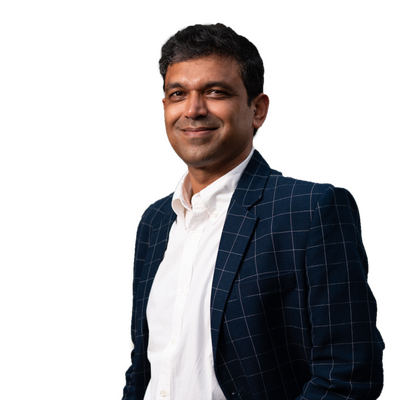

Karthik Reddy
Karthik Reddy is the Co-founder and Managing Partner at Blume Ventures, one of India’s leading early-stage venture funds with over US$900 million in AUM. Blume invests in emerging tech and tech-led innovation from Seed to Series A…- Current Section
- Co-founder & Partner
- Sector
- Media, Entertainment & Gaming, ConsumerTech