
[Weekday Ep.] Powering India’s Sovereign AI: The E2E Blueprint | S4 E3 | Destiny Avenged | Podcast

- Episode
- Episode 3 [Weekday Ep.]
- Published
- Reading Time
- 19 minutes
“AI is going to be the new electricity of the world, and we’re building its power grid.” says Srishti Baweja, co-founder of E2E Networks.
From a small hosting provider that started with a ₹30,000 check to becoming India’s AI infrastructure pioneer valued at ₹6,500 Cr, E2E Networks’ (Fund I vintage) journey is a masterclass in thinking 10 years ahead of it’s competition.
In the third episode of season 4 of the Blume Podcast, Karthik Reddy sat down with Tarun and Srishti to unpack E2E’s remarkable transformation. While most investors overlooked this bootstrapped hosting company, Blume saw something different — a founding team with extraordinary conviction. As E2E’s first and only institutional investor, we witnessed their evolution from a scrappy startup to a vital force in India’s AI revolution.
The story of E2E begins with a simple observation: in 2009, while Silicon Valley startups could spin up servers for $100 with no questions asked, Indian companies faced a different reality. Local hosting was expensive, trapped behind long contracts, and accessible only to the well-funded.
Tarun saw this gap and launched E2E with a revolutionary premise: contractless compute in India, where anyone could pay for what they used without lengthy commitments.
Their first customer, an ex-colleague, took a leap of faith with a ₹30,000 check, demanding an India-based server. This small beginning sparked a word-of-mouth revolution in India’s startup ecosystem. Without a sales team, E2E grew 100% year-over-year, serving digital pioneers from CarDekho to Flipkart.
But it was a quiet pivot in 2016 that would prove transformative: investing in cloud GPUs. While initially a moonshot among many experiments, this decision positioned E2E perfectly for the AI revolution.
We know you have a busy day, so we’ve compressed our 1hr+ conversation with Tarun and Srishti into a crisp 20-minute T20-style ‘Weekday’ episode – pure insights, all turning points, zero fluff. Perfect for your lunch break or that drive back from the office.
(Don’t worry, the full director’s cut drops Friday for those who want the complete conversation.)
In this 20-min weekday cut:
- The ₹30,000 first customer and why contractless, low-latency infra mattered
- The GPU pivot: why they did it early and what it unlocks for AI teams
- Building locally: data residency, compute availability, and AI sovereignty in practice
- Culture as a moat: reliability, frugality, and clear roles as cofounders
Season Partners: IDFC FIRST Bank and Ultrahuman (Blume portco).
Transcript
[00:00:00] Tarun Dua: We invented cloud before cloud was a word in the sense that, like everything was uniform.
[00:00:04] Srishti Baweja: The IPO is never an exit for the founders.
[00:00:05] Karthik Reddy: Yeah, just continuation of the journey.
[00:00:07] Srishti Baweja: Exactly. It’s a trust vote from the public and you have to build on that.
[00:00:10] Tarun Dua: The big guys, who are well-funded, can afford to have local hosting. The small guys can’t afford that. We thought it was our entry point into the market, where you could do dedicated servers and VPN servers and any kind of contractless compute in India.
The very first customer showed faith in India and in us, and cut a check for ₹30,000 and said that, okay, by this date, I need a server in India or you can return the check.
[00:00:35] Karthik Reddy: As the business changed with this GPU focus and what AI is doing, what does E2E today look like?
[00:00:40] Tarun Dua: We are building a lot of software with a view that like a lot of people will eventually be able to use the software as the sovereign AI and sovereignty for the cloud takes off.
[00:00:50] Srishti Baweja: Yeah. I think AI is going to be the new electricity of the world, and as E2E, we see ourselves as being the power grid of that.
[00:00:56] Karthik Reddy: What’s one AI trend you think is overhyped?
So, if you go a step back and say, who is Tarun and of course, I’d love to ask Srishti as well, your better half, but who’s Tarun Dua that he actually came up with this idea that this was all a market, this was a need. So, walk us through a little bit of your background on why this problem even arose in your head and why did you think E2E was a solution at that point?
[00:01:29] Tarun Dua: So, a part of my journey was spent in the US. I think I might have spent 6 – 7 months working in the valley through an outsourcing company. And over there, I went to a Linux user group meeting where a small startup, which used to call itself Flickr of videos, was presenting. That turned out to be YouTube.
Now, nobody knows Flickr. But at that time, YouTube called itself like Flickr of videos.
[00:01:57] Karthik Reddy: And Flickr was acquired by Yahoo.
[00:01:59] Tarun Dua: Flickr was acquired by Yahoo. So, YouTube was kind of like happened because there was enough compute available in the Valley. There were enough providers in US who could give you like a dedicated server for a $100. No questions asked. You could take it, return it.
It was completely contractless compared to India where we saw that only biggies could afford to have like local servers and local content and faster delivery through, like having a lower latency to their audience. So, what I thought was that that’s a gap in the market.
The big guys who are well-funded can afford to have local hosting. The small guys can’t afford that. And again, in the valley, the culture was that like small guys will become big guys. So, that we thought was our entry point into the market where you could do dedicated servers and VPN servers and any kind of contractless compute in India. So, we started doing that.
Our original idea was that like host the servers in Singapore. Then, the very first customer showed faith in India and in us and cut a check for ₹30,000 and said that, okay, by this date, I need a server in India or you can return the check.
[00:03:23] Karthik Reddy: Who was the first customer?
[00:03:24] Tarun Dua: So, that was an ex-colleague.
[00:03:26] Karthik Reddy: Okay.
[00:03:27] Tarun Dua: They continued to remain a customer for a very, very long time. We still speak sometimes. So, the customer number one, like CRN number one, remained there for, I think, like 15 – 16 years of our existence.
[00:03:38] Karthik Reddy: Lovely.
[00:03:40] Tarun Dua: So, that was that. Basically, we started off. So, we had a couple of friends who were doing molarity, and they had cracked some deal with the local data center. So, we rode on top of their deal that, okay, you’re already selling to these guys. And we negotiated a small contract where our costs were far in excess of the revenue that we were going to get from that ₹30,000 check on a monthly basis. So, we were in business.
Initially, we had a very small static website. We just listed the prices and had a contact number, like, call us and practically, for most part, it was me racking and stacking the servers in the DC and doing the customer support and also answering the sales calls. So, for a while, it was like that until kind of like we…
So, there was somebody, who had a lot of servers in the US. They were looking for some other Tarun. So, it was a wrong number. This person called me, and I was like, no, I’m not that Tarun. Then, I reversed looked up on Google. Okay, who is this person? Okay, this person has a lot of web workloads, runs a lot of websites, has a team. So, I was like, called him back the next day morning.
And I was like, yeah, I wanted to talk to you. You spoke to me yesterday, but some other context. So, this guy was like a true startup guy. He said that, yeah, so come back tomorrow to meet me at our office and same day, he cut a check. So, he was like, okay, I’ll take your servers as long as you can deliver 99% uptime. We’ll do business with you.
And that became a customer that brought in their competitors. So, a competitor of theirs called and asked me why are their websites so fast? I was like, okay, one is we are hardworking people. We have fine-tuned their servers. We know Linux. We know Webscale. We know load balancing and all that stuff.
The other part is the servers are in India. So, they were like, okay, let us also try out. And that competitor again turned out to be someone who was very well-known in the startup community.
[00:05:49] Karthik Reddy: Why aren’t you naming anyone? You can name people.
[00:05:52] Tarun Dua: So, this was Amit Jain from CarDekho?
[00:05:55] Karthik Reddy: Yeah. Okay.
[00:05:56] Tarun Dua: Then, they became kind of like a inflection customer for us.
[00:06:00] Karthik Reddy: Yeah.
[00:06:01] Tarun Dua: We again got called by Flipkart because CarDekho was our customer. And I think for the next 6 – 7 years, we never had any salespeople. Every year, we grew more than a 100%, and mostly, it was word of mouth in the startup and digital native space. For us, it was like, okay, let’s do a small series A round.
[00:06:20] Karthik Reddy: Yeah. But which wasn’t happening, right? That’s why we went this far.
[00:06:23] Tarun Dua: Basically, we treated it as an alternative to a series A round.
[00:06:27] Karthik Reddy: Correct.
[00:06:28] Tarun Dua: So, long after that, I think many investors told me that people are threatening us that, okay, we are going to do a SME IPO rather than take their round.
[00:06:37] Karthik Reddy: Yeah.
[00:06:38] Tarun Dua: So, I think, we set that trend.
[00:06:39] Karthik Reddy: That’s awesome. Srishti, you were saying something.
[00:06:41] Srishti Baweja: I was saying that even the merchant banker, it was his first IPO. Obviously, it was our first. And then, we started in November, and we did the IPO in May.
[00:06:50] Karthik Reddy: That’s right.
[00:06:50] Srishti Baweja: The whole lot of, endless amount of documentation was required.
[00:06:54] Tarun Dua: Yeah, mostly, I would’ve given up. It was all Srishti.
[00:06:56] Srishti Baweja: At one point, Tarun said let’s not do it. It’s like too hard.
[00:06:59] Karthik Reddy: I think he said it every week as far as I recall. That’s why I said it was a very reluctant IPO CEO.
And then, from your lenses what changed? As a CFO, of course, you were reporting to us, but there was no other investor on the cap table. Now, you’re a public company CEO for what it’s worth.
[00:07:19] Srishti Baweja: See, for SME IPO, not much…
[00:07:22] Karthik Reddy: It’s more liberal.
[00:07:22] Srishti Baweja: It’s more liberal.
[00:07:22] Karthik Reddy: Six months reporting…
[00:07:24] Srishti Baweja: Six months numbers reporting. And not much pressure from the… or the quarterly pressure is not there.
[00:07:29] Karthik Reddy: Yeah.
[00:07:30] Srishti Baweja: But once you move to the main board, which we did in 2022, quarter-on-quarter pressure of the numbers, endless investor calls. Quarter-on-quarter, like why has your revenue not increased? You said that in the earnings call, what happened? So, that pressure has always been there.
[00:07:44] Karthik Reddy: And that’s continued even today.
[00:07:45] Srishti Baweja: That’s continued even today.
[00:07:48] Karthik Reddy: Yeah, I know. I get calls even though Blume is not an investor. I said I’m not in the picture, why are you asking me? But even I get calls on E2E’s health. But tell me… crazy, interesting IPO. If I recall, what was it like?
[00:08:08] Srishti Baweja: 70 times it was oversubscribed
[00:08:09] Karthik Reddy: Yeah. But the issue was about.
[00:08:11] Srishti Baweja: Issue was 21.99.
[00:08:14] Tarun Dua: Yeah.
[00:08:14] Karthik Reddy: That included our secondary?
[00:08:15] Tarun Dua: That included the secondary. So, the primary capital post the issue.
[00:08:19] Karthik Reddy: So, I want to reveal some secrets to the audience today.
[00:08:21] Tarun Dua: What was I think like 14 crore or something.
[00:08:22] Srishti Baweja: 14 Cr we got in the bank account.
[00:08:23] Karthik Reddy: Yeah. So, firstly, it was a 21 crore plus IPO. Tarun made some of us sell our shares. Not in a forced way, but like in a kind gentle way. And the hack was, Tarun wanted to stay majority owner. Proper North Indian baniya founder. I want to be the owner, 51%. So, basically, he did the math and said, if you sell this much, I can continue to be the owner.
[00:08:48] Srishti Baweja: One-third, yes.
[00:08:49] Karthik Reddy: But I think the bankers obviously went fairly aggressive on the pricing, which, I think, upset you. It upsets all founders. It’s like why is it so aggressive? I could have left a lot more money on the table. And that’s how I think it felt, right?
[00:09:03] Srishti Baweja: Exactly.
[00:09:04] Karthik Reddy: What is the indicator for that? You were saying it Srishti, but I cut you. How much were you oversubscribed by?
[00:09:09] Srishti Baweja: We were oversubscribed by 70 times.
[00:09:10] Karthik Reddy: 70 times. So, 70 into that 21. We’re talking about 1500 crores of demand for that 21 crores, and of course, we can’t get a benefit of that. And the guys who got allocated made out like bandits. How much did the stock run up on?
[00:09:24] Srishti Baweja: It was stubby. The IPO price was 57. I think it went up to 85 on the first day.
[00:09:29] Karthik Reddy: On the first day. Massive pop. And I got innumerable calls for the next month or two. How do we take a company’s SMB IPO? I said, most of them won’t qualify. They either don’t make money or the SMB market is so harsh that it won’t value your fancy valuations.
So, off the bat, this is a non-starter for most companies which most people couldn’t make a sense of. And the people who want to take the lessons did, right? Like Infollion later took a leaf out of your page. Another Fund I company.
[00:10:00] Srishti Baweja: Yes.
[00:10:01] Karthik Reddy: And I think Gaurav said I want to learn and became a board member.
[00:10:05] Tarun Dua: Right.
[00:10:06] Karthik Reddy: Learned and then he took it SMB IPO 4 – 5 years later. But then, as you said, did it change the company’s culture in terms of saying, “Oh, we are flush with money,” or is it just the setback from the customer who went away?
[00:10:21] Tarun Dua: I think both things went hand in hand.
[00:10:23] Karthik Reddy: Okay.
[00:10:23] Tarun Dua: We were spending a lot more money than we were used to. So, there was, I think, some letting go of, okay, now we can do this. Now we can do that. And the second part is then we got hit with revenue loss and we were like, yeah, we’ll make it up. But then eventually, it became like a very slow process.
[00:10:43] Srishti Baweja: The frugality runs in our DNA. So, till date, I’ve never traveled business class. I can’t get myself to pay three times the amount of money.
[00:10:51] Tarun Dua: I sometimes cheaply get the free upgrades because sometimes the airline gives you coupons, but that’s about it.
[00:10:58] Karthik Reddy: No, it shows in the culture of the firm. And what advice would you have from that experience on younger founders who think, first, like you are wary of going public. And, B, do you think it’s a better mechanism sometimes than chasing private money from your experience?
[00:11:20] Tarun Dua: I would say that there is a clean path of going public and doing everything clinically and cleanly. I think that is a recommended path. Don’t fall into the trap of making people happy.
So, whether they’re happy or unhappy, ultimately, it is the founder or the entrepreneur who has to run the business for what is best for the business. Not for the optics. So, I think that’s the main advice I have for people wanting to go public that don’t play optics. Work on your business as if you were private.
[00:12:03] Srishti Baweja: I would like to add on.
[00:12:04] Karthik Reddy: Yes, of course, please.
[00:12:05] Srishti Baweja: So, the IPO is never an exit for the founders.
[00:12:08] Karthik Reddy: Yeah. Just a continuation of the journey.
[00:12:09] Srishti Baweja: Exactly. It’s a trust vote from the public and you have to build on that.
[00:12:14] Tarun Dua: And somewhere or the other, the infrastructure in India at first couple of years that was not really great. I think by 2015 – 16, things started improving in terms of infra. I think 14 onwards, we started to get great up times and everything.
Before that, it used to be that, okay, tonight what has happened, again, I would leave her alone at house and drive to the data center and see okay, what happened?
[00:12:40] Karthik Reddy: I think that’s something that we’ve consistently seen about Tarun Dua, right? You’re obsessed about uptime, operational efficiency, getting into the tech, getting into the guts of the machine, obsessed about like customer reliability.
How did you manage to build that culture? How did you balance that out with, being a CEO in that sense which is far more broad-based, even as someone like me has grown up in the firm, and I find it very difficult to balance all of this?
[00:13:13] Tarun Dua: I think initial few years, because we had no cash and there was no visibility of cash coming from anywhere either as debt or equity, so we were very obsessed with managing the costs.
So, managing the cost meant that we were literally designing our own server, although we were not physically assembling them, but it was usually our server design. We would pick the processor. We would say that, okay, we are going to scale up this processor alone. So, don’t have multitude of things.
Any customer who came to us with a custom requirement, we would say, no. So, we were like, okay, we have built these servers. We can fit the solution for you in these servers only, but we are not going to buy like any hardware, which is non-standard. So, everything in software was open source or written by us.
Everything on servers was designed by us in a way that you could do a… So, we invented cloud before cloud was a word in the sense that everything was uniform. We treated our servers like cattle, not like individual named servers. And I think that just naturally happened because of the constraints.
So, I think constraints play a big role in what shapes you.
[00:14:20] Karthik Reddy: I think we sold at somewhere close to 250 crore market cap and you have all of it, most of it. And you went to 9,000 at one point. And now, I think you’re settled somewhere between 4,000−5,000. What happened? I don’t think you expected it. I don’t think we expected it.
[00:14:37] Tarun Dua: Yeah. Nobody, expected it.
[00:14:39] Karthik Reddy: So, take that in two parts. Both of you can speak from both your perspectives.
[00:14:44] Tarun Dua: Sure.
[00:14:44] Karthik Reddy: What did you change between 19 and 21 that this happened? I know you alluded to GPUs, etc. Was the dramatic liftoff from Sam Altman’s announcement or unveiling of Open AI?
[00:14:56] Tarun Dua: I think that was the second inflection point. The first inflection point was COVID, of course.
[00:15:01] Karthik Reddy: So, go through those two points for me.
[00:15:03] Tarun Dua: Sure.
[00:15:03] Karthik Reddy: And then, we will cover the stock journey, which is…
[00:15:05] Tarun Dua: So, I think will come very early. GPU journey started for us in I think 2016 or 2017.
[00:15:09] Karthik Reddy: Why don’t you give a 2‑minute ready reckoner for the audience on what does this GPU world mean?
[00:15:14] Tarun Dua: Sure.
[00:15:14] Karthik Reddy: And what does the context of it in what we are seeing today?
[00:15:17] Tarun Dua: Sure.
[00:15:17] Karthik Reddy: Where AI is what most people speak about day in and day out.
[00:15:20] Tarun Dua: I think I’ll speak to the old hats.
[00:15:23] Karthik Reddy: Yeah, explain it to my mother.
[00:15:26] Tarun Dua: The people who read Slashdot. So, I think 20 – 25 years back, people on Slashdot were raving about how a GPU can either draw triangles or rectangles, I don’t remember which, and that involves doing a lot of parallel math calculations. And there were people who had started using GPUs for doing maths in parallel computations. I think that was the early trend of people catching onto desktop GPUs, using those very powerful processors to do a lot of things in parallel.
So, I think that kept on being there and to Nvidia’s credit, they caught onto to that trend, owned that trend and fed into that by giving the libraries to those people who had been doing those kind of experiments. And I think that has stood them in good stead.
[00:16:21] Karthik Reddy: Yeah.
[00:16:22] Tarun Dua: And for us, of course, there were people who were doing analytics, people who wanted to do their analytics stuff on GPUs, and we knew GPUs as the add-on for a desktop machine. They were like, okay, shall we put into the server?
And I think there was a lot of pain in terms of how to get those GPUs virtualized. And we succeeded in cracking those kind of problems. And we were making some amount of revenue. So, we had a concept called moonshots where we said that, okay, we are going to do a WordPress as a service. We are going to do something on the GPUs.
[00:17:01] Karthik Reddy: I remember.
[00:17:02] Tarun Dua: We were also talking about like how to run Tally on Linux.
[00:17:06] Karthik Reddy: Yes.
[00:17:06] Tarun Dua: To avoid the licensing costs. We had a very frugal mindset and we thought that, okay…
[00:17:10] Karthik Reddy: And the customers will also enjoy that.
[00:17:11] Tarun Dua: Customers will also enjoy the cost cutting over there. Of course, none of those moonshots worked.
Now for GPU, it was actually one of the Blume startups who came to us and said that look, this cost X amount on a hyperscaler. And we feel that this is too expensive. We were like, yeah, this looks expensive because a typical GPU costs only like less than a $1000. So, nobody should be charging you $2,000 for a GPU per month.
And that kind of opened our eyes that, okay, people are selling GPU. And we are not even aware of it. This is a moonshot we are missing. So, we said, okay, let’s go and invest some money into the GPUs. We bought I think 20 of them. These were enterprise GPUs. Each one of them costed about 6 lakhs or 7 lakhs.
[00:17:58] Karthik Reddy: Oh, wow!
[00:17:59] Tarun Dua: And the desktop GPUs used to cost like, I think ₹50,000 – 60,000.
[00:18:03] Karthik Reddy: Okay.
[00:18:04] Tarun Dua: And then, suddenly we had people from Nvidia knocking our doors and like who are these guys who are buying these 20 GPUs? Nobody has bought like that many enterprise GPUs in one shot. So, I think the sales guy and the distributor who sold those became a rockstar over there. And the Nvidia team was like, okay, let us figure out E2E.
And to their credit, I think they work with us. We did a lot of things together. Not many successful, but I think the inflection came finally at the time of COVID. Next couple of years were a struggle on the GPU division. It was not a separate division or anything, but there was struggle in terms of how to fill those GPUs.
But then, we learned a lot because that was some expensive hardware we bought. So, we had to monetize it. So, with that respect that if an investment has to be made, it has to be made back. We had to learn GPUs because of that one, what do you call, the flying high kind of a decision that like Srishti said Tarun goes and flies high in the sky.
He builds castles in the sky and then does something, and then, the whole team has to figure out, okay, how to make money out of this.
[00:19:18] Karthik Reddy: How has that journey been Srishti? I can’t even imagine how it must be to see your stock hit upper circuit for like months at end.
[00:19:27] Srishti Baweja: Just to give some perspectives. So, a GPU has 17,000 core. And a typical CPU is 300 to 400 core. So, that is the processing capacity.
[00:19:34] Tarun Dua: Yeah. Two of the CPUs have 300 – 400.
[00:19:35] Srishti Baweja: That is the processing capacity of GPU as compared to the CPU.
[00:19:38] Karthik Reddy: Correct.
[00:19:39] Srishti Baweja: So, for my personal part, I do not check these stock price daily. I check it like once or twice a week.
[00:19:45] Karthik Reddy: Yeah.
[00:19:45] Srishti Baweja: So, we keep on getting calls like price is increasing. What has happened?
[00:19:50] Karthik Reddy: Yeah. You’re still answerable as CFO at that point at least?
[00:19:53] Srishti Baweja: The standard answer, we can’t talk about it.
[00:19:55] Karthik Reddy: Okay.
[00:19:55] Srishti Baweja: We have nothing to say on that. But that was like, really, really, overwhelming and surreal at the same time.
[00:20:03] Karthik Reddy: Yeah.
[00:20:04] Srishti Baweja: That it went to 5,200−5,300.
[00:20:06] Karthik Reddy: Yeah.
[00:20:07] Srishti Baweja: And it was like… what just happened?
[00:20:09] Karthik Reddy: Yeah, no. In fact, it is funny because I think Tarun is on that chat. We still have a Blume Fund I chat and I had said something like, someday soon when your stock was going up, that Tarun will become our first publicly listed billion-dollar company.
[00:20:24] Srishti Baweja: Yes.
[00:20:25] Karthik Reddy: And it just didn’t stop. It went all the way and shot past the mark. I said, it’s already here. But I’m thinking also at a personal level, I know you guys don’t go to work every day and say how much wealth have we created, etc. but how did this change employee morale and people’s self-worth or for all those years of hard work, did they feel like their destiny was also avenged in that?
[00:20:49] Srishti Baweja: Exactly. So, for the ESOPs, it’s a different volume altogether.
[00:20:54] Karthik Reddy: Yeah.
[00:20:54] Srishti Baweja: If you’re listed. People in our company, they have made upwards of, if I can say that number, upwards of hundreds…
[00:21:01] Tarun Dua: Multiple millionaires and multimillionaires.
[00:21:04] Karthik Reddy: Fantastic. No, it’s very fulfilling for you to see that happen.
[00:21:08] Srishti Baweja: It has helped us attract talent, retain talent, the ESOP, part. It has been wonderful for the people.
[00:21:13] Karthik Reddy: And what is the discussion at home when you saw your wealth grow 5% every day.
[00:21:20] Srishti Baweja: The only discussion…
[00:21:21] Tarun Dua: I think at one point of time, we stopped looking at it.
[00:21:24] Srishti Baweja: The only discussion I think, I keep on telling Tarun, is like don’t tell Sasha. She has to figure out her own part. Don’t tell, this is the paper money.
[00:21:34] Karthik Reddy: Yeah.
[00:21:34] Srishti Baweja: You don’t have to tell her how much money do we… She keeps on asking us and very conservative.
[00:21:41] Speaker 1: That’s a wrap on this weekday episode of The Blume Podcast. We’ve handpicked these moments to give you the most valuable insights in the least amount of time. The full weekend episode drops soon on YouTube and your favorite podcast app.
So, stay tuned.
[00:21:55] Karthik Reddy: Our season partner, Ultrahuman, is back for a second time. I’m biased as the seed investor here, but their immensely loved brand is making waves globally. Ultrahuman is a health tech pioneer, redefining how we track and improve our health. Their sleek titanium ring AIR and its new rare-metal cousins accurately tracks sleep, movement and recovery to deliver real-time health insights and personalized nudges.
Ultrahuman is creating a unique health ecosystem built on top of the wearable data. It just launched Blood Vision in the US in addition to India, a blood testing service that offers a panel of over a 100 longevity and chronic disease biomarkers with the convenience of an at-home test.
They’re also launching Ultrahuman home globally for environment aware analysis and sleep insights. Whatever your health fix, go sign up and experience being truly Ultrahuman.
Our season partner, IDFC FIRST Bank has earned its reputation as one of India’s most startup friendly banks through its FIRST Wings program, which provides dedicated mentorship and tailored financial solutions to help early stage ventures scale effectively.
Coincidentally, many of Blume’s portfolio companies, much later stage, also partner with IDFC FIRST Bank for their banking and financial needs. If you’re well-funded and scaling, they are great lending and banking partners, and our portfolio companies would attest to that.
Moderator
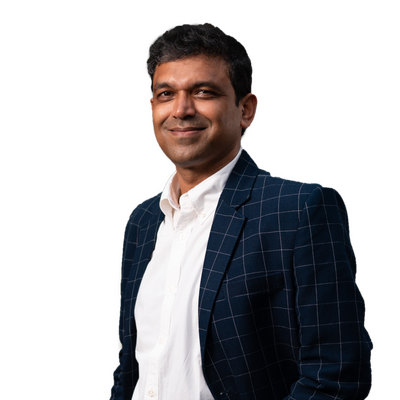

Karthik Reddy
Karthik Reddy is the Co-founder and Managing Partner at Blume Ventures, one of India’s leading early-stage venture funds with over US$900 million in AUM. Blume invests in emerging tech and tech-led innovation from Seed to Series A…- Current Section
- Co-founder & Partner
- Sector
- Media, Entertainment & Gaming, ConsumerTech