
S3 E04 | Amitabh Kant's Vision for India's Transformation: From Incredible India to Invincible India

- Episode
- 04
- Published
- Reading Time
- 28 minutes
Guest: Amitabh Kant, Former CEO of NITI Aayog and G20 Sherpa
Host: Karthik Reddy, Managing Partner & Co-founder of Blume Ventures
This episode offers invaluable insights into India’s economic transformation and its aspirations to become a global powerhouse.
Amitabh Kant shares his diverse experiences from grassroots development in Kerala to high-level diplomatic roles, highlighting his contributions to India’s progress.
His perspectives on entrepreneurship, digital infrastructure, and global competitiveness provide inspiration and practical advice for entrepreneurs aiming to build world-class businesses from India.
Key Topics:
• Amitabh Kant’s early career in Kerala and cultural adaptation
• Transformation of Kerala’s tourism through the “God’s Own Country” campaign
• Launch and impact of the Incredible India campaign
• Improving India’s ease of doing business ranking
• Success of the Startup India initiative and its impact on entrepreneurship
• Role of Digital Public Infrastructure (DPI) in fostering innovation
• Vision for India as a developed nation by 2047 (Viksit Bharat)
• Importance of global market penetration for India’s economic growth
• Leadership insights from G20 negotiations and team building
• Navigating cross-border cultural differences in international diplomacy
• Key qualities sought in team members and delegation strategies
• Advice for young entrepreneurs on risk-taking and thinking big
• Importance of physical exercise and work-life balance
• Future challenges and opportunities for India’s global competitiveness
Our special thanks to our annual partner IDFC First Bank and our sponsor Ultrahuman for their support in the making of the Blume Podcast S3.
[00:00:00] Amitabh Kant: India was 145th in the World Bank’s ‘Ease of doing business’. And I think we were very terrible. So, it was a lot of effort to work with about 40 to 45 ministries, work with the state governments to crack that. And India jumped up in three years time, 79 positions in the World Bank ease of doing business.
Karthik Reddy: Yes, sir, amazing.
Amitabh Kant: India really improved. Imagine if cement factories and if industrial plants had come up on the backwaters on the sea of Kerala. Kerala would have been ruined.
Karthik Reddy: I remember 20 years ago, it became like everyone’s “the place” to go if they were traveling into India.
Amitabh Kant: Yeah, Kerala is not a product of Five Star hotels. It’s a product of boutique resorts. It’s a product of local entrepreneurship. It’s a product of local art, local culture, local cuisine.
India has built up this very unique digital public infrastructure, which is open source, open API. Last year, we did about 130 billion transactions. So, 46% of the fast payments in the world. China is next with just, 18%.
Karthik Reddy: Today, we are honored to host a distinguished leader whose pioneering work has put India on the global map, truly embodying our theme, Winning Beyond Boundaries. Our guest is none other than Mr. Amitabh Kant, a name synonymous with innovation and transformative governance in India. Mr. Kant is the architect behind the iconic Incredible India campaign, which redefined India’s image as a premier global tourism destination.
He also anchored the successful God’s Own Country campaign in Kerala and the Atithi Devo Bhava initiative. As the former CEO of NITI Aayog, Mr. Kanth has been instrumental in driving groundbreaking initiatives. Under his leadership, NITI Aayog played a pivotal role in launching transformative programs, such as Make in India, Startup India, and the Aspirational Districts Programme.
Most recently, Mr. Kanth was India’s G20 Sherpa, navigating complex global discussions and forging consensus on critical issues. During India’s G20 presidency, he led over 220 meetings across the country, transforming the G20 into a people’s initiative and making the presidency a resounding success.
Mr. Kant, you’ve been a champion of all of what startups look forward to in India, which is government support, policy support. So, you were an obvious guest for us in this season.
[00:02:31.12] Amitabh Kant: Thank you.
[00:02:31.28] Karthik Reddy: And also this whole theme of winning beyond boundaries is just something you embody. So once again, welcome to the Blume Podcast.
[00:02:39.24] Amitabh Kant: Thank you.
[00:02:41.16] Karthik Reddy: I think what usually is never spoken about too much is the backstories behind our guests. So, I would love to go back a little and delve into the history of what shaped Mr. Amitabh Kant in his early days. So, from what our research says, you were a Delhi boy, studied here, post grad, and then, of course, cracked the IAS.
And how did Kerala Cadre happen, and how do you navigate the cultural differences? I’m a South boy who came to Roorkee for the first time at the age of 17, and I knew how challenging it was to acclimatize myself to UP, and so you did the opposite.
[00:03:20] Amitabh Kant: I sat for the exam. I got in and then I got the Kerala Cadre and Kerala was really the backwaters and beyond.
It was tough. And those were the days when the trade unions were very strong and industries had been driven out and so on. But I landed up in Kerala in my first, posting as Sub Collector, was in a place called Thalassery.
[00:03:50] Karthik Reddy: Thalassery, yes.
[00:03:51] Amitabh Kant: Thalassery. It was in the Malabar region of Kerala, very next to Wayanad, which is very much in news right now. I spent two years there, and I fell in love with the region. It was a fascinating area and I fell in love because Kerala had very high rates of literacy, it had great social advancement, health standards were high, people were very literate, people were very aware and everybody knew their rights.
So, it was dealing with everybody at a personal level and the system of governance was good and I really enjoyed myself. I really had a collector who made me speak in Malayalam. So, throughout my stay in Kerala, I never spoke in Hindi or English. I spoke in the local language and I gave all my speeches in Malayalam.
And that’s how I perfected my skills in Malayalam language. And after Thalassery, I was posted in the fisheries sector. My job was to transform the lives of traditional fishermen. Fishermen, they used to get only about 18% of the market price of the fish they used to catch.
And it used to go through about almost 15 different middlemen.
[00:05:15.21] Karthik Reddy: 15?
[00:05:16.11] Amitabh Kant: 15 different middlemen. So, I introduced beach-level auctions. I worked for almost four years in that sector with traditional fishermen and fisherwomen. So, I got new technology, which is fiberglass crafts for them. I got new outboard motors, and they could go much further into the sea.
And I got new fishing nets, which are known as the Disco nets and their catch went up. And because we introduced beach-level auctions, they were able to get a much higher earnings. And then, we had to open their bank accounts, and opening a bank account was a real nightmare.
[00:05:55] Karthik Reddy: Those days it was nightmare.
[00:05:56] Amitabh Kant: Chasing, know your customer, chasing bank managers used to take 6, 7 months.
But a lot of hard work. But it gave me an immense amount of job satisfaction. And I learned a lot from forming self-help groups of traditional fishermen. And for fisherwomen, we introduced buses for taking fisherwomen to city areas. New buses so that they could keep their baskets at the back. In the normal buses, they were not being allowed. So, they could keep their baskets at the back and sit in front. And today, Trivandrum ihas almost 20 odd buses for fishermenwomen and it was the most satisfying period of my life.
[00:06:40] Karthik Reddy: Sir, in this age, if you had done that, somebody would have given you a 10 million term sheet. Had asked you to leave the IAS and start the…
[00:06:48] Amitabh Kant: No, it was greatly satisfying because you could transform the lives of fishermen and fisherwomen.
[00:06:54] Karthik Reddy: It’s fascinating that you created a fish marketplace back then and built all the elements of it.
And, of course, your Kerala stint is known a lot for coining and championing, amazing phrase called God’s Own Country, which became like almost a global sort of brand campaign.
But even in that small way, I think, it put India on the tourism map and sold brand India in a very unique way.
So from fish to selling God’s own country, how did that transition happened?
[00:07:24] Amitabh Kant: Later I was a District Collector in Calicut, which is the place where Vasco de Gama had landed and discovered
[00:07:32.14] Karthik Reddy: India.
[00:07:33.21] Amitabh Kant: India, and I did some very interesting work in terms of, rejuvenating the city of Calicut, widening its roads.
The heart of the city had a lot of encroachment, which I removed and I created a public library, started a Malabar Mahotsavam. After 3 to 3.5 years, because I removed over 450 encroachments, I also ran into major challenges. The government, I was, persona non grata with the then government for almost 10 months and I had no posting.
So, as a punishment posting, I was posted as secretary of tourism. Nobody had heard of Kerala as a tourism destination at that point. Everyone used to go to Kashmir or they used to go to Rajasthan, but nobody used to travel to Kerala. I thought I’ll use this punishment posting for transforming Kerala tourism.
The only product then known was Kovalam Beach and Kovalam Beach used to get low-value tourists from UK, charter flights, $20-a-night destination. It was being encroached, local culture was being invaded. And therefore I closed on Kovalam and I started new products. And I went back to the roots of Kerala.
I brought back the traditional, Kerala architecture, the Nalukettu houses Nalchitram houses. I opened up new destinations like the backwater, brought back Ayurveda center stage, not as a massage, but as a therapy to be utilized over 21 days. Aand I’ve been back to traditional Kerala cultural arts, the Koodiyattam and the Kathakali and Mohiniyattam.
And we went back to traditional Kerala martial art. That is Kalaripayattu and revived it. And we brought back the traditional Kerala cuisine, which is very popular now, but nobody had heard of it then.
So, actually, we differentiated Kerala from the rest of the world by going back to its traditional art, culture, martial art, backwaters, Ayurveda, and differentiated it totally.
National Geographic Traveler, that year, after 3 years, did a feature on the ten exotic paradises of the world. And they rated Kerala as a paradise found in the world. Bill McKibben, who’d written that piece, said that it’s a paradise. It’s an exotic paradise, not merely because of its natural beauty, but it’s the only destination in the world which has a physical quality of life index. And the human development index is more advanced than the Western countries.
And when you combine its high education and health standards with the natural beauty, Ayurveda, backwaters, art, and culture, it’s a unique paradise in the world. And that’s how Kerala was put in the world. And we worked and it was a product of private public partnership.
It was a product of a lot of young entrepreneurship.
[00:10:54] Karthik Reddy: I’ve heard that. So what do you mean by, like, what worked on that private-public partnership? And I know today we champion it a lot, but was it one of the earliest great examples of how private-public came together to make this successful?
[00:11:06] Amitabh Kant: So, before I did Kerala tourism, Mr. S. K. Misra had done tourism in Haryana. He had developed very nice government guest houses and so on and he named them after beautiful birds and then Mr. Misra did some remarkable work. Haryana was known as a tourism destination for a while. And then when he got it posted out, those guest houses were taken over by politicians and civil servants.
I felt very early that it’s not government, but private sector, which must drive it. And industry had already failed in Kerala. So, I sat down with the private sector and I said, I’m going to support you. And we supported them in a very big way in terms of land, in terms of providing credit through o the state industrial development corporation, through brand marketing.
But I said, the resorts must be established by the private sector. They must run and operate it. And they did some great work. And then I realized that actually the entrepreneurship of Kerala was top-class. The young entrepreneurs were better than anyone else. And I really felt that actually in a way it was good that Industry had not succeeded in Kerala because imagine if Ccement factories and if industrial plants had come up on the backwaters on the sea of Kerala, Kerala would have been ruined.
So, actually, the trade unions had saved Kerala for tourism purposes and tourism really flourished and tourism became a great job creator. The multiplier impact on jobs was enormous, huge, and for every direct job created, there were 12, 13 indirect jobs being created, and jobs were being created for women.
And one of the early studies I got done through TCS, Tata Consultancy Service, on a tourism satellite account, demonstrated that big jobs had been created. So, all political parties actually supported tourism in Kerala in a very big way and everybody has been a champion of tourism.
[00:13:15] Karthik Reddy: And it went so fast, I think, it transformed so rapidly. I remember 20 years ago, it became like everyone’s “the place” to go if they were traveling in to India and the transformation has been fascinating and obviously, this set like an incredible benchmark for every other state.
[00:13:33] Amitabh Kant: Because Kerala is not a product of Five Star hotels. It’s a product of boutique resorts. It’s a product of local entrepreneurship. It’s a product of local art, local culture, local cuisine, and therefore.
[00:13:45] Karthik Reddy: Very difficult to replicate anywhere else in this country, I think. And, rumor has it that you obviously spotted for this, stroke of genius and imported into Delhi back, under Mr. Vajpayee’s leadership to run Incredible India. And that must have been even more daunting or challenging. Was that the comeback to this part of the world or?
[00:14:05] Amitabh Kant: So, what happened was actually one day I got a call. I was a young officer and I got a call from the Principal Secretary to the Prime Minister.
And he said that the Prime Minister wants to have a holiday. It’s a plaine holiday and he will not interact with politicians, state politicians and the rest of it and you will organize the trip. You will take care. You will do everything.
So, I hosted Mr. Vajpayee in Kumarakom in the backwaters for 7 days. And, he wrote the Kumarakom Musings after that, and we were then able to show him the backwaters and we were able to show him Ayurveda. We were able to demonstrate all that Kerala tourism had done.
One evening, Mr. Brajesh Mishra, who was his Principal Secretary, told Mr.
Vajpayee on the dinner table that we should get this young officer to Delhi. So Mr. Vajpayee turned to me and asked me whether I had applied for Government of India. And I said, no sir, I have not applied.
So, he said, “nahi, bahut acha kiya, nahi apply kiya.” “Kyonki agar apply karte to Brajesh Mishra ji aapko, Women and Child Development main bhej denge.” “To aapp mat apply karo.”
To maine to apply nahi kiya. I applied, tourism ke badle Women and Child Development main bhej denge and everybody had a laugh and we forgot about it.
But I applied one and a half years later and I was to go to the finance ministry, but the civil services board selected me for finance ministry. But Mr. Briajesh Mishra called me up and he said, “Have you applied for Delhi?”
I said, yes. So he said, “You remember that conversation there, we’ll post you to tourism.” So, I said, Sir, but there are no vacancies there. So, actually, they posted the incumbent out and created a vacancy for me in tourism and that’s how I landed up in tourism ministry.
[00:15:51] Karthik Reddy: Fascinating.
[00:15:52] Amitabh Kant: What happened was the minute I landed within two months of that, month and a half of that, the twin tower blast happened. And then there was a war in Afghanistan. There was an attack on our parliament and there were several travel advisories against travel to the South Asian regions, particularly India. So, our hotels, which were very few in number, their occupancy came down to 10% to 15%.
And all hotels were saying that we are not getting tourists. We are not getting tourists. Very few hotels, but they were just not getting tourists. So they said, we need to do something. So, I went to tour operators, travel agents, and those days tours used to sell by creating tour packages and brochures used to be made. And then those packages were sold by the tour operators and the tour operators said that whatever marketing, we said, we’ll buy many packages, this, that.
So, tour operator said there’s no consumer demand for India. Nobody will go to India, even if you give us advertising space. And at the peak of that crisis with no tour operators supporting us, we went straight to the consumer and we launched the Incredible India campaign, which was commercials
[00:17:12] Karthik Reddy: And it was like, I think, a New York Times front page. I was living there then.
[00:17:16] Amitabh Kant: Also, CNN, BBC, we did the Incredible India campaign. Indonesia, Malaysia, Thailand, all had withdrawn their campaigns. We launched it at the peak of that crisis. And at peak of that crisis, we did this. And we brought tourism back to India and that led to our hotels getting 100% occupancy. Demand just grew, blossomed, and that led to new airports being created in Hyderabad, Bangalore, Mumbai, Delhi, because it was a marketing-led strategy to drive growth.
[00:17:49] Karthik Reddy: And they say never waste a good crisis. And I think it’s a perfect example of that.
Shifting gears a little to your more recent avatars. I don’t know if you can pick between favorites, your CEO NITI Aayog, G20 Sherpa, it seems like a natural transition, but would love to see, what were the principal things that you wanted to achieve in each one of these, given that you’ve already put India on the map, but these are very different, kind of, diplomatic missions, if I may say so, especially as the G20 Sherpa. And Niti Aayog, of course, people wanted you to come up with new ideas to motivate the entrepreneurial spirit of this country.
So, if you can compare and contrast the two and see what you enjoyed about both and what was the most fulfilling part about both.
[00:18:40] Amitabh Kant: I was Secretary Department of Industrial Policy and Promotion. And then the Prime Minister in 2014, when he came in as the Prime Minister, the first presentation I made, he said, go after ease of doing business because India was 145th in the World Bank’s ease of doing business and I think we were very terrible.
We were full of procedures, rules, regulations and he made me in charge and I went after it. And at that time, everybody used to do long, long forms, long, long papers. Nothing was digital. So it was a lot of effort to work with about 40 to 45 ministries, work with the state governments to crack that.
And India jumped up in three years time 79 positions in the World Bank ease of doing business.
[00:19:31] Karthik Reddy: Yes, sir, amazing.
[00:19:32] Amitabh Kant: India really improved. But the other thing that we did was that we started ranking states and the first year we did this, Gujarat came number one. Next year, Andhra beat Gujarat and the third year Telangana beat Andhra and Gujarat.
But the good thing was that Jharkhand and Chhattisgarh, which were 24th and 25th, they have jumped to 4th and 5th position. So my belief was and rightly so, the Prime Minister said, make the states compete. If you make the states compete, they improve.
So that was a lot of hard work with the ministries to change mindsets, to change forms, to change procedures, which is very, tough in government. But a lot was achieved.
And, I think, after that we did the Make in India campaign. And that was the first time we got all the industries together. So not only ease of doing business, but before we did this, we opened up the FDI régime in India, which was very complex, which was case by case.
So, we did a lot of work going to the cabinet again and again. We opened up the régime. Today, 98% of the FDI comes through the automatic route. And we opened up the patent and trademark régime in a very big way. So those were very, very major structural reforms which were made in India at that point of time.
[00:20:51] Karthik Reddy: 2016, we see Startup India rolled out. I think it’s held on for 8 years now. Every year it gets bigger and better. What is the thinking behind Startup India?
[00:21:02] Amitabh Kant: So, Startup India, when we launched, there were just about 200 odd startups. Today, they’re 140,000 startups in India, and I think it’s the great entrepreneurial spirit.
But before we launched the startup, a lot of homework was done in terms of ensuring that we removed the government rules, regulation procedures, labor laws, etc., away from startups. We brought incubators. We brought the whole ecosystem of Atal Innovation Mission, etc.
[00:21:33] Karthik Reddy: Yeah, was there.
[00:21:34] Amitabh Kant: We opened up tinkering labs in schools. All that we did, and that enabled us to drive the Startup India movement. And it’s been a huge success story of India that we’ve been able to build up the third-best ecosystem in a very short while. And we’ve built up a lot of young entrepreneurs.
And they’re all great national assets. And that’s partly because, India has built up this very unique digital public infrastructure, which is open source, open API, which is globally interoperable. So, we are able to do, 46% of the fast payments. Last year, we did about 130 billion transactions.
So, 46% of the fast payments in the world. China is next with just 18%. So, based on that, many young entrepreneurs like, Mobikwik, Pine Labs, they are able to give credit. Many of young entrepreneurs like Zerodha, gGroww, uUpstox, stock. They are able to take the stock market into rural areas, into tier II, tier III cities.
And then you have insurance companies like Go Digit and ACKO. All young entrepreneurs grown in the last few years. They provide insurance in 30 seconds to 1 minute. So, this has not happened anywhere else. This has happened because of the digital public infrastructure India has built up that you are able to do everything within 30 seconds to 1 minute.
And the cost of acquisition of a customer has radically fallen in India and no paperwork, all digital. And the data belongs to the citizen.
[00:23:15] Karthik Reddy: So actually just for the audience’s perspective, especially a lot of young entrepreneurs, some were probably still in school and college as they’re listening to it in 2024.
I think that 2015 to 17 was a magical moment and it’s very interesting that you, along with Mr. Modi, decided to go all out and kickstart Startup India in 2016.
It’s the same year that UID came alive in a lot of applications, UPI came alive, Jio came alive. So what you described, this perfect storm and then add, the bank accounts that we opened 500 million plus, I think it’s created absolutely different vision of where an India riding on India’s DPI can go.
As we discussed, Mr. Kant, the theme is not just think of our borders, but how can Indian entrepreneurs not just build the next wave of great public companies in India, but actually have a shot at conquering the world so that might come by exporting anything, right? Can we move beyond services, to potentially agriculture, cutting-edge manufacturing, which is beginning to happen?
So I think it also kickstarted that aspiration and ambition. It’s a vision that we set aside.
And today I know it’s repeated often, but what’s your perspective on the pride in seeing digital public infrastructure becoming almost a great template for emerging markets around the world?
How do you see that play?
[00:24:45] Amitabh Kant: So, we demonstrated the power of it during G20. And, every country realized that what a powerful tool it was, and many of them came and actually did fast payments, etc., while buying.
Therefore, both the definition of digital public infrastructure and the framework for it was accepted.
This has enabled us now to take DPI to the rest of the world. So, we have actually taken it to about 20-odd countries. And this is the fastest way you can achieve progress on sustainable development goals by technologically leapfrogging. And, therefore, all these areas, whether it’s education, health, agriculture, the way forward is to create digital public infrastructure, where data is still owned by the citizens.
[00:25:33] Karthik Reddy: I think one of the most powerful exports that we will get at the national level, now coming down to individual entrepreneurs, we’ve had some really fascinating stories. I’m hoping they come to even broader light. Since you talked about Startup India and the Prime Minister sharing stage, one of the selfies on that stage was taken by the founder of GreyOrange, who actually solves warehouse automation in the U.S. Carbon Clean wasn’t there, but they solve carbon capture in U.K. Ultrahuman, which I’m going to introduce later, is making these rings and selling to 150 countries. Who would have thought that all of this was possible 10 years ago.
But the underlying question is slightly different. Do you believe for us to become a 2025 trillion dollar economy? A lot of that growth has got to be not waiting necessarily for Indian consumption, both at the SMB and the consumer level to come up, but our ability to become an export giant, much like China’s GDP first was built on the export capability, insourcing all of that capability of that’s manufacturing or whether it’s IP and then selling it to the world at a higher dollar price. And then that creates, as you said, the trickle-down effect, just as you saw in Kerala 30 years ago. We need that to be seen here.
Is that the playbook we are advocating now for as a country?
[00:26:49] Amitabh Kant: See, no country in the world, post World War II, whether it was Japan, whether it was Korea, whether it was Taiwan, whether it was Singapore, and in recent times, China, no country in the world has grown without penetrating global markets.
[00:27:04] Karthik Reddy: That’s right.
[00:27:05] Amitabh Kant: So, the market for Indians is not the 1.4 billion people of India. It is the 5 to 6 billion people who will be moving from poverty to middle class, in the next 5 to 6 years.
But it’s also important to capture the markets of Europe and United States. Without capturing these markets and penetrating these markets, it will be impossible to grow. Every time India has grown at high rates of 8% to 9% per annum. It’s because exports have grown enormously and unless the exports grow and therefore the vision for every single entrepreneur of India, young entrepreneur of India, is not to look at the market of India, but to look at the global market and to be a global champion.
And that’s clearly the reason why we need companies to think big, think large, and think globally.
[00:28:01] Karthik Reddy: And, I think you hit the nail on the head. I think there’s things like DPI, and I think you’ve spoken a lot in support of energy transition as well. Both EVs, solar, etc. These are spaces where you can see government incentives and initiatives being pushed towards, more PLIs, production-linked incentives.
So it becomes a superpower in those areas. That goes to the 5, 6 billion emerging, middle class that’s moving from poverty to middle class, whereas the West doesn’t seem unattainable anymore. I think we will build great world-class companies serving Americans and Europeans as much as we serve Africa and the Middle East.
[00:28:38] Amitabh Kant: Absolutely. The challenge is that we need many young companies. First of all, we need many young companies with that energy and dynamism to be thinking globally. And to look at all cutting-edge areas of growth. So whether it’s electric vehicles, whether it’s battery storage, whether it’s quantum computing, whether it’s a green hydrogen, whether it’s battery storage, all these are emerging areas of growth.
And these are areas where young entrepreneurs must really crack it and they must get the size and scale to become global champions. And that’s how companies have become big across the world. The big tech or what you call it today, all these were young entrepreneurs actually at one point of time. So, we need to really think globally and many of these companies are actually doing it. There’s transformational work happening in energy transition in India.
[00:29:30] Karthik Reddy: And I keep telling people that we need the equivalent of a Nasdaq-100 by 2035 where technology companies which didn’t exist till 2015? The transformation of this DPI suddenly become the biggest companies in this country. We have not seen that transformation happen yet.
[00:29:49] Amitabh Kant: As the Prime Minister said, if you want to be a Viksit Bharat means that we are talking about being a developed nation, which means that you have to take your GDP close to $30 to $35 trillion by 2047.
And that means you need to raise the per capita income from close to $2500 to nothing less than $14,000. And that would mean a quantum jump in not merely the services sector, which is important, but you need to be transformational in manufacturing. You need to raise your agriculture productivity. You need to do cutting-edge work on new urbanization.
All this requires entrepreneurship of the highest variety.
[00:30:36] Karthik Reddy: Obviously, the idea to have you was to just spell this vision out for, hundreds of thousands of people that are listening to you. What do you see as the short-term challenges to getting to that goal? And, are there new fascinating ideas we should expect from the government over the next 5 years to like keep injecting us with that energy as a…
[00:30:55] Amitabh Kant: So, if you want to be a $30 to $35 trillion dollar economy by 2047, which is critical for India and the Prime Minister spelled it out, that would mean that we have to really, ensure that we are able to throw a lot of top-class entrepreneurs. We’ll also require a lot of 10,000 large companies. We have very few large companies.
The large companies then create the ecosystem for MSMEs, tier II, III, IV producers. And there’s a need for young entrepreneurs to become large and therefore my belief is that a lot of young entrepreneurs should really look at becoming big. And for that to happen, India also needs transformation in many, many areas.
We need to increase our agriculture productivity, which will not happen without technology, which is very critical. You need new urbanization, new cities, walk to work, which is important. And that would mean you need new areas of construction. You need new technology in construction, 3D construction, etc.
And it also means that India needs to improve on its learning outcomes, on its health outcomes, on its nutritional standards. All this is very, very important. The human development index rising is very critical. And the last point I want to make is, which is very important to my mind, is that our new education policy spells it out that we need to create skilled workers of tomorrow.
Everybody need not going in for higher education and aiming to become a M.A. or a PhD but we need skilled workers right after school and top-class skilled workers who will really, add value to the Indian system.
[00:32:46] Karthik Reddy: Awesome. No, I can’t ask for more inspiration. I thought, we’ll move towards the wrapping this up with three interesting people questions. And shows the world like what your sort of leadership qualities are. One is, you’ve probably come across hundreds and hundreds of young officers and IAS cadres. What do you look for? What do you pick? How do you build your leadership team? That’s the charm of a leader like you. You can’t be doing everything yourself. All of us know that as leaders of our firms, but what does that spark or what are those 2, 3 qualities that have always worked for you in your long illustrious career?
[00:33:31] Amitabh Kant: I delegate a lot.
[00:33:33] Karthik Reddy: Which is why I’m asking, sir.
[00:33:35] Amitabh Kant: No. So I delegate everything to the team which works with me. I look for just three things. One is positivity and optimism, a huge amount of positivity and optimism. The will to change and people who are not status quo-ist, who want to transform the system. And thirdly, I look for people who think big in terms of the next 15 years.
So, three things, big-thinking people, people who want to change the status quo and people who are positive and full of optimism against all odds. And those are qualities which are transformational to my mind.
[00:34:23] Karthik Reddy: Awesome. And I think that’s clearly the only way to sell big vision and which is what your, I think, playbook has been. Build a large vision, sell it, see who can buy into it.
What is your sort of introspection led to as a leader? What are your core skills? Delegation is one thing you mentioned. What are the other things that you feel like have worked for you at a personal level?
[00:34:48] Amitabh Kant: Welll, you got to communicate whatever you want to do well, and your team, immediate team, and I saw this challenge during G20. I was working for the first time with officers from the foreign service.
And it was very important to build a team which had the same objective of delivering the G20 for the country. The Prime Minister wanted it to be very action oriented. He wanted it to be inclusive. He wanted it to be decisive and he wanted it to be ambitious. Now we have to deliver on that. This opportunity comes once in 20 years. And we had to do it to perfection.
Now I had to build a team which could crack this. And everybody with the same vision. And therefore I had to communicate the vision to everyone. And get everybody to act to that vision. And then work towards a document which could achieve consensus and yet be very ambitious and inclusive.
So, we did a lot of risk-taking. We did a lot of very aggressive negotiations. We did a lot of brinkmanship, but all that could be done because we were clear about the vision of achieving success forful India.
[00:35:55] Karthik Reddy: Amazing. So we went through a similar visioning exercise as an organization. So, I know exactly what you mean. Even to drive 10 leaders in a small organization required like 2, 3 days of dedicated brainstorming.
[00:36:06] Amitabh Kant: So, this was about bringing consensus from G7 countries, all emerging markets, Russia, China. One paragraph on Russia, China took us 300 hours of negotiation, 16 drafts failed. We had to do about close to 250 bilaterals, but we were very clear that we’ll achieve consensus at the end of it.
[00:36:28] Karthik Reddy: Amazing. That was going to be the last question. How do you navigate the challenges of cross-border dynamism between all of these folks because we are used to handling our own, but we’re selling the idea that Indians have to go conquer the world, but how do you actually navigate the complexity of these cross-border cultural differences?
[00:36:48] Amitabh Kant: So, be very clear that you want to be fair, you want to be just, but be very clear that you want to achieve this. And work on principles which will apply to everybody. Don’t get into this business of naming and condemning others, but be clear that I’m going to work on principles. So, we were very clear that we are going to work for principles, and we are going to be the voice of the global South. That is what we did.
And, if tomorrow 60% of the growth is going to come from emerging markets in the global South, then speak that voice out and we did it very strongly.
[00:37:24] Karthik Reddy: Fantastic, Sir. So, thank you once again. I think we covered a lot of ground, a lot of different dimensions of who Mr. Amitabh Kant has been over 30, 40 years.
I’m just going to wrap up with a fun rapid fire round and, and thank you once again. Quickly, what books have shaped you the most? Is there one particular book you tend to keep going back to?
[00:37:45] Amitabh Kant: In recent times, I just read this book called Chip War, which was very fascinating. I found it of great interest. And what it demonstrated to me is that all industries are going to be shipped by the chips in the future, and therefore it’s very important that India also does manufacturing of chips because tomorrow defense, IT, mobiles, cars, automobiles, everybody. Yeah, so it’s a fascinating book.
[00:38:14] Karthik Reddy: If you could travel back in time to and tell your younger self a piece of great advice, what would that be?
[00:38:20] Amitabh Kant: Well, to be even more transformational, to be even more risk-taking, to be even more, you see.… as long as you do things in good faith and good trust, take all the risks possible. I’ve taken a lot of risks in my official career. I have done this because my intentions, my motives were always clear.
[00:38:47] Karthik Reddy: No, you clearly stand out, sir, as almost like a classic entrepreneur within a very un-entrepreneurial ecosystem.
[00:38:53] Amitabh Kant: Actually, I really believe that a lot of more officers should be intraentrepreneurial within government. They should start their career as startup officers within the government.
[00:39:02] Karthik Reddy: Fascinating. And, I know it’s difficult to choose when you have so many, but, if you had to pick one of your greatest of favorite achievement, what would that be? There must be some emotional connect to one of them.
[00:39:14] Amitabh Kant: I think I really enjoyed working with traditional fishermen in Kerala for four years. That gave me a lot of satisfaction. But the toughest one was to crack the consensus document on G20.
[00:39:27.07] Karthik Reddy: Two extremes.
[00:39:28.11] Amitabh Kant: Yeah, two extremes.
[00:39:29.27] Karthik Reddy: From fisherman to diplomatic, world leaders.
[00:39:32] Karthik Reddy: How do you unwind and recharge after a challenging day? What’s your like go to in the evenings? What calms you down?
[00:39:38] Amitabh Kant: Every day I do about one and a half hours of exercise. Physical exercise. I believe in sweating out. It’s very important that all young people must sweat out. I do about hardcore physical exercise for about close to 90 minutes in the morning. With a little bit of yoga woven into it.
[00:39:57] Karthik Reddy: Awesome.
[00:39:58] Amitabh Kant: That’s important. But Saturdays, Sundays I play golf.
[00:40:01] Karthik Reddy: Lovely, lovely. And your favorite holiday destination in India?
[00:40:05] Amitabh Kant: I keep going back to some hill states, but once in a while I go back to Kerala, but I believe in going to the hilly terrains of India as well. I go to Uttarakhand. I go to Himachal. All these areas I’ve traveled extensively.
[00:40:20] Karthik Reddy: The hills over the beaches and scaling new mountains every day.
[00:40:23.28] Amitabh Kant: Yeah, we try and do that.
[00:40:26.08] Karthik Reddy: Thanks a lot again, Mr. Kant. It has been an absolute pleasure having you. Thanks for taking the time and speaking to our young entrepreneurs of this country. They need a dose of inspiration and they need to know that it’s even possible in government. So, thank you once again.
[00:40:37] Amitabh Kant: Thank you. Thanks. Great, pleasure.
[00:40:40] Karthik Reddy: Our friends at Ultrahuman, we’re a proud investor, actually building a world class product for US and Europe and the whole world, 150 countries. And they want to have a relationship with you by giving you a ring. And please tell us your size and we’ll get a ring shipped over to you. And given how much of a health buff you are, I think you’ll enjoy the product. Thank you.
[00:41:04] Amitabh Kant: Love to have it.
[00:41:05] Karthik Reddy: No, it’s Made in India, as you said. And it embodies everything that you stood for, sir.
[00:41:09] Amitabh Kant: I love that. It’s a great product to use all through the day, particularly while exercising. And it’s a great make in India.
[00:41:17] Karthik Reddy: A lot of people don’t like to wear a watch, but you can wear this and sleep. It’s very light on your fingers.
We thank IDFC First Bank for being our annual partner. IDFC First Bank is deeply engaged with the startup community in India. Their commitment to fostering innovation and supporting entrepreneurship has made them a valuable partner in the growth journey of numerous startups, including many, many Blume Portfolio companies.
This partnership helps us in our mission to back the next generation of revolutionary founders in India.
Moderator
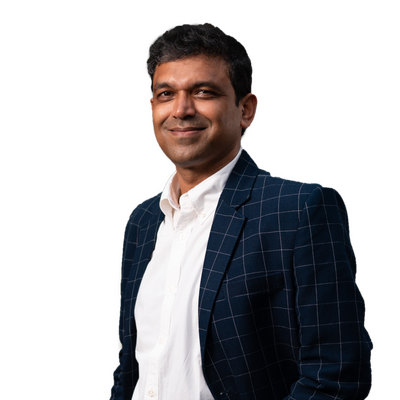

Karthik Reddy
Karthik Reddy is the Co-founder and Managing Partner at Blume Ventures, one of India’s leading early-stage venture funds with over US$900 million in AUM. Blume invests in emerging tech and tech-led innovation from Seed to Series A…- Current Section
- Co-founder & Partner
- Sector
- Media, Entertainment & Gaming, ConsumerTech