
S3 E03 | Scaling Marico to Rs 86,000 Crore Global Brand | Harsh Mariwala’s Winning Formula

- Episode
- 03
- Published
- Reading Time
- 43 minutes
Guest: Harsh Mariwala, Founder and Chairman of Marico
Host: Karthik Reddy, Managing Partner & Co-founder of Blume Ventures
This episode offers invaluable insights into building a successful FMCG business from scratch and expanding it globally. Harsh Mariwala shares his journey of transforming a family commodity business into Marico, a leading multinational FMCG company. His experiences and perspectives on talent management, innovation, brand building, and international expansion provide inspiration and practical advice for entrepreneurs aiming to create world-class businesses from India.
Key Topics:
- Harsh Mariwala’s early years and transition from family business to building Marico
- The journey of converting unbranded commodities to powerful consumer brands
- Importance of talent acquisition and retention in building a successful company
- Strategy of focusing on categories where MNCs were not strong
- Going public early and its impact on corporate governance and growth
- International expansion strategy starting with neighbouring countries
- Acquisition approach to enter new markets like Egypt, South Africa, Vietnam
- Transforming Saffola from an edible oil to a health brand
- Advice for D2C brands
- Creation of ASCENT Foundation to support and mentor entrepreneurs
- Marico Innovation Foundation’s work in accelerating innovative startups
- Leadership transition and importance of clear roles after stepping down as CEO
- Hiring practices and key leadership qualities sought in executives
- Advice for entrepreneurs on grit, continuous learning, and creating differentiation
Check out Harsh Mariwala’s memoir of building Marico here: https://www.amazon.in/Harsh-Realities-Making-Marico-Mariwala/dp/0670094781
[00:00:00] Harsh Mariwala: We didn’t compete with many of the larger players because portfolio choice to me was very important. And we said hair oils is not something which resonates with the MNCs. Hair oils business is bigger than shampoos. And we have a great opportunity to create a big hair oil market and become a market leader in that.
And if you look at our portfolio of products today, I think in all brands, we are market leaders. But initially, we saw an opportunity of leveraging our success and innovation in coconut oil in some neighboring countries. Today,in Bangladesh, we have something like 80% market share in coconut oil category.
It’s a large category. We must be the largest Indian company in Bangladesh doing a turnover of more than a thousand crores.
[00:00:58] Karthik Reddy: Mr. Mariwala welcome to the Blume podcast. It’s an honor and pleasure to have you here today. We’ve had a longstanding association. A lot of people on the show, listening to the show might not know this, but you were one of our first backers. So, very proud to have you as a backer and an investor from the early days.
[00:01:15] Karthik Reddy: And, that journey started in 2011, as you know. And we are on our 14th year and I’ve always been grateful for the early belief and support that you showed. One of our largest investors in that tiny first fund that we raised of 100 crores. I think from the outside Marico has been a, like a, daunting amazing name for people to aspire to and we always talk about it as an example of how an Indian brand competed with global brands, right? And built an FMCG behemoth in the country.
But then when we did a little bit of background work, obviously, we don’t know the history as well as you do. And what we always realize is the entrepreneur’s early days and how the germination of these ideas come about are somewhat layered in the nurturing and your nature as a child and where you grew up, right?
And each person’s journey is unique. So we would love to surface that a little bit today for the audience. I don’t know how many people have heard it, but would love to hear how did growing up in a business family in Bombay in the 70s kind of influence and shape your thinking and how early did this germ of entrepreneurship and building kick in into your life.
[00:02:29] Harsh Mariwala: Okay. Thank you very much Karthik for inviting me first and I still remember the first investment I made. I think must have been one of the first investments I made beyond the business had built up. So, in a way, it was first for me also and I’m so happy that you’ve done so well over a period of last 13, 14 years. So congratulations and thank you for inviting me to your talk.
So I’ll go back to my own, should I say, younger days when I passed out of college and I wanted to study further and my father, conservative at one level, and I couldn’t get admission into a management school. I was very clear. I wanted to do management and nothing else.
I didn’t want to become a chartered accountant. I was not good in technology. So, I couldn’t pass the MBA exam in say, India. I wanted to go abroad, but my father said no. And, I mean, in those days we were far more obedient. So, in this world, we are staying or in today’s, when I spent childhood, it was very, very different, there was nothing like electronic mediums and a lot of it is doing things together.
So, I was staying in a building which my grandfather had built and everybody stayed in the same building. We had a common kitchen. So, a lot of sharing, a lot of doing things together. And, I mean, though every day whenever I started working, two or three of us would go in the same car. So a lot of tolerance because somebody is late, then you have to wait for them to come back. So basically an atmosphere of frugality at one level and tolerance and respect for elders. One could not say something to the elder on their face, as against today where the youngster may get up and say, even I couldn’t say the same thing to my father.
So it was very different than, When I started working, we are in the heart of commodity markets in Masjid Bandar, which is one of the most crowded localities in the world I would say. And it was very difficult to park a car there, very dirty locality, and whenever, as my business started growing, started recruiting talent and half the time, good talent would just run away before coming to the office.
So how do you overcome that negativity or something which is not working out? And as an entrepreneur, you never say, no, you need to try out some different approaches. So that’s how we started calling them to the Willingdon Club, very close to where we were staying in, luckily we were members. and that changed the whole thing.
You meet once, you meet twice, and then you slowly put it in that this is an office space, but it’s a matter of time. We’ll move out. So, grew in a very relatively small business, in terms of size. We had three different divisions in Bombay oil industries. We had a chemicals business. We had a spice extracts business, and we had an edible oil business, which was mainly unbranded.
Most of my friends at that time, coming in from business families would be spending a lot of time in Delhi because that was the License Raj era and for everybody, the route to success was to get a license. Once you got a license, then you’re made for life. To me, it didn’t appeal me because I was not cut out for entertaining bureaucrats or making my way through to get a license or a favor.
So luckily I found my calling in the edible oil business and it was mainly unbranded. In short, what I did in my initial stages of business was to convert that from unbranded to branded. And I had to deal with distributors and I didn’t have to go deal with even like a B2B business where you deal with some buyers of some big companies.
So in a way it suited my personality. And if I had gone into a business which was not based on what I liked, then I would not have succeeded. So, I strongly feel that your passions, your strengths, and the work you’re doing, there should be a very close fit. And if it is not there, then you’ll not enjoy doing it.
And if that is there, then you will not have an issue of work-life balance. And many youngsters go on saying work-life balance is missing. But I say if you enjoy your work, then everything is the same. So, the business grew over a period of time and faced many, many challenges. But, I think any entrepreneur, as I said, you bounce back. I’ve had many setbacks.
But, the ability to bounce back is very important. What is the learning from that setback? And can you apply that learning to your subsequent journey? And make a virtue of it and then succeed in that particular area.
[00:07:36] Karthik Reddy: I think there are 3 – 4 brilliant anecdotes or little lessons for entrepreneurs even in this age.
I agree with you. I think both the age of entrepreneurship and family values and how you deal with society have undergone a sea change, right? We can’t be teaching those lessons and hoping they’ll follow. Especially because the pace has picked up so much that I don’t think there is a time for anyone to slow down and absorb some of this. The 2 – 3 big ones I took away is, we call it in our jargon founder-market fit. Can a founder build? And we call them founders now. We don’t simply call them entrepreneurs. I think a slightly different DNA because the founders tend to drive the vision. From what you’re telling me, whatever you called yourself, you fit that founder persona back in the 70s. And the market fit is very important because as you said, if you went and chase something you’re uncomfortable with, you can be an entrepreneur, but you’ll be miserable and you won’t grow, I feel.
[00:08:38] Harsh Mariwala: Absolutely.
[00:08:40] Karthik Reddy: And we try to tell a lot of founders, please index on that. Please index on a problem you’re in love with and your persona. You can’t run a B2B business if you’re a B2C person and vice versa.
The second element of that you mentioned is when you have these journeys, I think what has gotten corrupted in this decade and a half is that a little bit of the Western cooler things to adopt, which is, Oh, you can fail fast. It’s okay to lose money. Venture capital money is there to lose. And if you have a setback, it’s okay to throw up your hands. Whereas I feel we’ve enjoyed journeys a lot more where there have been incredible, persistence in sustaining the journey.
Now that you brought that up, I’m intrigued, right? So if you looked at, going from, edible oil, the way you were selling unbranded to branded, and those first 20 years from the seventies to the nineties and also out of curiosity, did Marico get spun out? Was it a new entity? So, if you walk us through a little bit of that history, and what are these challenges?
I know you spoke of them in generalities, but I would love to hear one or two anecdotes on what you mean by challenges in the 90s.
[00:10:00] Harsh Mariwala: So, I think, as I said, we were in Masjid Bandar, difficult to attract talent, completely family managed. My father being the eldest, three of his brothers, and then I joined, and by the time I started the business, 3 – 4 of my cousins joined the business. So there are 7, 8 same surname, individuals in the organization.
That would be very scary for a professional to join because one would not know what is the reporting relationship, what will happen between so many family members. So to me, one of the biggest challenges was talent and that challenge still remains for any business in my opinion.
But I realized very early in my own journey that talent plays the most important role in your business. And from early days, I’ve been aspiring for better and better quality talent. Because I saw the results in an FMCG business without putting in any money in fixed capital. We already had those factories for edible oils.
All we had to do was to small, to add very small packing machines and most of them were manual and we could create a big, big asset in terms of turnover, profitability, just because we had good talent in terms of marketing distribution. But my biggest challenge those days was attracting talent. So, in the initial stages, when I, as a commerce graduate, I don’t know what marketing is. I don’t know what distribution is. At one stage, I am not able to attract talent at the same time I need some inputs.
[00:11:30] Karthik Reddy: To learn skills yet.
[00:11:31] Harsh Mariwala: So basically again, change tracks and said that, okay, can I work with some individuals as consultants who are very good in these functional areas? So worked with an HR person who was working with the MNC and he would spend time with me in the evening, all the HR issues, starting from how to have an appointment letter to all the other systems.
Similarly, in marketing, we established or we identified a consultant, a professor from IIM Ahmedabad. Very good in marketing and I met him through some networks and he said, but I don’t have any time. If you want to consult with me, you’ll have to come in the evening flight. And I’ll spend the whole night with you and you can go back in the morning.
Multiple times, Karthik, I’ve gone in the evening flight, spent virtually the whole night and came back in the morning. So that’s the adjustment. That’s the sacrifice you need to make to learn. Then in smaller towns, when we started distributing, I was doing everything on my own.
So started appointing distributors in smaller towns. I have stayed in distributor’s houses because there were no hotels those days. It’s small towns. So you have to go on making those adjustments. And to me, that was very important learning. Similarly, when we appoint an ad agency, the first thing I would tell ad agencies, okay, we are appointing you, but you have to make me learn advertising.
[00:12:48] Harsh Mariwala: So spend one day with the ad agency in terms of how advertising is created. So very much bottom up because of my lack of qualification to some extent, because I was not qualified and I started recruiting talent, which was more qualified than me, whether it’s MBAs or chartered accounts. I had to make it up much more by reading, by attending short-term training programs, by interacting with thought leaders.
And to me that has played a very important role because at one level, it was bugging me that I’m just a commerce graduate. But I was very clear that I had to attract better quality talent because my role models were companies like FMCG giants, Levers, Procter & Gamble, or L’Oreal. And all they had was good talent.
So, I think that’s how I learned a lot from my own talent, and every time there has been opportunity to replace, I’ve tried to look at a better quality talent. And if you have talent, which is better than you, then automatically you empower them, and most entrepreneurs I find that they are reluctant to let go.
When you are small, you are doing things, which I was doing, but when you become larger, you’re getting things done. It’s a big difference. You need to recruit good talent. You need to manage processes. You need to have team building, inter-functional coordination and things like that. So, if you have very good quality talent, then the talent itself will take a lot of empowering from you and it’ll show results. So let’s say talent played a very important role.
The other thing which played a very important role. We grew the business because of distribution, but we started stagnating. And I have this burning desire within me that, okay, I have to grow more fast. To me, growth is very important because growth is like oxygen for anybody.
It basically satisfies not just shareholders, but all the stakeholders, including employees, including associates, including whoever it is, because it is good, if growing the organization will have a rosier future, you’ll get more opportunity to grow, more salaries, what not. So growth was very important and we started stagnating.
So then we said that can we innovate? And if I look back at my own journey, whenever we’ve had innovations succeed, and many times they will fail, I can tell you. Whenever they have succeeded, it has had a discontinuous impact in terms of our market share and growth. So, my belief in innovation just went on getting reinforced that to succeed and that is increased now in today’s world where there is a lot more competition.
And you need to create a very strong right to win. But innovation is something which I’m very passionate about. Or pioneering, do something which is first time. But innovation has to be in a perpetual way. You can’t just say I’ve innovated once and stay put because it’s a matter of time. Your other competitors will copy you. So you have to be two steps ahead of your competition.
[00:15:43] Karthik Reddy: Great lessons. And I think one thing is that a lot of entrepreneurs have these slog stories in the early days. When did you notice that you didn’t have to hustle as much and is that, part of that evolution of saying, I don’t need to do everything.
I don’t need to hustle. I can go and hire good people. And how long did that take in the journey?
[00:16:03] Harsh Mariwala: No, it didn’t take too much longer time because so-called hustling was more to learn for myself. I’ve never been a control freak. And as soon as we started recruiting talent, we saw an opportunity to recruit talent and let go of the talent quality.
Initially, of course, when new talent comes in, you have a little bit closer interaction, but once you have that confidence that the talent is good, better than you, then let them manage on their own, because then you can do newer things.
[00:16:31] Karthik Reddy: Interestingly, there are founders who still do what you did with that Ahmedabad professor. So they will figure out how to hack a plane ride with me. It then becomes a 5 – 6 hour. Now because of traffic, you get car rides on both sides. So we still go both our own ways, but they get 5 – 6 hours with me. I think it’s an age-old tactic, which is still being used.
Shifting gears a little. I’m now understanding from what you’ve just told us that this learning gene in you actually prompted you to think or bring management concepts, build vision as early as the nineties. These were all like esoteric management concepts back then. Maybe, global companies were pioneering it in India because they were borrowing it from their motherships. But that was one of my questions, but I think you’ve already answered that.
But now, when you look at your competition back then, which is HUL, P&G, and all of these other folks, what do you think made you withstand or differentiate that kind of money power, onslaught, talent, etc?
They went to the best B‑schools and got like the best marketing guys on day one. And I remember that was continuing at least till the late nineties when I was in that stream. So what made Marico win in that tough phase?
[00:17:53] Harsh Mariwala: In the employment market or in the business.
[00:17:55] Karthik Reddy: A combination of employment, like how do you compete with that kind of money power/brand power and what transformed Marico into winning the hearts of all the stakeholders. There must have been a big winner somewhere that changes this right for you.
[00:18:13] Harsh Mariwala: So, I would say that though we were in a similar space of FMCG, we didn’t compete with many of the larger players because portfolio choice to me was very important. So, we selected portfolios where we had a very strong right to win. Where we can become a market leader.
To me, market leadership was again something which was always there that I want to be a market leader in whatever I do. So, basically, we went into portfolios where either MNCs were not present or if they were present, they were not paying too much attention to that category because it was not that large enough category.
So we were in hair care and we said hair oils is not something which resonates with the MNCs. Hair oils business is bigger than shampoos. And we have a great opportunity to create a big hair oil market and become a market leader in that. So we went aggressive in spaces like that which we identified where they were not there. And if you look at our portfolio of products today, we have something like 20 brands, I think in all brands, we are market leaders, in their own segments.
For example, in shampoos, we were not present. Because we never thought we will be a serious player in shampoos where each large player has not only one brand but two or three brands like Levers or Procter or L’Oreal or something. And with their global R&D budget. And I said we cannot succeed in that marketplace.
So let’s identify markets where we can win. And that’s how Hair oils came in. And we’ve been able to build a very large business and a profitable business in those categories. And we are market leaders in all the brands.
In shampoos, we acquired a very small segment of anti-lice shampoo, which is very small compared to the main shampoos. But there we have a 70% market share because for them, it doesn’t make sense to be an anti-lice shampoo being a very small category. Similarly, in hair care, we said that beyond hair oils, where can we go?
So we said, can we go in pre- and post-wash hair care? So again, hair oils, then hair serums, hair gels, hair creams. MNCs are present, but they are not paying that much attention because it’s not a large category, like they have one extension, but it’s just neglected.
So we have basically, I think, identification of portfolio combined with innovation, branding, distribution has led to this Marico in terms of owning so many brands. And then we acquired also many brands in India, as well as outside India.
[00:20:43] Karthik Reddy: And just that success drove talent to come over and work or is it that did brand?
[00:20:46] Harsh Mariwala: No, it’s a good talent will make you succeed. I think talent would come first in my opinion, but that belief has to be there that good talent will pay off.
[00:20:58] Karthik Reddy: What would be your sales line for talent? I mean talent, as you rightly said, super important, but usually buys in, I think, at least for the first building blocks of the company, primarily on the vision of the founder. And I don’t know if you believe the same and is that absolute?
[00:21:14] Harsh Mariwala: I think it’s very important and basically, the founder has to set the right example in terms of the leadership style. You have to go on learning. if I’m recruiting MBA, then I better know what MBA concepts are and I should be able to talk to them.
So self-learning was very important to me and good quality talent, but combine that talent with culture, because it’s easy to attract talent. It may not be as easy, but retaining talent is also equally important. And putting them in an environment where they flourish, where they enjoy working, means you have to attend to your values, culture, where they enjoy working.
And I used to hear from a lot of talent whom we had recruited this company has a lot of politicking. In this company, you have to use certain routes, you have to play to some people to rise.
And it was just upsetting me no end. So I said, I don’t want this in Marico. So from day one. Influence will not work. Very open organization, based on meritocracy, trust, and these kind of backbiting and all was something which I wanted to eliminate.
[00:22:15] Karthik Reddy: Very first principle. Yeah, you learn from mistakes other people make and build a great culture.
[00:22:19] Harsh Mariwala: So, we’ve been able to do that.
[00:22:21] Karthik Reddy: There are 3 – 4 anecdotes we picked up about, like, why I think Marico is different, and there was foresight very early on. I’m going to, maybe get a quick answer from you on each one of these. Your Nihar acquisition in 2006. Now, you already spoke of other acquisitions. It looks like you were always thinking about gaps, either in your portfolio or things which are not important to MNCs, as a way to keep leadership and win those markets. Is that a fair way to say why you got so acquisitive much earlier than most others?
[00:22:58] Harsh Mariwala: I think acquisition is a means to an end. It’s not an end by itself. And people think I acquired. Why do you want to acquire, and for different reasons we acquired different type of business.
[00:23:08] Karthik Reddy: Would love to hear a few examples, sir.
[00:23:11] Harsh Mariwala: So, in Nihar, which, we acquired, it was more a consolidation play. We were relatively weak in East India, and we were stronger in other parts of India. So this fit in beautifully in terms of improving our market share and giving us a consolidated market share of 60% plus in coconut oil category. In case of Mediker, it helped us, we knew that it was too small. It was owned by Procter&Gamble.
It was up for sale and we just bid for it. I think we must have spent about 8 or 10 crores at that time. Today, if I had to sell that brand, I think it can fetch us at least 500 to 1000 crores. So, Nihar also acquisition was made at 200 crores. I can easily sell for more than 5,000 crores.
But why do you want to acquire is more important. So in this case, in case of Mediker, we wanted to enter a category where we clearly thought that we will get that market share and be able to grow the market.
In some other countries where we didn’t see an organic opportunity for extending our current range of products, we said can we enter those countries by acquisitions. But in certain areas where we are, so it has to be in haircare, skincare, and it should give us a market leadership.
So in Egypt, we acquired two brands in post-wash haircare, which is hair creams and hair gels. In South Africa, we acquired now, over a period of time, we acquired two or three companies in basically ethnic haircare for South Africans. And in Vietnam, we acquired a male grooming company where they’re in male shampoos and the market is segmented to male, female shampoos, and again, market leadership.
So these acquisitions helped us gain an entry. On the back of that entry, we’ve been able to expand our range of products and be present in those countries.
[00:24:58] Karthik Reddy: I’ll come back to that because, of course, as you know, the theme of the podcast this season is, “Winning Beyond Boundaries” and clearly, you’ve used acquisition as a strategy, but I would definitely double click on that and figure out why you thought that was important. We’ll come back to that.
The other thing which piqued our interest was you went public very early. And, of course, back in the day, there was no venture capital private equity. So if you wanted equity capital, everyone chose to go public. And also people didn’t know how to build businesses making losses. So I think the ingredients were there. You were profitable probably.
And I’m just trying to understand and also translate this mindset to entrepreneurs who seem in the current environment a little nervous or scared to go early. So I want to shed that fear.
And maybe you can guide our listeners today. What does it take to be a founder or a part of a public company as a key stakeholder? And did that change the company in positive ways? Was it shaky for the first 10 years? 96 was a very different environment.
[00:26:05] Harsh Mariwala: So, I’ll give you a background of why we went public first, because, I was forced to go public. Okay. There was a split in the family in terms of financials. And as I mentioned earlier, my father, three brothers, I bought over two of my uncles and their children. So, two 50% of the business I bought over and Marico was the largest part of the family, total business.
So as a part of that deal, I had entered into an agreement and put my shares in escrow. And the final step was valuation of Marico. Now the valuation was Marico was much higher than what I thought it would be. And I had to pay the money. If I didn’t pay that money, I would have lost the control of the company because the shares are under escrow.
So in a way, I had got one or two years time to pay the money. And I tried to raise. At that time, Goldman Sachs had started coming in. We had a couple of negotiations. It didn’t work out.
[00:27:03] Karthik Reddy: Very early days of privatization.
[00:27:07] Harsh Mariwala: Yes, absolutely. Very, very early days. And, the only option open to us was to go public and the markets were not in good shape. But finally, at some stage, we said just let’s go because there is no other option otherwise we’ll lose the company. So, in frustration, we just entered the market and luckily our issue was oversubscribed.
We went public at a very low multiple because we were still perceived as a branded commodities company. It was not perceived to be a full-blooded FMCG.
[00:27:34] Karthik Reddy: Consumer goods company.
[00:27:36] Harsh Mariwala: So we went public at a multiple of I think 13 or 14 price to earning multiple. Today, it’s maybe at 50 plus. I don’t know what it is. You are at a far discount compared to the bigger players. But it is a matter of time. We built it up over a period of time by taking many steps and improving, shall I say, perceptions to some extent, product portfolio to some extent, to be perceived as a properly full-blooded FMCG company, but going public to me, though I went under circumstances, which made me go, it is a double-edged sword. Some people don’t like it. I think it has been positive for Marico from various angles. First of all, being public means that you are more visible. So to some extent, image improves. If you have good results and good products that will help you in terms of attracting talent.
So, talent attraction, the role the board can play in adding value. I think these are all positives. Of course, the negatives could be how do you manage short-term and long-term and we didn’t have to manage earlier but now quarterly versus long-term. But we’ve been able to manage it so well that I personally think it has been more positive. Of course, you have to be far better in governance, which to me is again a positive. So governance is always good for us irrespective of whether you’re private or public, but I think overall governance levels went up substantially more because then you’re subject to questioning by your outside investors, whether it’s a related party.
[00:29:07] Karthik Reddy: Even an equity analyst can ask you tough question.
[00:29:09] Harsh Mariwala: Correct. So I think that has been positive and we’ve been able to establish a very good image of the organization amongst all the investors.
[00:29:15] Karthik Reddy: The way I see it is on a quarterly basis, numbers is one thing, and you are under that pressure, but the ability to engage with stakeholders as wide as the public market allows you, it’s impossible in the private markets. So you can’t build that discipline because they are all known entities…
[00:29:33] Harsh Mariwala: And the whole organization gets used to working in a quarterly as well as long-term,
[00:29:36] Karthik Reddy: I think I’m a huge fan, especially in the Indian context, I believe you’re not like an aggressive M&A market or culturally we’re not attuned to simply sticking a company…
[00:29:47] Harsh Mariwala And then it is given flexibility over a period of time. We made some acquisition. We didn’t have money. So we did some QIPs and today has money. And if we had not public, we would not have been able to do QIP at that time.
[00:29:57] Karthik Reddy: And, there’s one other interesting anecdote we found about you took an edible oil category, which was going through, its own transition of how oil is seen as fattening or unhealthy, etc. And did a 180 and converted Saffola to almost a healthy brand. Was that your personal insight, organizational insight? And how long or how challenging was that transformation to take that brand and convert it to like health? It’s almost like Shell or Exxon becoming green companies.
[00:30:30] Harsh Mariwala: So, edible oil is a very, very competitive sector. And the differentiation between the different brands in terms of product quality is very low. You need to have some differentiator if you want to have higher margins. So, we were very clear that we wanted to have an edible oil and at that time, safflower oil was connected with lowering cholesterol.
So we started off Saffola as not a healthy brand, but good for heart and good for cholesterol reduction. Over a period of time, the brand has transitioned from cholesterol reduction to good for heart to anything connected to heart, now more healthy. So, it has changed over a period of time. It is more turned towards healthy, but if it is not healthy, then we also had a brand Sweekar, which was refined sunflower oil. There is no differentiation and the gross margins in that kind of business are like 5%-10%. So we said that this is lowering our margin profile. So we should not be in this market. So we sold that brand off. But Saffola gives us much higher margins, with highest margin edible oil in the country, maybe in the world because of the health positioning.
[00:31:37] Karthik Reddy: Lovely. And now, just maybe tips or maybe a precursor to what should the current age of people who are building brands. D2C is suddenly the new cool hot thing. I think, the definition of it is a little obscure, because there are enough companies which call themselves D2C, but 80% of its distribution is like yours only through marketplaces, which might be online and offline.
But, now seeing the trend, A, what’s your sort of 10,000-foot view on this proliferation of brands? Do we think it’s the right thing for India or we’re jumping the gun here? Is there enough consumption power? I would love to hear your macro take on it.
And, B, you’ve started for the first time beginning to acquire some of these. So, clearly, you believe in some of the propositions. So, what’s prompting that and is it a set of audiences you’re not able to reach or distribution you’re not able to reach? I know it’s a complex question, sir, but the corollary is, should D2C brand founders now build fearlessly knowing that there are 5 or 10 Maricos who can give value to whatever I build, which was not present, I would say even 5 – 7 years ago.
[00:32:54] Harsh Mariwala: No, so a very good question. Let me give you a little background until the D2C brands surfaced in India and all over the world maybe about 8 – 10 years back or whatever time frame. We were perceived to be the most defensive sector in terms of industry, very difficult for a new enterant to enter because of huge entry barriers in distribution, especially in a country like India, where there are so many outlets to reach.
We have some of the products go on to 3 million, 5 million outlets. Any new brand coming in unless they have distribution, there’ll not be any off takes. So you need distribution combined with brand awareness, advertising. Most advertising through mass mediums like television, press. You need a minimum budget of at least 25 crores to launch a brand. On top of that, you need distribution.
Both are interconnected. If there is distribution and there is no demand generation, stock will come back. If there’s demand generation and no stocks in the market, it’s wasted. So, these entry barriers prevented new entrants to come into FMCG.
And all of a sudden, this digital opportunity came up where you don’t require big budgets. You can do digital marketing. You don’t need to go into so many shops. You can sell through e‑commerce sites. So, there were some early entrants which did very well. And because of that many, many others joined in, which is okay. There’ll be some shakeout definitely. And on top of that, so many investors wanting to back. So, it was a perfect storm.
[00:34:33] Karthik Reddy: Yeah, it’s very hot even now.
[00:34:36] Harsh Mariwala: Yes, but I think over a period of time, things have changed in terms of expectations, in terms of returns, paybacks. So, in a way, it is a good development for the overall consumer because all of a sudden the consumer has many, many more choices.
Now to an FMCG player, D2C could be perceived as a threat because some of the D2C players may take away some share from you. Or it could be perceived as an opportunity if you decide to enter D2C.
We in Marico said that we have to look at it from threat, of course, if they’d like to hit us. But more importantly, we have to look at it from an opportunistic point.
It’s completely different. The way these brands are managed versus the FMCG way of managing is poles apart. So, we said that if we want to be in D2C, we need to have a different type of people. Very young, very digital savvy, and away from our FMCG teams because we don’t want FMCG mindset to influence the D2C mindset.
[00:35:42.20] Karthik Reddy: Eventually, there are positives but shouldn’t do it…
[00:35:43] Harsh Mariwala: Yeah, but in terms of big budgets and all that, you have to work with small budgets. Agility levels are very, very high. So we had a young team and then we said that can we look at acquisitions as a way to grow and through acquisition we’ll also learn. So, we acquired, over a period of time, four brands plus we launched two of our brands.
And I think it has been a phenomenal experience, managed separately, different teams, but once in a few months they meet together, sharing of best practices, how do you learn from each other. And once a certain brand reaches a certain critical mass through D2C routes, can we then use our traditional distribution network to sell those products? Because to a D2C player, which does not have a distribution network, they’ll find it very expensive to enter. And again, it’s a very different ball game to do offline distribution.
So in a way, it has fitted in beautifully for us because then we can exploit our current distribution and learn from each other. And last year annualized turnover, I think, in March was about 450 crores. We see it growing, and we will have a much faster turnaround than most other D2C brands because we have that profitability at the back of our mind and we don’t have any funder who is saying grow, grow, grow, but there is a strong expectation. At some stage, the EBITDA margins of D2C brands have to be closer to your FMCG brands.
[00:37:12] Karthik Reddy: No, awesome. I think you’ve hit upon very good lessons for the D2C founders. So, thanks for sharing all of that.
Of course, we love you as a founder, as an Indian story, always appreciated your support. But one of the key reasons we said you’re an apt guest for this season was that you are also an Indian brand that has the ambition now to go and win global markets. Now, maybe we will find your products outside of the Indian stores in the US someday, but today, you’ve gone and seen that the needs are very similar in near Asian markets. And we were pleasantly surprised to be honest when it surfaced that, why we’re not talking to Marico? I said, what are the numbers? Somebody told me over 25% of the revenue comes from overseas. I said I had no idea. I’ve known the family for 14 years.
And that’s what we want to showcase. I think historically we have said manufacturing karo, export karo. You do IT services, great story. Nobody thought Indian consumer brands have the courage and ability. We’ve done it with telecom. I’m saying there are a few more industries, but physical products becoming global brands, not very common. Not commonly heard. And I think we are on the cusp of an era where we’re going to see more of this. And, suddenly we realized you’ve done this 20 years ago, sir.
So what prompted you to have the courage back then when India was such a daunting market in itself?
[00:38:50] Harsh Mariwala: It started off by the hearing from the Middle East that Parachute is being smuggled. Those days coconut oil exports were not allowed. And in came the liberalization of 90s, and then we were able to convince the government to allow us to export. Initially, you would get a license to export that much again, over a period of time it got liberalized and no license was required.
But initially, we saw an opportunity of leveraging our success in innovation and coconut oil in some neighboring countries. One of them being Bangladesh. So a lot of innovations we made and which succeeded in India in the area of packaging. We saw a great opportunity to tap those innovations in Bangladesh. We went there, zero market share, 100% of the market dominated by local brands. And we rolled all the innovations together. Today at Bangladesh, we have something like 80% market share in the coconut oil category. It’s a large category. We must be the largest Indian company in Bangladesh doing a turnover of more than 1000 crores. So, that’s how organically we started expanding to some countries — Middle East, Bangladesh, some other Sri Lanka, Nepal.
[00:38:50] Karthik Reddy: That explains of the birth of this …
[00:38:50] Harsh Mariwala: But then, when you’re an entrepreneur that growth momentum comes in, you have to grow. And sometimes it is just not for the sake of growth and profitability and increase in sales but we also saw that MNCs were able to retain talent. We’re transferring people from one country to another country, that aspirational posting, better.
So we said, can we use that also? Can you grow so that we can post people to other countries? They’ll get experience. We will also get a chance to evaluate individuals in a profit center role in different countries. So, currently, we made many acquisitions, as I said, in. Middle East, we didn’t make acquisition. Egypt, South Africa, Vietnam.
So we have, our big geographies are these four where we have our own factories or we get it manufactured locally. Others, we do it through India or through Egypt or wherever be our factory. And I think now it’s growing to other parts of Africa, other parts of the world.
So you’re right about 26%-27% of our turnover comes from international market. And it has been a very good experience of getting some trends coming in from those countries to India, ability to wanting to travel, posting people, testing out people apart from running a profitable business in the international markets.
[00:41:21] Karthik Reddy: I think you’ve covered a whole bunch of things in the narrative. So I won’t repeat the questions, but I just want to summarize them for the audience.
One, I think it explains how there’s a hunger for growth made you look at overseas markets.
Second, very interesting, expansion strategies or acquisition strategies in different markets. Some were pull, some were your ability to go build adjacencies and acquire them.
Three, this question was on my mind around how do you manage the complexity of these many markets, but you’ve dropped enough hints. I might ask a little bit around that because that’s the most daunting part.
But you seem to have addressed it by giving people and almost making it a training ground. And as you were speaking, it felt like you can very cleverly expand India from 25 – 30 states to psychologically perhaps making it like United States and saying, it’s actually maybe 50 – 60 markets. So, the same challenge of sending someone to Tamil Nadu versus Bangladesh in some sense. And it felt that’s how we thought about it.
[00:42:27.24] Harsh Mariwala: I’ll just add a little bit.
[00:42:29.11] Karthik Reddy: Yes, please. I would love to hear.
[00:42:30] Harsh Mariwala: International markets are very different from Indian markets. In the past, my initial stages, I used to ask the local country head of sales and marketing to handle opportunities in some other neighboring countries. And I realized that every time India is such a large market and they would just not get the right time to visit those markets, which at that time were small. There was some potential, but always neglected. And I said there are enough escape buttons for the Indian team not to pursue international opportunities.
So out of frustration, we said that Indian team will not handle international business. I will recruit a Vice President International at the same level, very senior position person, the business scale is very small, but you have to build it. And I think that removing escape buttons and having good talent without a base, but all the time to look at opportunities, I think, it helped us build a much stronger base. We started visiting markets, identifying which are markets we wanted to be in. Because international is very big. You need to prioritize your markets.
So that person went and came back, okay, these are the markets you want to be, spread the word around in the local community, local banking that you want to acquire brands. And that’s how many of the acquisitions happen because of so-called proactive approach to acquisition rather than something coming to you in all. So, we planted seeds among bankers, visit this family, try and see whether there is a deal happening or not.
So, removing escape button is very critical for key organizational initiatives where there is potential. And many a time we try to optimize, saying that, okay, let the same person do that. But that doesn’t work out because it’s a completely different ballgame to manage International and Indian businesses.
[00:44:14] Karthik Reddy: No, that’s an important tip. I’ve seen whatever little success we’ve begun to see. One of our partners who wants to give you their health ring, Ultrahuman, they have this ambition right now because the product is global in nature. Competing with a global product. Today only 15% come from India and the person running, global business is very different from focusing on India. So, it’s not like we have hundreds of these businesses in the startup world. But we would love to see that happen. We would want Indian brands to be seen everywhere. And a lot of good lessons from what you just told us.
And I think it also explains how you need to balance out. It feels like you almost created a set of entrepreneurs in the truest sense, who could come and take the challenge of building businesses in multiple markets, which usually you don’t expect a large company to do. There’s a lot more command and control from the center and maybe a different founder.
[00:45:12.06] Harsh Mariwala: Something I’ve not done it from…
[00:45:11.27] Karthik Reddy: Yeah, it took a founder like you to think in a very different way to make that happen.
Would you say there are other regretted or missed opportunities in international and, just to take a punt at it, 10 – 15 years from now, where do you see your share growing?
[00:45:32] Harsh Mariwala: Internationally, we grow today about 26 % or 27%. It’ll grow. I can’t predict share, but I think international will grow because we will try and tap newer geographies. By design, we went into developing markets and not developed markets. Because that’s where we can leverage our distribution network, which is one of the key ingredients for success.
So, we didn’t go to Europe, USA. At some stage, out of frustration, when things were not growing, I went and acquired a company in the USA based on principles of Ayurveda. And I’m talking of maybe 20 years back or 25 years back, but it was in B2B business.
So they were making Ayurvedic products for the spa industry, a completely different business model, very far away. And then it was not getting scaled up and we sold that company. But out of that learning came that, okay, let’s go into more aggressive into acquisition in some other markets where we are not present. So that’s how Egypt, South Africa, and Vietnam acquisitions happened.
[00:46:32] Karthik Reddy: And, is this something you’ve managed to ingrain and I know clearly, the kind of entrepreneur you are from just the stories that you’ve told us? But even now, after being a 10,000 crore company, we see you on social media, in stores, engaging with customers. This is a hunger for learning. How do you transmit that into an organizational culture? Or is it just by seeing you people are inspired and they learn? Or has it seeped down to everybody in Marico?
[00:47:01] Harsh Mariwala: No, I think it has to be the top management’s responsibility to have this quest for learning by travelling, by asking the right questions, by reading, by interacting with thought leaders, by exposing to the whole organization in terms of whether it’s seminars or experiences. Asking them to go abroad and I have, maybe 4, 5 years back me and my son went to USA just to look at what is happening in terms of international trends. And that time, the trends were what we have seen it now coming to India, natural, vegan, all those trends we could see that 5 – 6 years back.
But you have to have an open mind and you have to have that burning desire to learn and succeed enough. It can get translated down the line, there could always be more, but if put in the right kind of processes, if you have the right culture, if you expose people to more and more, if you ask the right questions, then I think you will find many other individuals practicing this.
[00:47:58] Karthik Reddy: And I know the story from you before. I think I’ve asked you and you’ve given me the detailed answer, but again, for the audiences, which are our young entrepreneurs. There’s a little bit, I’ve sensed this fear of building very long term. So, what happens after 10 years? What happens after 20? If I go public, am I married to this forever? When will I enjoy life? So some of it you’ve answered that you have to choose your cause.
But you also were open enough that you transitioned out of the CEO role very early. Now for the first time, we’re beginning to sense that it’s going to happen in the first of these startups. And any, frameworks for thinking through, what’s the right time to hand over the baton and yet be incredibly valuable for the company.
[00:48:51] Harsh Mariwala: So, I stepped down when I was 63 years old. I had not thought of stepping down, but I think internally there were some aspirants for this post and India being very hierarchical in terms of society. It is expected that your children will step into your shoes. So, at that time I went to the board and the board felt that I was in this chair from the time I started virtually 30 – 40 years. And it’s high time I gave some chance to somebody else.
And I’ve always followed this thumb rule that whenever there is a conflict between the organization’s interest and any stakeholder’s interest, whether it’s a key employee or whether it is promoter’s, the organization’s interest comes first. So, in this case, based on the board advice and all the organization’s interests was that we need a change in leadership.
So, two things. One is, okay, I have to step down. Another is, my son is not stepping into my shoes, which is unheard of at least in most Indian families. But I again use that thumb rule. It is good for the organization I have to do. Ultimately, the promoters, everybody will benefit from that. So, I think that’s one rule whenever there is a decision, a conflict coming in that, you have to see what is good for the organization comes first and not your personal interests.
And number two, when the transition happens in this case, transition happened to an individual who was working with us for almost 10 years. So, there was a very good understanding in terms of what will work, strengths, weaknesses, but there is a tendency from the founder to interfere in day-to-day affairs and the board said please don’t let that impact the new incumbent because if you start interfering, that will demotivate that person, that person should be given free hand.
So at that time, I wrote down myself, he wrote down what will I do, what I won’t do, what he will do. What decisions will come to me for approval, very, very clearly laid down, including when will we have review meetings, monthly review meetings, but I will not have any investor meetings. I will not be involved in any decisions selecting say, ad agency or I don’t even know who is our ad agency is.
So, I’m saying that hands off, mind on. The mind on comes in through review meetings, through a lot of information which comes to me. My whole objective is to add value. And, of course, when things are not going well, I need to correct things. I spend time in terms of recruitment of people who are reporting to him.
I’ve written a book, which I think if some entrepreneurs are interested, it’s mainly meant for entrepreneurs. I can definitely say that it’ll add value. And there’s a chapter on this transition and this role clarity. And I think there is a lot of learning because I’ve heard from some other family-managed companies where the founder have recruited, but they are still taking all the control and that doesn’t work out.
[00:51:50] Karthik Reddy: No family or otherwise, I think the cultural elements are the same. You can’t have a founder from the past controlling it. And I know you’re hiring. We will, of course, recommend the book and we will show the book as a part of the podcast, but hopefully, even potentially get your signed copies and give it to a few of our founders.
But, as you said, it’s all about culture and hiring and you spoke about, you’ve been quoted as saying you look for internal drive for success, which is clear, very entrepreneurial alignment with Marico’s culture, ability to identify and resolve key issues, spoken about a lot today. What kind of questions do you ask to get a sense that, to even gauge these? I don’t need to understand how you gauge these, but what are the good…
[00:52:38.02] Harsh Mariwala: While interviewing these?
[00:52:39] Karthik Reddy: Yeah, while interviewing, how do you start?
[00:52:40] Harsh Mariwala: I think one has to look at what is the ambition. What is the leadership style? We can’t have dictators in our organization nor can we have autocrats. We have to have very participative leaders. We give them some tests also, which they’ll figure out what the leadership style is. What is that burning desire to succeed? What is the ambition? What are the failures? What is the risk-taking? What are the learnings out of your failures in your own career? But in spite of doing all that, there could be some mistakes because interviewing is not a perfect way to judge an individual. So, you do multiple interviews, you do proper reference checking. Reference checking is very, very important, and then make a choice.
[00:53:16] Karthik Reddy: Awesome, sir. Now, before we wrap up today, I wanted to touch upon your passion for entrepreneurship, partly in the book. There are two big initiatives I’ve noticed come out of Marico in the last 10 – 15 years. One is ASCENT, not-for-profit, to promote entrepreneurship. And I’ve been to one or two of them. I know you kindly, graciously invite us every year. You have phenomenal speakers. What do you want as an outcome for that? If there was a mission and vision for that, what would you like to see out of ASCENT?
[00:53:50] Harsh Mariwala: I personally think that entrepreneurs will drive India’s growth story. No amount of government will play a role. Ultimately, it will be the entrepreneurial drive, which will make us a 5 trillion, 10 trillion dollar economy. And many entrepreneurs have good ideas. They don’t know how to execute. They don’t know how to scale. And if I can help them in creating a peer-to-peer learning platform where they learn from each other, then they will add value to their own business. Hopefully, it will lead to much larger businesses. It will help in India’s growth story, provide employment.
So, I strongly believe that entrepreneurs can add a lot of value to the society by providing employment, improving lives, and by taking this route of ASCENT, we believe that we are able to add value. We have about a thousand entrepreneurs associated with ASCENT, cumulative turnover of 1 lakh crores. If you add all the thousand entrepreneurs and we want to expand that initially started with Bombay, then went to Chennai and we just launched in Delhi.
But clearly, any entrepreneur wanting to learn, wanting to improve, they can just visit our website, www.ascentfoundation.in. I fund this whole thing, it’s almost for free. For attending some events, you may have to pay. But these are events where they’re held at good locations and it includes whatever, attendance, food, and all that. But otherwise, we have got very good rating, very good NPS scores and we are looking for more entrepreneurs to join us.
[00:55:27] Karthik Reddy: Now the fact that it’s grown so much, is a testament to the fact that something’s working there. And is this disconnected or aligned with Marico Innovation Foundation?
[00:55:35] Harsh Mariwala: No, it is very different. Marico Innovation Foundation is a part of my… this is my personal philanthropy.
[00:55:40] Karthik Reddy: And that’s been up also for 20 years.
[00:55:42] Harsh Mariwala: 20 years, yes.
[00:55:44.24] Karthik Reddy: And, again, it seems to be a CSR arm per se.
[00:55:46] Harsh Mariwala: Yes it is, and that reports directly to me. I didn’t want CEO to look after CSR. So that part reports directly to me and I’m passionate about that. So I spend some time on that also.
[00:55:57] Karthik Reddy: And, we came across one of the many testimonials around that was, very hot brand today, Atomberg. I think they gained phenomenally from that.
[00:56:08] Harsh Mariwala: Yeah. We do mentoring and acceleration programs. I spent a lot of meetings with Atomberg in terms of changing their strategy. One other company S4S, which makes all these dried vegetables and all that and they wanted to launch their brand. I said don’t go and launch a brand, you’ll not be able to succeed. Go to B2B, go to HoReCa and they are thriving now.
[00:56:27] Karthik Reddy: So, I think and that program allows you, how do you get selected into that?
[00:56:33] Harsh Mariwala: No, so you have to apply. There is a process, Marico Innovation Foundation has a website. Apply, then they go through that thing. We work with various, starting with me to Marico people to outside CEOs who are retired, they act as mentors. We also take 3, 4 challenges and send it to management schools as summer training program. So, we do multiple things for helping, innovative, but innovation should be at the base of that.
[00:56:59] Karthik Reddy: How early or late can you apply for that?
[00:57:01] Harsh Mariwala: No, as long as, it could be very small, as many of them are doing lakhs turnover, but there is good potential. We should be able to do …
[00:57:08.13] Karthik Readdy: That’s what the selection criteria is trying to look for.
[00:57:12] Harsh Mariwala: It’s basically innovation and.
[00:57:11.20] Karthik Reddy: You’re judging for innovation and scalability.
[00:57:13.27] Harsh Mariwala: Scaling up and what is preventing their scaling up from happening.
[00:57:18] Karthik Reddy: No, it’s fantastic. Clearly, your way of giving back in more ways than one has always been visible. But I wanted again the audience to know that Mr. Mariwala has somewhat unique and special entrepreneurial ecosystem. No, only because of this sequence of how you’ve, A, established the firm and the culture, made it a very proud example for India that we can build consumer brands globally. We’re trying to get, in some sense, pioneers who actually can become role models for others. And we would love for more D2C brands say if Marico could do it.
[00:57:56] Harsh Mariwala: No, but if any of your brands want to have, because I mentor on average 6 to 8 entrepreneurs every month.
[00:58:00] Karthik Reddy: We’ll take you up on that. And, no, thanks again for the time.
Before we wrap, I’m just going to try a small rapid-fire round. And, then we’ll thank you for your time today. What’s your sort of go-to stress buster?
[00:58:16] Harsh Mariwala: I think working out and when my grandchildren are in town, spending time with them.
[00:58:19] Karthik Reddy: Now how many grandchildren?
[00:58:20.21] Harsh Mariwala: Two.
[00:58:22.03] Karthik Reddy: Two. Great. And, most important lesson that you might have learned from these various failures that an entrepreneur goes through?
[00:58:28] Harsh Mariwala: Grit. Bouncing back. So passion combined with determination, perseverance.
[00:58:33] Karthik Reddy: And one, one habit that you believe every entrepreneur should have? Is it the same grit or is it something else?
[00:58:38] Harsh Mariwala: Learning. I think you have to be curious and always on the learning mode.
[00:58:42] Karthik Reddy: And since you said workouts, any favorite, what’s your go-to?
[00:58:47] Harsh Mariwala: A variety. I think every day is a different day.
[00:58:49] Karthik Reddy: That’s amazing to know that you’re still at it.
[00:58:51] Harsh Mariwala: I do everything. I do yoga, Pilates, weights, functional training, swimming, cycling, golf.
[00:58:56] Karthik Reddy: Lovely, lovely. And your favorite cities in India and outside India?
[00:59:00] Harsh Mariwala: I love Coonoor, which is in South India.
[00:59:02] Karthik Reddy: You spent a lot of time there:
[00:59:03] Harsh Mariwala: I go 2 – 3 times a year. I’m building a house there. So it’s favorite because of beautiful weather, not so crowded. And there’s a golf course there.
[00:59:10] Karthik Reddy: Okay. Awesome. And, outside India, any favorite?
[00:59:14] Harsh Mariwala: I think, nothing’s favorite, but I think mainly, I would say British countryside, Switzerland, Austria, Germany.
[00:59:21] Karthik Reddy: You seem to love the green, basically. And, any, final advice for upcoming D2C brands? I know you’ve given a bunch.
[00:59:28] Harsh Mariwala: Create a strong right to win. Don’t follow others. It’s a highly competitive environment and you need to be differentiated.
[00:59:34] Karthik Reddy: Thank you again, Mr. Mariwala for your time and the advice and wisdom collected over like now about 50 years and hopefully will be evergreen, through your books, through your foundations. So once again, thank you. Pleasure having you today.
Mr. Mariwala, courtesy, our portfolio company, Ultrahuman. They want to marry you for life. They want to give you a ring. So, please let us know your size and we’ll ship over a ring to you. We think they’ll be our next story going global. And in the future, it’s not ready yet, but they want to do an Ultrahuman home, which gives your environmental wearables on whether everything is looking good at home. So we are awaiting that launch as well. But, thank you, again.
We thank IDFC First Bank for being our annual partner. IDFC First Bank is deeply engaged with the startup community in India. The commitment to fostering innovation and supporting entrepreneurship has made them a valuable partner in the growth journey of numerous startups, including many, many Blume portfolio companies. This partnership helps us in a mission to back the next generation of revolutionary founders in India.
Moderator
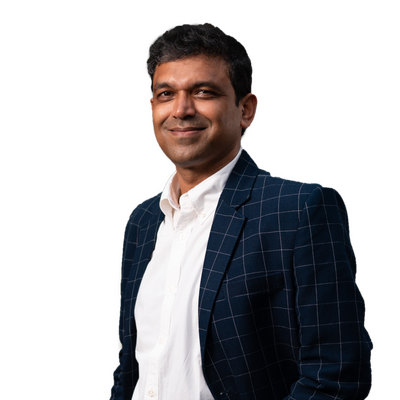

Karthik Reddy
Karthik Reddy is the Co-founder and Managing Partner at Blume Ventures, one of India’s leading early-stage venture funds with over US$900 million in AUM. Blume invests in emerging tech and tech-led innovation from Seed to Series A…- Current Section
- Co-founder & Partner
- Sector
- Media, Entertainment & Gaming, ConsumerTech