
New Swaraj, New Money: Inside the BitFury Revolution | S4 E5 | Destiny Avenged | Weekday Episode

- Episode
- Episode 5
- Published
- Reading Time
- 13 minutes
TL;DR: 12+ years of crypto lessons + 3 unicorns + 1 insane $20 Bitcoin bet — distilled into 19 minutes. If you missed the full podcast, this weekday cut has all the essentials (but the full version is absolutely worth it).
Imagine betting your entire fortune on Bitcoin back in 2012, when it traded at $20 a coin.
Thats what George Kikvadze, Executive vice chairman of Bitfury, did in 2012 when most people dismissed Bitcoin as “magic internet money”.
On the surface, it sounded like pure madness. Newly fired from his hedge fund job, family thinking he’s lost it, the asset trading below a dollar just two years earlier. Who does that?
But as George puts it, “The comfort level of owning Bitcoin is directly proportional to the time you spend studying it.”
He studied math, cryptography, monetary history. He watched the Cyprus banking crisis play out, saw accounts frozen, and connected it back to his childhood in the Soviet Union where his parents’ savings evaporated overnight.
That’s where his core thesis came from:
- Global debt levels keep rising
- Governments and central banks will keep printing more fiat money
- Bitcoin, with 21 million hard-capped supply and declining issuance, is an asymmetric bet on that lack of discipline
This understanding allowed him to hold his nerve when everyone thought he was crazy — and then use that belief to build, not just trade.
Along with his co-founder Val, he built not one but THREE bitcoin unicorns from the BitFury Universe, choosing to focus on enabling mining versus hoarding coins.
And George still isn’t done. On CNBC, he doesn’t say Bitcoin might hit a million dollars. He says it will — driven by the same forces he’s been tracking for over a decade.
Karthik sits down with George to unpack his journey, his book “And Then You Win”, and his $1M Bitcoin thesis on the latest weekday episode of the Blume Podcast.
Season Partners: IDFC FIRST Bank and Ultrahuman (Blume portco)
[00:00:00] George Kikvadze: If Mahatma Gandhi would be alive, he would have been a Bitcoin maxi. I guarantee you guys; decentralization, self-reliance and truth. Absolutely! I grew up in Soviet Union and everything collapsed. The life savings of my parents evaporated overnight. And I had this distrust towards the system, the establishment that could just throw you under the bus. Things connected and in 2013, I decided to place the bet and went in all-in with Bitfury.
Do you trust a Fiat that is being inflated by Central Banks year after year? Or you trust a system that was created of mathematics and cryptography, which is the ultimate truth in my book?
[00:00:45] Karthik Reddy: What is the worst startup advice you got?
[00:00:49] George Kikvadze: Using our Bitcoins to pay for CapEx. We had 600,000 Bitcoins. Now, we’re down to a couple of hundreds. The comfort level of owning a bitcoin is disproportionate into amount of time you dedicate studying it.
[00:01:05] Karthik Reddy: Bitcoin at $20 versus Bitcoin at a $100,000, which took more courage to buy?
I think I am going to walk you quickly through the journey in four, five parts. Let us go to the earliest days. When you look at the day that you were fired being when Nakamoto published it, have you ever thought through this journey that this is what Destiny means?
[00:01:37] George Kikvadze: Of course not. Here I am running this Russia and Ukraine operation of a large US-based hedge fund, private equity fund, and top of the world.
I am 32, doing these mega deals and the global financial crisis hits. You guys remember that the big Volkswagen-Porsche bet kind of went crazy and many others, AIG-Lehman, and the founder of York Capital, Jamie Dinan has called me in New York. I already knew that there were a lot of redemptions. There was blood on the streets.
Went out Cipriani and he said, George, we love you but the fund is down and we just need to shore up and go back to basics. Jamie has been my mentor and one of the things he said, think of the next big thing. And that kind of stayed with me ’cause it was a complete reinvention.
I took a year off, traveled the world. By the way, whenever you have these type of moments where your high and fly and then life throws you under a bus, go and self-reflect, spend time in nature or go travel, it is really a big decompression and switching your mentality on things because during that you can find an answer in terms of what to do next.
I traveled a lot. I went to 60 countries and ended up coming back, and became a big investor in agriculture of all the places in Ukraine. So, I built up a portfolio of lots of lands. So, I got to appreciate the power of production of land, the scarcity value of that.
And then at certain stage when we exited that sort of a investment, a friend of mine kept pestering me about this Bitcoin and Bitcoin and Bitcoin. I am like, listen, I have no idea what it is, but I will start it up. And sure enough, Cyprus banking crisis happened. I do not know how it affected India, but in Europe, that was like a big wake up moment because all of a sudden your accounts being frozen, not being to take out.
And sure enough, interesting Bitcoin shot up from $20 to $200. And I am numbers guy and I am like, okay, this is interesting. What’s going on here? And I started exploring and contacted our classmates on West Coast. I contacted Hardeep, Travis, Jagerson Ty, and Divesh Makan.
Talking to these guys, Divesh said George, forget about Buffet and all these guys, big clients of mine, serious tech guys are investing in it. So, I am like, okay, this is like serious stuff.
I have started reading up, went on Khan Academy and more I realized that this was really something profound. It is from mathematical beauty of it, the cryptography, the decentralized sort of a nature of it. Because I grew up in Soviet Union and everything collapsed. The life savings of my parents evaporated overnight, and I had this distrust towards the system, the establishment that could just throw you under the bus.
Things connected and in 2013, I decided to place the bet and went in all-in with Bitfury. In our space, we always joked. They ignored us. Now they are laughing at us. Now they are fighting us.
So, Gandhi’s theme and arc was always there. And if you think about… More, I was thinking, 15, 16, I started noticing that. You look at a Gandhi’s satya, truth, right? You have this underlying but truth through Mathematics.
Do you trust the fiat that is being inflated by central banks year after year? Or you trust a system that was created of mathematics and cryptography, which is the ultimate truth in my book. And then you look at a Gandhi’s concept of self-reliance. Bitcoin is all about self-reliance.
You are in the system. You rely on yourself. There is not going to be someone bailing you out, system of decentralization and connecting all these dots, I came out to a point where I have traveled to many countries. Have any of you ever heard any country where you use a terminology of 10 million as a word? Any country?
No. Typically, in a west, you use 100 or a thousand or a million, a hundred million, but nowhere, 10 million. Nowhere! And it downed on me that you have crore, which is 10 million. One Bitcoin is 10 million Satoshis. One Bitcoin is one crore. And I just connected it, the other day talking to the concierge, like we are talking about things and okay, 10 million; it is very interesting.
I am not saying Satoshi Nakamoto is Indian, but whoever, whatever was due, definitely what has been exposed to Indian culture and a Gandhi philosophy? Absolutely! I am certain of that. A person or group of individuals that have created this. And frankly speaking, I was joking, if Mahatma Gandhi would be alive, he would have been a Bitcoin maxi. Totally. I guarantee you.
I guarantee you guys; decentralization, self-reliance and truth. Absolutely. And you know who else would have been Maxi, Nelson Mandela, Martin Luther King, and all of those that started out the movements to fight the oppressor and going out and making a positive impact.
So, there is just a lot of undercurrents, and for me, to come to India on that day of a release to pay a homage to this great man. It was really important for me. And the title of the book, And Then You Win and then, we all win.
And the next chapter is taking the winnings from Bitcoin and reinvest in entrepreneurs and funding the next generation of entrepreneurs that can go on and make wins and make a positive impact on the world.
[00:08:19] Karthik Reddy: Awesome. When do you think the Valley eventually caught on? I mean, Andreessen had a crypto fund eventually. How long did it take for the Valley to catch up?
[00:08:31] George Kikvadze: Listen, I appreciate also the Silicon Valley guys sitting there. Here we come in, a team from Ukraine, that does have a great sort of a chip. And yes, at that time, we already had Bill Tai vouching for us and bringing in, but it is a hardware business. Hardware business is very, very tough business.
It is very CapEx intensive. One mistake, you will set you back. There were 20 or so competitors back then. So, I totally understand. I was one of the founders of Kyiv YPO Club in Ukraine, and through that, I got to know people and one of the people were CNBC producers and I flew into New York with Val. By the way, it is the first trip that Val has ever made in United States, and there was a big conference in New York.
I just reached out to one of the producers like, wow, Bitcoin is a hot thing, why do not you guys come in? So, here I am. I know what Squawk Box is; it is first day of Val in United States. At that time, his English was, it is okay. And his question was, what is this thing and is this live? And I said, yeah, it is live, but do not worry, we will get through it.
So, I remember that time Hardeep Walia, our friend, Motif. He was on CNBC all the time. So, I called Hardeep. Hardeep, dude, like you need to help. Like George, do not worry about it. You just need to memorize couple of one-liners and do it and show the product.
Back then, Val had this chip, a small Bitfury chip, in a small plastic bag and he was like, he pulled it out before the show. I am like, dude, this is going to look like crack cocaine. We cannot be showing, going on a Bitcoin and this is a time when you have Silk Road and all this thing, and all of a sudden this, Ukrainian Latvian guy comes in and waving a crack cocaine with Andrew Ross Sorkin and Joe Kernen, on the live show.
So, we made sure in order for him not to lose the chip, he had few chips. And thank God, there were one liners and he pulled out the chip. They showed and Andrew Ross Sorkin was like this thing mines Bitcoin and he said, yeah, this thing, mines Bitcoin. He’s like wow, amazing.
And Joe Kernen, I do not know how many of know this guy who is one of the old timers, CNBC guys. He was observing. Since then, he has become, like over the years, the Bitcoin maxi of all this sort of. So, I am proud that maybe we have orange build him at that point. So, as we are growing and developing, we are riding the wave, competition is falling sideways because we really had this brilliant team.
2015, we put up this first immersion cooling data center. Now, they are all like very sexy and everybody talks about it, but basically, you are submerging your chips in a liquid solution. So, you eliminate a lot of the air cooling. So, you PUE or your energy goes down to one or two, you save a lot on CapEx.
But we were the largest 3M company’s producer of the solutions. And we launched 40-megawatt facility in December 2015. And we made, I think, crucial mistake. In 2015 December, we announced that we had a 16-nanometer chip. That was by far the industry… That was like, kind of, Ferrari of the industry, and we showcased it on YouTube. It was not some kind of PR. We actually had a YouTube recording.
I think that kind of set up in motion a very strange sort of a situation where, we got a lot of orders, hundreds of millions of dollars, which was a lot of money back then. And come February, I am flying to Hong Kong and I get a phone call saying, you know what? The chip does not work. Like what is going on? And it was just a realization that, it had a 99% yield on MPW and when it went to full production, it went down to 1%.
And that has never happened in history of TSMC and then you realize, okay, this is it basically because we have taken the pre-orders and the chip is not coming out. And that is, you realize, okay, this may be over and interestingly, once that information was there, I rallied up internal team and we put everything we had. All our life savings to buy us that extra six to seven month in order to figure out what the fuck was going on.
And that was the first big crisis that hit us that in a way altered in a big way of the market Share.
[00:13:28] Karthik Reddy: What went wrong just to finish that story and how did you fix it, by the way?
[00:13:32] George Kikvadze: So, we started. We flew into a Taiwan and one of the key advisors… first of all, Bill Tai brought senior advisory. So, we had guys like, Young Sohn, the vice president/president of Samsung. He was semiconductor guru, working with Samsung and he was head of Intel before in Korea, I believe. Jackson Hu, who was, vice chair of UMC and then, president of UMC and then TSMC from Taiwan.
So, we came to Taiwan to start figuring out what was going on. We went to the design house. We went to TSMC, and there was a working group created in order to start figuring out what was going on. And at some point, sort of months are going in for us. For TSMC, we are small fish. And I realized that, okay, this thing is not going to go anywhere. So, we had to go in and engage a prominent lobby firm in Washington DC that reached out to John Negroponte, who was Ambassador Luminary, who knew Dr. Morris Chang.
And if you guys know anything about Taiwan, Taiwan is really Dr. Morris Chang that started TSMC. He is the legend. And John called him up and told the situation and Morris was extremely surprised this thing happened. Such a yield. He called up the head. And within 24 hours, this thing was accelerated. And sure enough, in a month time, the new chips were produced.
The comfort level of owning a Bitcoin is a disproportionate into amount of time you dedicate studying it. This is the ultimate DYOR and to many, many people that do not have time, I have been saying for the last 12 years, put in 1 – 2% of your liquid position into this and let it arrive. Put in a position. If 1 – 2% position worries, you are going to be waking up in the middle of the night checking the price, then do not put 0.5%.
If 5% you are fine, then go and do it. But I guarantee you, once you start going down the Bitcoin rabbit hole and learning about how it is constructed and such, you will be putting more and more into this.
Now, it is an asymmetric bet and it is not a bet on, Paul Tudor Jones coming or BlackRock. Of course, the institutionalization has played a big part, but it really is the bet against the global central banks printing more fiat. It is a simple bet. It is a directional bet. Yes, it will be volatile.
By the way, the volatility has come down tremendously, but it is, you are betting against humans’ lack of discipline. Look at the global… You look at Elon, God bless. When he started Doge, I knew that that was not going to go anywhere. You kidding me? He is fighting up against the establishment that has massive allocations from budgets in various places like Alabama, Mississippis, Oregon, and so on and so forth. There is no way.
So, if you trust that the government will be living within the means and within budgets, and the central banks will not be printing money. Do not buy Bitcoin. Do not! It is not going to go anywhere. But unfortunately, the world is completely different and that is why it has shined and it will continue to do so.
Look at the global debt levels. Look at the global budget deficits. It is one directional bet, and the guys like Paul Tudor Jones and Larry Fink, they have come to it, not because, okay, Bitcoin, is because they connected those dots. And that is a bet on that or as Chamath likes to say, it is a schmuck insurance.
[00:17:42] Speaker 3: That is a wrap on this weekday episode of the Blume Podcast. We have handpicked these moments to give you the most valuable insights in the least amount of time.
[00:17:52] Karthik Reddy: Our season partner, Ultrahuman, is back for a second time. I am biased as the seed investor here, but their immensely loved brand is making waves globally. Ultrahuman is a health tech pioneer, redefining how we track and improve our health, their sleek titanium ring, AIR, and its new rare-metal cousins accurately track sleep, movement and recovery to deliver real-time health insights and personalized nudges.
Ultrahuman is creating a unique health ecosystem built on top of the wearable data. It just launched blood vision in the US in addition to India, a blood testing service that offers a panel of over a hundred longevity and chronic disease biomarkers with a convenience of an at-home test. Thye are also launching Ultrahuman home globally for environment aware analysis and sleep insights.
Whatever your health fix, go sign up and experience being truly Ultrahuman.
Our season partner, IDFC FIRST Bank has earned its reputation as one of India’s most startup-friendly banks through its FIRST Wings program, which provides dedicated mentorship and tailored financial solutions to help early-stage ventures scale effectively.
Coincidentally, many of Blume’s portfolio companies, much later stage, also partner with IDFC FIRST Bank for their banking and financial needs. If you are well-funded and scaling, they are great lending and banking partners, and our portfolio companies would attest to that.
Moderator
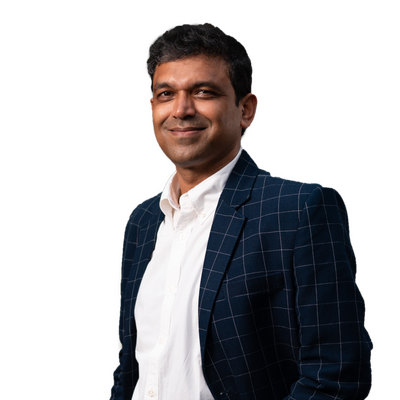

Karthik Reddy
Karthik Reddy is the Co-founder and Managing Partner at Blume Ventures, one of India’s leading early-stage venture funds with over US$900 million in AUM. Blume invests in emerging tech and tech-led innovation from Seed to Series A…- Current Section
- Co-founder & Partner
- Sector
- Media, Entertainment & Gaming, ConsumerTech