
How Minimalist Hit ₹100Cr in Just 8 Months from launch | S4E7 | Destiny Avenged | Weekday Ep

- Episode
- Weekday Episode 7
- Published
- Reading Time
- 14 minutes
We are back with another crisp weekday episode of S4 of the Blume Podcast. In this episode, Karthik Reddy sits down with Mohit Yadav of Minimalist to unpack the secret sauce behind India’s fastest-growing new-age beauty brand of the decade. In case you missed the full episode, we have compressed it to give you all the goodness in 1/4th the time, perfect for your lunch break!
Here are three insights that stood out for us from the episode:
1. Radical Transparency as a Core Philosophy
Minimalist built their entire brand on honesty. They printed pH levels, supplier names, and ingredient sources directly on their packaging, rejecting the beauty industry’s opacity and buzzword marketing. Customers tired of the industry’s false promises took to this approach immediately.
2. Problem-Solving Over Maintenance
Rather than launching with everyday maintenance products like moisturizers, they started with hardcore problem-solvers: acne treatments and pigmentation serums. The insight? When customers see visible results in two weeks, they’ll trust you with everything else. By beginning with just 6 – 7 targeted face serums, they built deep credibility before expanding into other categories.
3. Deep Customer Learning Through Direct Engagement
For the first two months, both founders personally answered every customer query. This gave them invaluable insights that shaped their entire product philosophy. For instance, printing the PH levels on their bottle was a response to the repeated customer questions around it in their queries. Its important to do things that don’t scale to stand out from the crowd.
If you’re building a consumer brand, obsessed with customer-first strategies, or believe transparency beats marketing hype, this episode is essential viewing.
[00:00:00] Karthik Reddy: Beauty products, personal care, there is like tons of products out there. By now, Nykaa and Purplle are growing. There is Mamaerath. There is like Sugar. So, you have seen big companies, why did you think you will stand out?
[00:00:11] Mohit Yadav: When we started getting a little deeper into the category, in our two years at Freewill, we realized there is a lot of opacity.
We will not have those opacity into our communications. So, we will make it like transparent. Was it transparency? It was always about transparency. If you treat people right, they become an evangelist. We are very smart as a community, as a society to figure things out. And you cannot be selectively honest.
[00:00:36] Karthik Reddy: But suddenly, like within 8 – 12 months, you are like a 100-crore brand. What happened? What is the lesson or clues you can give for other folks who trying to build a 100-crore brands in one year?
How did the thought process around building this kind of a product evolve?
[00:00:58] Mohit Yadav: No. So, it never started as a Minimalist as an idea. It actually evolved with time. So, when both I and Rahul left, we were, as I said, with CarDekho and Rahul was building a lot of digital products. So, he was a pure play, a product and tech guy. And our initial idea was to use that experience and build certain consumer product around it. So, we started with a brand called Freewill. There, we were doing personalized haircare.
[00:01:25] Karthik Reddy: Yes, I saw that.
[00:01:27] Mohit Yadav: So, a user can come on the site, answer some 25, 26 different questions based on your lifestyle, your goals, your current hair style, statuses and all. And then this entire answer will convert into an algorithm. We will use certain actives in different concentration, depending on your individual profile and create a product from scratch. It looked like a FMCG, but in our mind, it was a pure play tech company.
Because we felt that this is something that we understand. And if you are able to create personal solution, very easily we feel this is a better product than what is available in the market. Because at the end of the day, you have those four or five solutions, which are not custom created for you.
And a lot of small, small thing in terms of your weather, humidity, your exposure to chlorine, whatnot, impact how your hair looks like. So, we onboarded some research guy from US. He knew how the R&D function should work. We just converted all that into a program, and that is how the journey started. We launched, I think in 2018. We launched in October, 2018. We ran that business for almost a year. We saw initial success also.
And we scaled to around, 12 – 15 crore of ARR. And it was profitable. And we felt that, okay, this is it. right? This is the PMF, good early signs. So, we raised a round through Surge. We were part of the second cohort.
After four or five months, we realized that there are certain limitations. So, initially the plan was we will do D2C. And then with time we will do offline. So, we will set up kiosk in malls, in multiple other places. You can go answer those on a tab and can see a product being created in front of you.
The laws in India are a little different and if you mix two different active, if that become a third solution, it is called manufacturing. It can only happen in a manufacturing industrial area. So, we spoke to a lot of lawyers and tried to figure out a way around it. And everyone said that till you are small, no one will notice. But at any point in time, it can become a risk and this entire thing can go down.
So, that is how actually the journey for Minimalist started. So this was probably early 2020. And just after a month or two, we all got impacted by COVID. Very, very tough time for everyone. And there was no supply chain. We also got like three months doing nothing. And we were working on personalized skincare parallelly around that time, which was supposed to be launched in June or July.
But looking at those distribution challenges, we felt rather than doing a personalized product, why cannot we build different brand, offer specific solution-based product, and let us see how that scale. So, in Freewill, we would have put, say, if you are dealing with pigmentation and aging, I will put both that in a bottle and give that solution to you.
We felt that why cannot I create one solution, which is very, very potent for pigmentation one, say, for aging.
Now, there are two products. Those who need both solutions can buy both. And with that I can leverage retail, e‑com, every other channel. And let us see how it evolves. So, that is actually how the journey for Minimalist started.
[00:05:00] Karthik Reddy: Fascinating.
Beauty product, personal care, there is like tons of products out there. By now Nykaa and Purplle are growing. There is Mamaearth. There is like Sugar. So, you have seen big companies. Why did you think you will stand out? I do not get where that conviction came from. So, walk us through that.
[00:05:17] Mohit Yadav: See, rather than honestly design, when we were also doing hair care, idea was to solve problems. And personalization was a way to solve those problems. We never even launched Freewill with those claim that, hey, we have a product which contains, say, your Brazilian clay, Amazon Rainforest, and all right.
[00:05:38] Karthik Reddy: Understood.
[00:05:39] Mohit Yadav: We felt that, someone who is dealing with, say, hair loss is looking for a product for hair loss. It does not matter where it come from. And they would be more people like us who are more functional, and use product largely for those benefits and not for the marketing statements. And maybe because so many years we have spent in tech where things are largely like problem solution, right? Not market-ish, very flurry in terms of how it has been offered.
So, that has been, maybe, our life, our thinking. And when Minimalist also started, we were talking to a lot of suppliers around that time, and we felt that around 90 – 95% of those conversations are just around, hey, I have a story. And I always feel that, I do not know, whether that is the right way of creating it, that I have a story of, say, a particular product, particular plant. This is used for some really great benefit.
And we felt that, if this is clinically proven, it should be a mainstream thing. It should not change every two year. And actually, if you will go back earlier, between like 2010, 2018 or so, every year there is a new concept. And that concept will change every year.
And we felt there will be at least some customers like us who do not care about whether I am using one of those buzzwords. and just go solve the busy problems. So, that is how it started. Secondly, when we started getting a little deeper into the category in our two years at Freewill, we realized there is a lot of opacity.
While everyone say that we are consumer focused, we are really consumer first and whatnot, in reality that is not true. People are taking for ride, left, right and center. And if you will start reading some labels, you will understand what it claims, what it offers. So, we felt that it was actually those moments where we felt that this is how it should not be done.
And when we will build, we just want to focus on two things. One is we will not have those opacity into our communications. So, we will make it like transparent. And secondly, if we do not like those no claims and all, the value around which the branch should build is largely on clinically proven. Then, it is not subjective. That I think this is good. If I can go prove that in an independent lab, whether it work, then I know it is working, otherwise not.
And then everything around it, when you see product, communication, design, labels, colors, everything revolved around these values. So, why it is black and white? Because usually we say that, no, it is like complete black and white. There is no gray. So, we felt that black and white should be a design language.
[00:08:26] Karthik Reddy: It comes through.
[00:08:27] Mohit Yadav: Yeah.
[00:08:28] Karthik Reddy: Is it like when you speak that transparently and you are very open with what you are solving, what you have, do customers tend to love you a lot more, trust you a lot more? How much of a part do you think that played in the success of Minimalist?
[00:08:43] Mohit Yadav: Good you asked this, because a lot of time in those business conversations, people overcomplicate with a lot of jargons. End of the day customers are humans. They are people, right? And you start to see what we value as humans. How many relationships you have right now with, say, your friends, your family, your spouses, kids, whatnot, which are deep but not built on transparency and honesty. If you start to see your customers just like human, these are certain things that we all value.
[00:09:17] Karthik Reddy: Yeah. It was very core to us.
[00:09:18] Mohit Yadav: Yeah. So, it is not that has it changed right now? I think what really changed right now is our exposure on social media. So, it is very easy to communicate. Earlier, if I know I am, say, aware consumer and what the brand offering is incorrect, for me to communicate back to customer, it is very difficult, right? Maybe I can talk to five of my friends and all, but my reach is limited to those five, maybe 10, 15.
Now, with social media, everyone is creating content. So, virality of that is very, very different. Second is, and again, one thing that we realized in our journey, there is an income disparity, but knowledge parity. So, say, even a person from a low-income background in, say, a Tier‑3 city or a village, can follow, say, a dermat in US, know exactly what should go into a skincare and how he should or she should consider the product.
The person may not be a consumer today because of the income reason, but the same tool is available to both.
[00:10:27] Karthik Reddy: Absolutely.
[00:10:29] Mohit Yadav: Initially when we started, our hypothesis was this is something that maybe people in metros, that to an age group of 18 to 22 will understand. And that tool maybe in a higher income group. And we were random looking at our data on Amazon, 50% of business were coming from Tier‑3 cities and small villages, 50%.
[00:10:51] Karthik Reddy: Wow.
[00:10:52] Mohit Yadav: Some of those orders used to come from area where there is no even address. So, you will say that my name and this address is exact opposite to this temple on third gully or fourth gully in some very random area you have not even heard of.
[00:11:04] Karthik Reddy: For a Minimalist product within the first year or two.
[00:11:06] Mohit Yadav: Within the first year.
[00:11:07] Karthik Reddy: That’s crazy.
[00:11:09] Mohit Yadav: I think that was honestly the moment where we felt that maybe at some point in time will plateau because not too many people understand, but we are amazingly surprised by knowing that how much people know today. And going back to your question, was it transparency? It was always about transparency. If you treat people right, they become an evangelist. We are very smart as a community, as a society to figure things out. And you cannot be selectively honest.
[00:11:37] Karthik Reddy: Here you are trying to figure PMF, you got to some number, but suddenly, like within 8 – 12 months, you were like a 100-crore brand. What happened? What is the lesson or clues you can give for other folks who are trying to build a 100-crore brands in one year, Mohit?
[00:11:55] Mohit Yadav: So, yaar, it looked like it is a eight-month journey or one-year journey, but actually it is not. See some of the work we have been doing at Freewill also. So, we had a plant. We made lot of mistakes setting up Freewill.
So, there were some learnings in that journey also. We had an R&D team. Some of them were working on product for almost a year. So, there was some work done before launch for almost two year in which we learned, made mistakes, understood before the day one, right?
So, actually from launch, of course, it looked like a very different story altogether. But all we wanted to do it is just two things. So, one idea was, again, I said, solving problems first, rather than going into the maintenance category. If I can solve some hard-hitting problem, your trust on the non-core problem is also very high on me.
So, if I offer a moisturizer, you cannot see a visible difference after five usage or 1ten usage.
[00:12:57] Karthik Reddy: That is right.
[00:12:57] Mohit Yadav: And maybe a repeat will be much lower, but say if I offer something again, I said for acne pigmentation, and you see a visible change after two weeks, your trust on me is much higher and you will come back and buy maybe some of those non-core products.
[00:13:09] Karthik Reddy: That is a great insight. Need to have versus like to have.
[00:13:12] Mohit Yadav: Yeah, exactly.
[00:13:13] Karthik Reddy: You are so focused on the need to have.
[00:13:15] Mohit Yadav: So, our first year was all about need to have hardcore problem-based product, right?
[00:13:23] Karthik Reddy: How many SKUs or categories did you?
[00:13:25] Mohit Yadav: No, it was all face. So just one, category. All just serums. And, if I am not wrong, we had like six or seven products. Six or seven SKUs.
[00:13:33] Karthik Reddy: Got it.
[00:13:34] Mohit Yadav: But across different problems.
[00:13:36] Karthik Reddy: Understood.
[00:13:36] Mohit Yadav: Which are the mainstream problems in India and globally also, right? So, that is how it started.
Second, we knew because we have focused so much on product. Somehow, we knew that results will come. Now, how to communicate that to the customer and how to have that honest, transparent relationship, right?
So, those small, small things sometime are not visible, but we never invested in say, influencer marketing. We felt that when people are smart enough, again to figure out that I am saying, oh, I have been using this product, I do not have now acne issues, right? If I go back and see your reels, which you did a month or two months before, and I cannot see an acne, I know you are just faking it. So, why cannot we have real customer stories and all?
So, we waited for two or three months. After that, then become more viral and you start to see those snowballs. So, one, there was referrals. So, those were pretty happy with it. They were referring to others. And then the second wheel was repeat. So, when both started to work, you see the effect of compounding.
[00:14:42] Karthik Reddy: That creates a crazy virality and compounding.
[00:14:44] Mohit Yadav: Correct. And again, I said that we did a lot of those small, small changes. So, like both I and Rahul used to handle every customer query, not like one or two hours.
[00:14:55] Karthik Reddy: Amazing.
[00:14:56] Mohit Yadav: So, for first two month, no one other than two of us were replying to email, SMS, DMs, comments.
[00:15:04] Karthik Reddy: Just learn everything about the customer.
[00:15:06] Mohit Yadav: Yeah. So, like, 10 to 5 or 6, we were in office. And then from 7 to like midnight, we used to go back home, reply to everything. That gave us lot of insights and help us build what the brand is today. So, like in a small, small thing, people used to say that Oh, I like because you are mentioning pH on your site. And when we saw 5, 10 such comment, we realized if pH is so important, why do not we publish that on the product itself, right?
[00:15:33] Karthik Reddy: It should be on the package.
[00:15:35] Mohit Yadav: And that change even our product philosophy. So, my R&D know that changing certain number on site is very easy. If I am not certain about it, I can go change it anyways tomorrow. If it is printed, better be like fully, fully prepared about it. That people can ask why this is 3.6, not 3.8. And you should have your answers because I cannot go back and change and make it like 3.8 tomorrow.
So, their readiness in product increased dramatically. We even started writing the supplier names and that came from some of those conversations. People said, oh, your product is expensive. And again, when we started, we felt like vitamin C is vitamin C. But you know, there are different forms, from Ethyl Ascorbic, L‑Ascorbic and whatnot. And even if I am using Ethyl Ascorbic, the suppliers are giving that for ₹8,000 to even ₹35,000 because of purity of content and multiple other thing and some of those.
It is very difficult for customer to understand. So, we felt that we will write that I am using this particular molecule from this particular supplier and because of which maybe my product is a little bit expensive than others. And we even started printing that on a package.
[00:16:41] Speaker 3: That is a wrap on this weekday episode of the Blume Podcast. We have handpicked these moments to give you the most valuable insights in the least amount of time.
[00:16:50] Karthik Reddy: Our season partner, Ultrahuman, is back for a second time. I am biased as the seed investor here, but their immensely-loved brand is making waves globally. Ultrahuman is a healthtech pioneer, redefining how we track and improve our health. Their sleek titanium ring, AIR, and its new, rare-metal cousins accurately track sleep, movement, and recovery to deliver real-time health insights and personalized nudges.
Ultrahuman is creating a unique health ecosystem built on top of the variable data. It just launched Blood Vision in the US in addition to India, a blood testing service that offers a panel of over a 100 longevity and chronic disease biomarkers with a convenience of an at-home test. They are also launching Ultrahuman Home globally for environment aware analysis and sleep insights.
Whatever your health fix, go sign up and experience being truly Ultrahuman.
Our season partner, IDFC FIRST Bank has earned its reputation as one of India’s most startup-friendly banks through its FIRST Wings program, which provides dedicated mentorship and tailored financial solutions to help early-stage ventures scale effectively. Coincidentally, many of Blume’s portfolio companies, much later stage, also partner with IDFC FIRST Bank for their banking and financial needs. If you are well-funded and scaling, they are great lending and banking partners, and our portfolio companies would attest to that.
Moderator
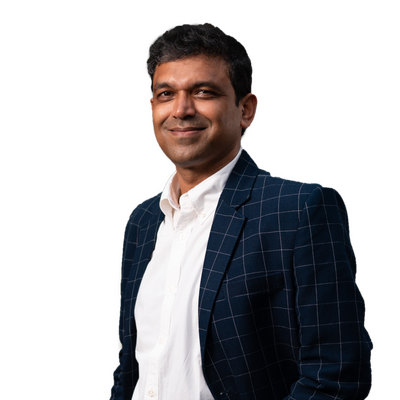

Karthik Reddy
Karthik Reddy is the Co-founder and Managing Partner at Blume Ventures, one of India’s leading early-stage venture funds with over US$900 million in AUM. Blume invests in emerging tech and tech-led innovation from Seed to Series A…- Current Section
- Co-founder & Partner
- Sector
- Media, Entertainment & Gaming, ConsumerTech