
Why energy storage is as much a policy problem as a physics problem?


- Published
- Reading Time
- 4 minutes
India has deployed solar faster than almost anyone predicted. Energy storage, the piece that makes that solar useful after sunset, is moving far more slowly.
This BluPrint looks at how storage will actually get deployed in India: who buys it, why they buy it, and what stands in the way. We presented it at a closed-door evening at Blume Villa in Bengaluru, where founders, investors and policy experts pushed back on parts of it. This piece draws on that conversation.
To read the full BluPrint, click here.
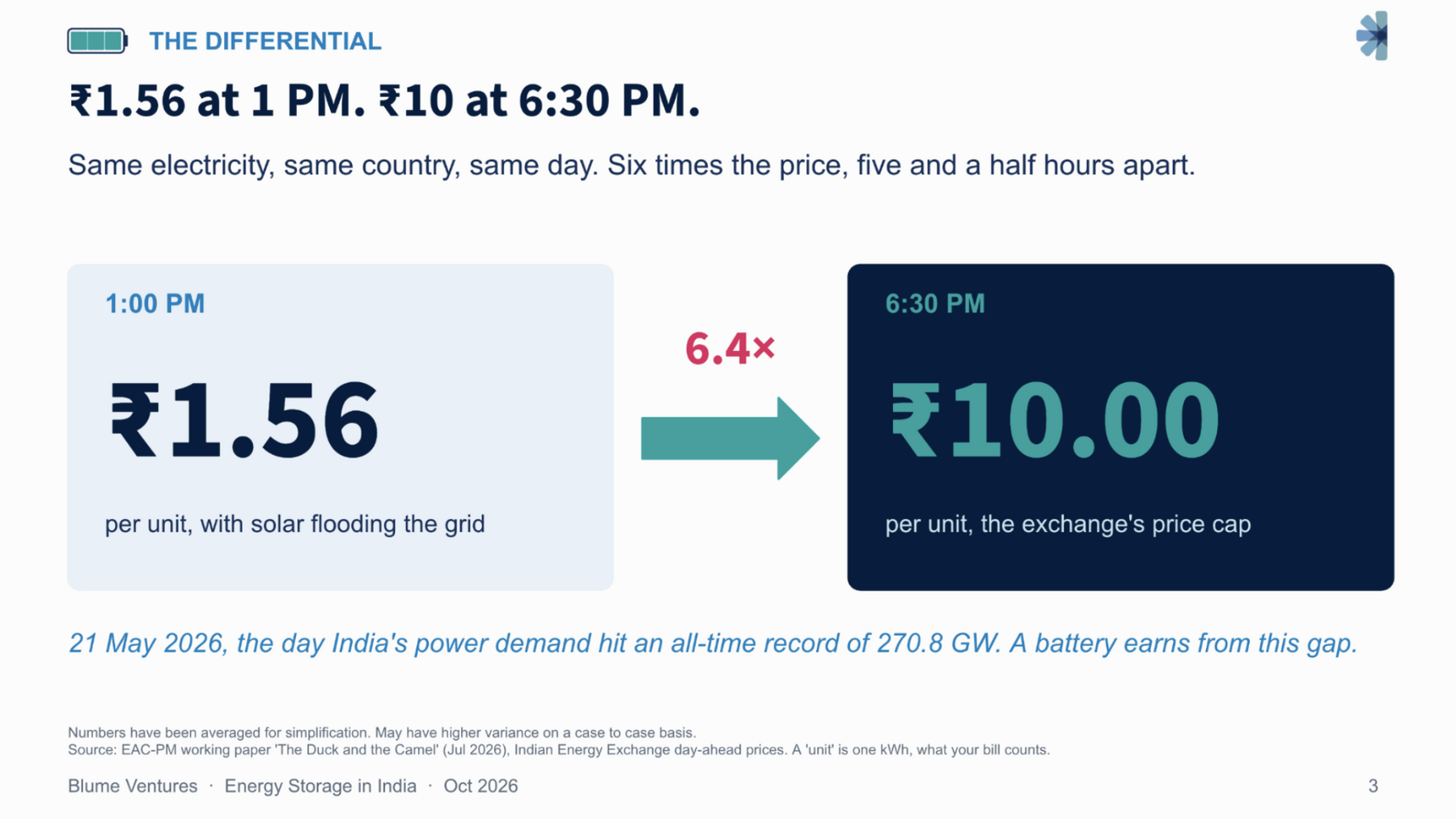
The gap on that slide is solar’s doing. India has about 157 GW of solar, nearly all of it producing in the same few hours, so midday power is cheap and evening power is scarce. Few people now dispute that India needs storage. As one founder on our panel put it, the debate has moved from whether to deploy it to how to make it pay.
Deployment has not kept pace. Of roughly 144 GWh of battery projects on paper, the Central Electricity Authority counted about 5% running at the end of May, and nearly 40 GWh that had won auctions but had no signed contract. Much of that is a pricing problem. IEEFA and JMK Research estimate that about three-quarters of last year’s two-hour capacity was bid below break-even, and cell prices rose after the bids were won. Crisil expects about 12 GWh now under construction to earn weak returns. Supplying the battery itself has become a game won on balance sheets and economies of scale.
A policy expert on our panel, with two decades in storage economics, argued that the way storage is judged makes this worse. Decisions are anchored to the average cost of power, but a battery only needs to beat the most expensive unit it replaces at the evening peak, and every such unit it displaces pulls the average down. By that measure, the argument went, storage has been economical for years, and what has been missing is the business model.
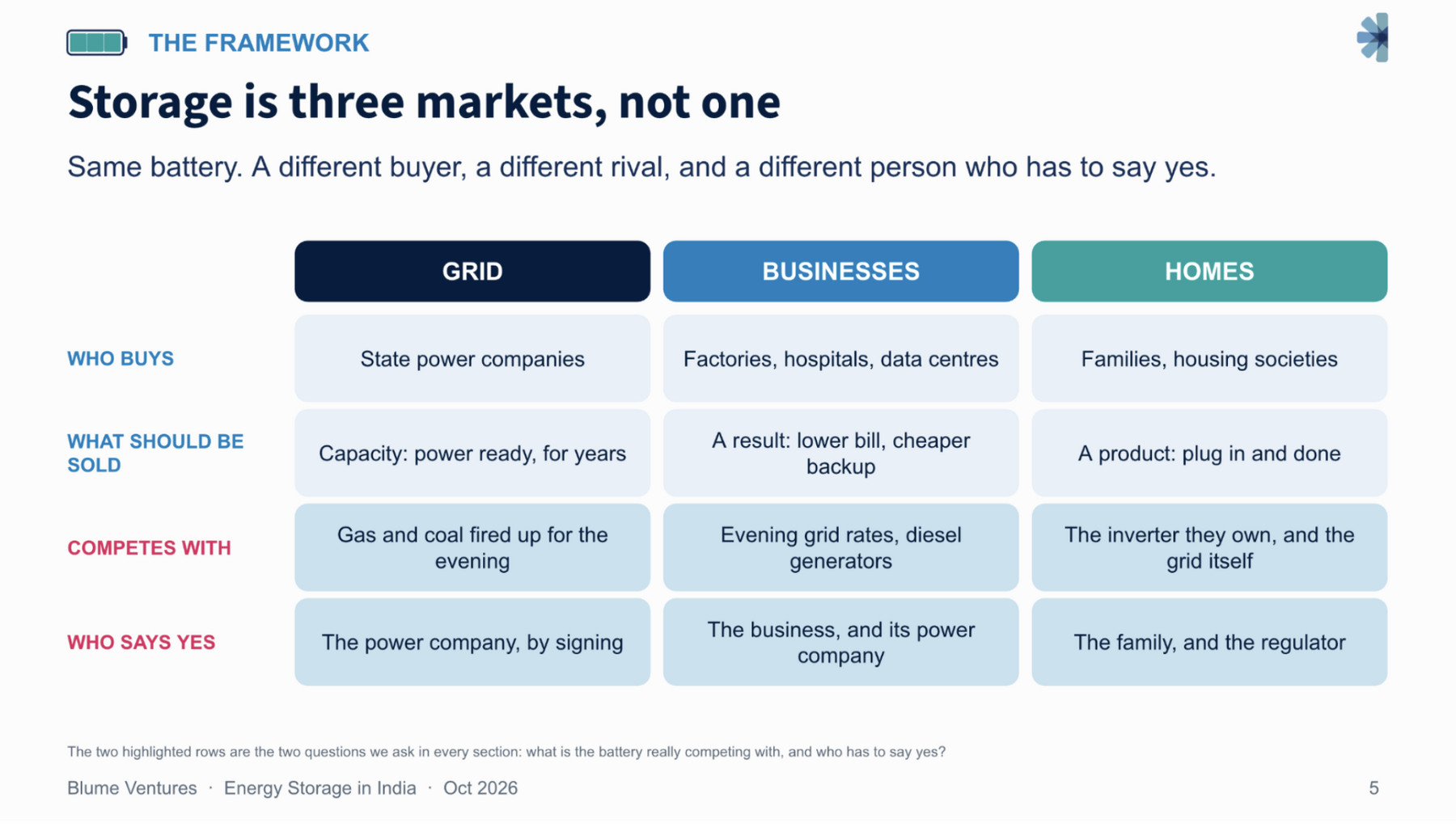
How storage gets deployed depends on who buys it, and what it replaces. The grid is the largest buyer, but state power companies buy through auctions and long contracts, and their finances make them slow to commit. That end of the market favours developers with large balance sheets and patient capital.
Our deck argues that duration is where newer players could matter on the grid, since on peak days power stays expensive for longer than today’s batteries last. The panel was more cautious. Long-duration alternatives still cost several times more than lithium-ion, one expert argued, and 16-hour storage is not yet commercially viable. Its nearer buyers are niches that will pay for resilience, such as hospitals that need multi-day backup and data centres replacing diesel. On cells, the view in the room was blunter still: China has won the electrochemistry race, and India’s opening lies around the cell, in packs, battery management, engineering and integration.
Businesses were the room’s consensus for where deployment happens first. Their alternative is often a diesel generator at ₹25 – 40 a unit, and the decision sits with them. Operating an energy storage system isn’t core to a hospital or a factory, so what they buy is an outcome: a lower bill and backup that works, from one vendor who sizes, installs and maintains the system. Panelists cautioned that “C&I” covers very different customers, from steel and pharma to retail chains and EV charging networks, and that energy management software rarely sells in India without operating experience behind it.
Homes split the room. One view was that households already manage energy carefully and have little use for a battery yet. Another came from a panelist who runs rooftop solar, an EV and a hybrid inverter at home: the economics already work, and the barriers are awareness, financing and installation, from finding a competent electrician to relying on imported energy management apps. Pricing may settle it. Rules from 2023 required time-of-day tariffs for homes by April 2025, a deadline most states missed. Draft rules issued in March 2026 now propose April 2028, tied to the smart-meter rollout.
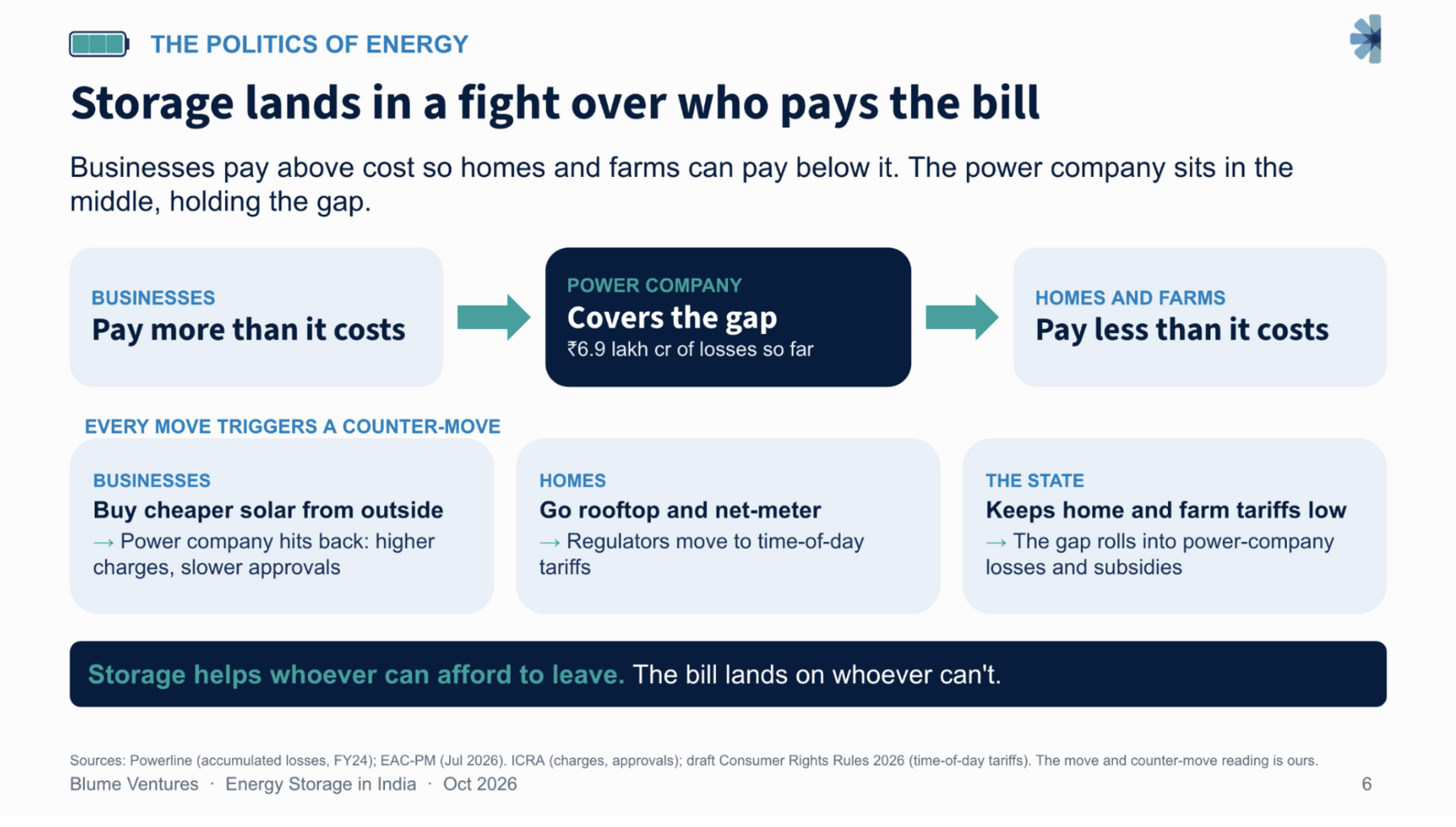
All three markets sit inside an older fight over who pays for India’s power. Businesses pay above cost so that homes and farms can pay less, and every move a customer makes to pay less draws a counter-move: Gujarat raised its surcharge on power bought from outside by 22% in six months. Unlike telecom roaming, about half the charges on a solar unit pay for real physics. Savings built on avoiding charges can vanish with one regulatory order, while savings from moving noon power into the evening hold.
Policy will move slowly, and the panel was clear about why. Open access was legislated in 2003 and is still applied unevenly, cheap power is a political promise, and grid services that batteries provide, such as frequency support, often go unpaid. Their advice to founders was to build businesses that work under today’s rules, rather than ones that depend on better rules arriving.
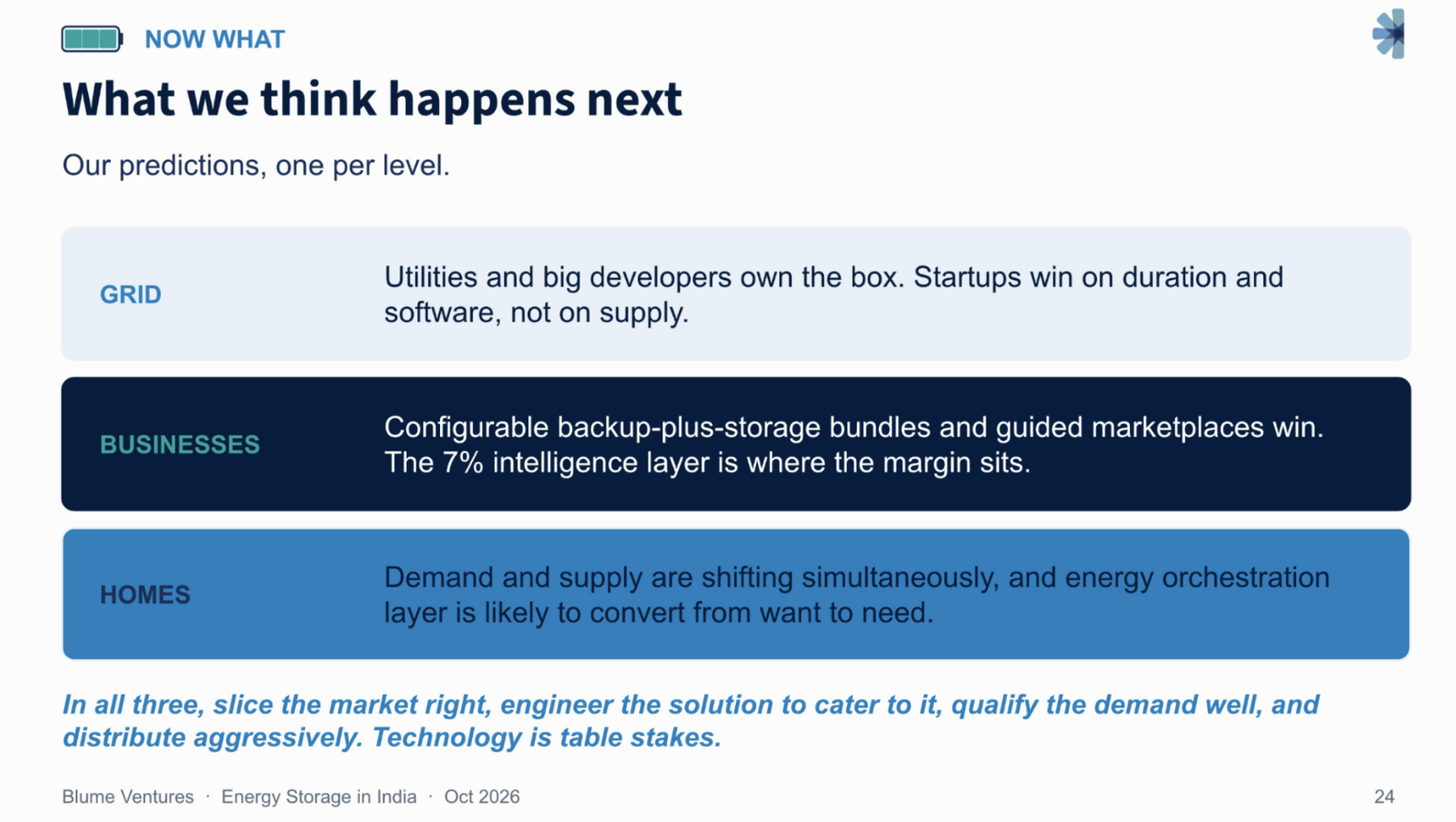
If this reading is right, storage reaches scale in India through businesses first, through companies that sell an outcome rather than a box, and through homes once tariffs reward it. The advice from the room for anyone building towards that was consistent: install real systems and measure them before modelling averages, understand a customer’s willingness to pay and bankability before building, and pick one segment rather than “C&I” as a whole.
We hold these views loosely, and parts of them were challenged on the night, especially on homes and on how soon long-duration storage pays. If you are building in this space, or think we have misread it, we would like to hear from you.
Authors


Yash Jain
Yash is part of Blume’s investment team, where he spends most of his time deep-diving into climate tech and deep tech. He brings over a decade of diverse experience across investing, entrepreneurship, and consulting.Before Blume,…- Current Section
- Associate Vice President, Investment Team
- Sector
- ClimateTech, DeepTech

Kinjal Shah
Kinjal is part of the DeepTech Investment team at Blume Ventures and is based out of the Bengaluru office.Originally from Mumbai, with ancestral roots in Udaipur, Rajasthan, Kinjal graduated with a Dual Degree in Aerospace…- Current Section
- Analyst