
Unlocking High-Value Accounts: The Essential Account-Based Marketing Playbook for SaaS Startups

- Published
- Reading Time
- 20 minutes
- Contents

Did you know that one of the earliest success stories of an Account-Based Marketing motion, or ABM motion, was so successful that it ended up in an antitrust lawsuit?
In 1884, John Henry Patterson acquired a small cash register company in Dayton, Ohio, for $6,500. Little did the world know that this modest beginning would revolutionize not just retail technology but sales strategies as we know them.
Within a few years, Patterson realized that his cash registers were significantly more expensive than the simple cash drawers most businesses used. Instead of lowering prices, he boldly focused primarily on large, prestigious accounts that could afford the hefty price tag and appreciate the long-term benefits. The challenge was that there were only a handful of them — retail giants like Marshall Fields, Macy’s, Woolworths, Sears, and Roebuck, and Co.
Patterson trained his salespersons to not just sell to these accounts. They meticulously tailored their cash registers to each store’s operations, engaged everyone from floor managers to C‑suite executives, and quantified how their machines could slash transaction times and curtail employee theft.
This approach paid off spectacularly. By 1911, NCR sold its millionth cash register and controlled a staggering 95% of the global market, only 27 years after its founding. Patterson’s strategy transformed NCR from a small Midwestern company into a business juggernaut. The company’s dominance was so complete that it ended up in a landmark antitrust case. Despite this setback, Patterson’s approach to sales and marketing is perhaps the first well-known example of what we now know as Account-Based Marketing (ABM).
Today, ABM has become a cornerstone strategy for many B2B SaaS companies. It allows businesses to focus on high-value accounts by tailoring their marketing and sales efforts to specific clients.
In this primer, we’ll cover all things ABM — should you do it, persona creation, messaging, team structure, metrics, and budget allocation. Given the complexity, this might need more deep-dive articles. We’ll delve deeper into these subsections in a series of articles over the next few months.
This series is our attempt to create an ABM playbook for startups.
For this article, we spoke to Arun Gopalaswami, CEO of Recotap, an all-in-one account-based marketing software platform; Ankur Gattani, Chief Growth Officer of WebEngage (Blume Fund I company), a full-stack customer engagement and retention platform; and Siddharth Sharma, CEO of YellowKyte, a SaaS marketing agency.
We want to give a shout-out to Demand Spring’s State of Account-Based Marketing report andAndrei Zinkevich’s LinkedIn post. Andrei is the co-founder ofFullfunnel.io.
The article contains trackers and templates, courtesy of Arun, which you can use for your ABM motion.
Without further ado, let’s start from the basics.
What is Account-Based Marketing?
The easiest way to think of Account-Based Marketing is to envision it as Marketing 2.0.
Why 2.0?
Every company does elements of ABM in some form. Whether you are holding events, running ads, or writing thought leadership articles, you are touching on core aspects of ABM.
ABM is all about threading GTM activities and building a comprehensive multi-touch personalized program for high-priority/high-value accounts.
“ABM is a strategy, not a tactic. For me, it’s a way to approach high-value accounts,” said Siddharth.
Arun agreed, “Nobody’s inventing new channels. It’s about how you use those that are available already. It’s the right message to the right account at the right time.”
Ankur expanded, “You define the target account list and the precise message. Then, you create a communication architecture for the top, middle, and bottom of the funnel to effectively take the target accounts through an ‘unknown to known’ journey and problem-aware to solution-aware / AIDA (Awareness, Interest, Desire, Action), any of the frameworks that suit your specific category.”
What ABM isn’t, and how is it different from demand generation?
Now that we’ve explained ABM, it’s important to understand what it isn’t.
Target account size is one of the key differences between demand generation, such as Google ads, and ABM.
“You’d typically map your ACV, sales velocity, and how much you want to spend per account. So, with a $5,000 ACV and an 18 to 36-month customer lifespan, an ABM motion won’t make sense due to its expense and lack of ROI,” said Siddharth.
Arun offers another perspective on demand generation vs. ABM: demand creation.
“By running those ads, you’re targeting people interested in the topic, product, or services to tap into existing demand. In a typical ABM, you start with demand creation. You start with building product and brand awareness and eventually capturing demand.”
Ankur agrees, “intent isn’t always there on day zero in a majority of the accounts. it has to be nurtured.”
While you can start ABM with a small team, Arun believes a company’s demand engine must be firing before embarking on ABM.
“Go for ABM only once you have a working demand engine, have a demand generation team, and there’s a maturity in your GTM. In ABM, what you’re trying to do is make your GTM more effective. If you don’t have anybody on the marketing team or there is a one-person marketing team and two-person sales team, don’t do it,” said Arun.
Another big difference in ABM is that you target multiple stakeholders in an enterprise with high personalization. This means targeting not only the buyer but also key influencers, champions, and users, even if they don’t sign on the dotted line.
“In the traditional marketing approach, you’re treating buyers as leads and leaving out others who might have the same influence in closing a deal. You don’t have to worry about a buyer committee and talking to that committee instead of individuals,” said Arun.
Another important misconception (sort of) is that ABM needs a ton of tools. While you do need tools, they come in much later. You can start with what you have.

ABM readiness checklist
- Your ACV should be USD30K or more, according to Andrei’s LinkedIn post, but it could be higher depending on your industry.
- Do you have a finite number of companies to sell to?
- Do you know your ACV, sales velocity, and LTV with certainty?
- Does your purchase process involve more than 2 – 3 people in the target company?
- Can you dedicate a pilot ABM team without quarterly pipeline pressure, at least for the immediate future?
- Can your company handle (comparatively) longer sales cycles for dream accounts?
If you don’t check most of the boxes above, ABM isn’t for you (yet).
Now, let’s dive into the nitty-gritty of executing an ABM campaign.
Here are the top things we’ll uncover:
- Figuring out the ICP and buying committee.
- Creating your target list.
- Choosing your anchor channel.
- Figuring out the right message.
- Building an early ABM team.
- Sales and Marketing handshake.
- Budgets, ROI, and more
Finding the Ideal Accounts for ABM
Determining the Ideal Customer Profile (ICP) is the first step in a successful ABM motion.
“ICP combines target accounts and decision-makers. In ABM, unlike usual demand gen, it’s a tighter list,” said Arun.
In ABM, the ICP is defined at a granular level, focusing on specific accounts rather than a market segment. The ICP for an ABM campaign includes the firmographic, demographic, and behavioral characteristics of the targeted accounts.
ABM requires a deeper understanding of each targeted account, including their pain points, challenges, and decision-making processes. This insight tailors the marketing messages and content for each account.
The ICP should consider the account’s likelihood of purchasing the SaaS solution in the near term and the potential lifetime value (LTV). Factors like budget, decision-maker engagement, and current technology stack are analyzed to determine the account’s readiness.
Arun says there are two approaches to drawing up account lists: strategic and tactical.
Strategic is usually for big firms like IBM and Microsoft, who have the resources, both money and human capital, to go doggedly behind a handful of dream accounts.
“They start with a ‘dream list’, à la the best target accounts from the universe of accounts and go after those. They can nurture, educate them, and keep engaging with them, whether they have a demand today, tomorrow, next month, or next year.”
Most startups can’t do this and have to be practical. That’s where tactical ABM comes into play.
“They should figure out how to tune their demand-gen activities to focus on a subset of 10, 20, or 50 accounts where they can actually go deep. That is the tactical ABM.”
“Someone has to monitor daily and check, ‘Does this account match my ICP?’. If you use deal value as a parameter, can this account afford it? Then run it through that ICP filter and see if it matches. If it does, we mark it as our target account and nurture it,” said Arun.
Our experts highlighted rules of thumb for startups to identify and prioritize ICPs.
1. Look-alike targeting: Arun suggests targeting companies similar to your successful clients. For example, “If you already have Pepsi (as a customer), target Coke or other beverage companies.”
2. Regulatory-based targeting: For industries affected by new regulations, prioritize accounts likely to be impacted. As Arun says, “You have 200 accounts. You know 20 will be hit by the upcoming regulation. You need to prioritize those because demand will come from those accounts. You want to respond to them as soon as possible.”
3. Technology signals: Look for opportunities based on technological changes or company needs. Arun explains, “the trigger comes because a product they were using has reached the end of a cycle.”
Another angle to the ‘technology signal’ is what Ankur calls Greenfield (don’t use a certain kind of software) vs. Brownfield (use a competitor’s software) accounts.
Ankur explains, “If I were to say whoever is at a $100k ACV now (big company with paying potential), but still not using our platform or that of a competitor, they are greenfield. That’s my first priority because these are people who are still not in the category yet.”
He notes that targeting brownfield accounts can be effective if you can demonstrate substantial incremental value over their current solution.
“Do they have an enterprise legacy solution or a new-age competitor within Brownfield? Then the conversation changes. So, this affects your target account list as well as messaging,” said Ankur.
4. Serviceability: Consider the ease of servicing accounts as a factor in selection ‑Do you have customer success people who can handle 1000+ tickets daily? Serviceability considerations ensure a high-quality experience for targeted accounts, increasing the odds of successful conversions and long-term customer relationships.
Ankur also suggests considering factors like the aggressiveness of your outreach and the bandwidth of your business development team.
“From a prioritization lens, it boils down to how aggressively and thinly you want to spread. If you have low BDR bandwidth and several target accounts in the funnel, you want to reach just enough people to cover that target instead of reaching everybody.”
He also advocates for a focused approach, stating, “My current preference is to show high intensity, high frequency to a smaller group of people so that whoever I call is definitely aware of me, instead of having a low frequency to a large number of people.”
Arun proposes a batch-based or ‘flights’ approach to managing tactical ABM by grouping target accounts into batches based on the company’s conversion cycle.
If it usually takes six months to convert an account, the batch lifetime could be set to six months. During this period, the company focuses on engaging and converting the accounts in that batch. The batch is retired once the threshold is reached and a new set of accounts is identified. However, just to clarify, you could operate multiple batches, say, monthly or fortnightly, and each of these batches could run for six months. This means you could have more than one batch running at any given time, and they’ll end six months from when they were started.
Here’s a helpful tracker you could use or customize for your research. (Download link)
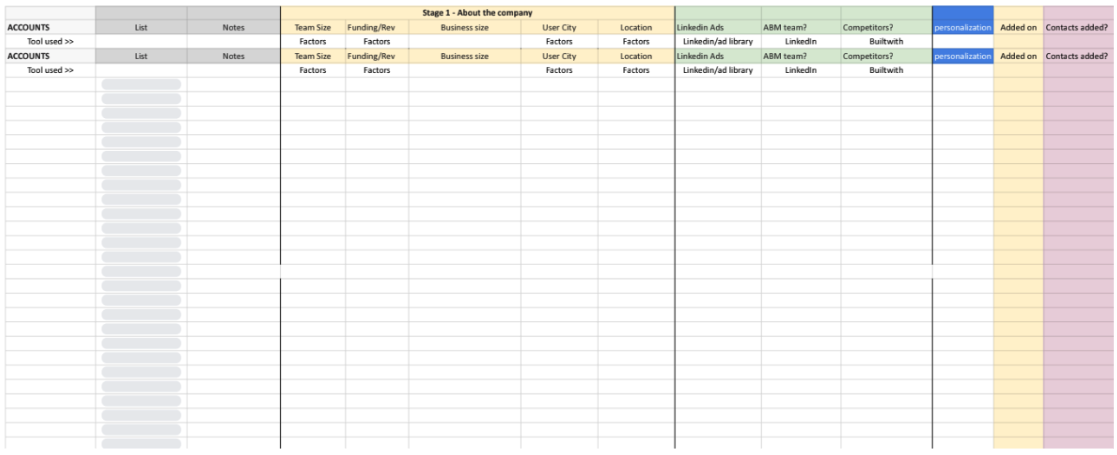
Building buyer committees/groups for these accounts
Unlike demand generation, you must identify a wider set of stakeholders — key decision-makers, influencers, and users involved in evaluating and purchasing your software. Then, you must determine their goals, challenges, and decision-making criteria for each role.
Here are the common B2B buying roles:
- Decision Maker: The person with final authority to approve the purchase, often a C‑level executive — CFO, CIO, CISO, or CTO. These titles are often called L1s.
- Budget Holder: The person who controls the purchase budget but may not be the final decision-maker. They are typically VP-level executives. This person is usually an L2.
- Influencer: People who have significant influence on the decision-making process, such as technical experts or department heads. Mostly L2.
- Gatekeeper: People who control access to decision-makers, such as executive assistants, can help or hinder your ability to engage with the account.
- User: The people who will use your product, whose buy-in is critical for successful adoption. This profile is an L3.
Create a detailed profile of your ideal account, including firmographics (e.g., industry, size, location) and behavioural (e.g., buying process, decision-making criteria) characteristics. Then, map these key roles with names, designations, email IDs, and social media handles for each ICP. You need to determine the most effective channels and messaging for these prospects.
As your business, market, and customers evolve, you must review and update your ICP and buying committee lists.
Siddharth said, “Your ICP will add up over time as you build more products/features and enter new markets. You’ll figure out what’s missing, what to add, and what your competition is doing. The more you add to your product, the more value you unlock, the more your ICP will grow. So, you’ll have multiple ICPs.”
Start with your anchor channel
Once the ICP process is up and running, it’s important to find the right anchor channel.
“Your anchor channel is something that’s already working for you. For some, it could be events; for some, it could be emails. The other channels become layers on top of it to provide surround sound,” said Arun.
“When you have something that’s working, use it as an anchor until you find another anchor channel. Maybe you’re not doing events. When you’ve grown enough and have enough budget, now you can do events. Now, maybe, events can be your anchor channel,” he added. “There’s no one-size-fits-all playbook.”
Arun also cautions that not every channel is a conversion medium.
“Not all channels should be conversion channels. It is a myth. So, if one thinks that my entire ROI for that particular channel is about whether that particular budget I spent, did it convert? it may not really work. Think of a newspaper or TV ad; there’s no real interaction, but it is driving engagement,” he said.
It is important to keep your eyes open to new or unexplored channels.
“Every place your customers or audiences are is a potential channel. If you’re not exploring, and your competitors aren’t either, it’s worth trying,” said Arun.
There’s no reason to believe that you can’t be creative in B2B sales. For example, Recotap has a Dilbert-based comic series.
“It’s been running for about 52 weeks today. We printed it and made it into a book. Unlike email subscription, nobody’s going to object saying don’t send it to me. We can say, ‘Hey, I wanted to send this. I thought you’d find it interesting. Have a look’, and then plug in whatever else you want to say,” said Arun.
Here’s a non-exhaustive list of channels that can be a part of the ABM mix:
1. Targeted advertising: Display ads, social media ads, and retargeting.
2. Email marketing: Personalized emails and email nurturing
3. Content marketing: Personalized content like thought leadership blogs; interactive content like quizzes, calculators, and assessments
4. Social media: LinkedIn, X, Reddit, Facebook, and Instagram
5. Direct mail: Postcards, packages, gifts etc.
6. Events and webinars
7. Sales outreach
8. Website landing pages
Next steps after identifying your anchor channel
Develop a strategy indexed on the anchor channel: Let’s say your anchor channel is email marketing. You must now develop content that can be distributed through emails, such as newsletters, personalized offers, and exclusive insights. Use this anchor to guide the development of content for other channels, ensuring a consistent and cohesive message.
Integrate channels for maximum impact: Once your anchor channel is established, integrate other channels to complement and enhance it. For instance, if email marketing is your anchor, support it with targeted social media ads and personalized landing pages that reinforce the messages sent via email. Like Arun said, this will help create the “surround sound”, amplifying your reach and engagement across multiple touchpoints.
Measure and optimize: Continuously track the performance of your anchor channel and the supporting channels. Based on the data, refine your strategy to improve the effectiveness of each channel and also look to expand the effectiveness of channels that aren’t your anchor channel so that you can identify more ‘anchors’ over time.
Perfecting the messaging
In ABM, delivering the right message to the right persona in the right account at the right time is crucial for engaging key stakeholders, building relationships, and driving business results.
This is where personalization comes in.
Tailoring messaging to funnel stages: Think ‘Outside-in’
Arun stresses understanding the buyer’s journey and segmenting messaging accordingly. He suggests breaking down the traditional funnel stages of awareness, consideration, and purchase into smaller slices to create targeted messaging that resonates with accounts at each stage.
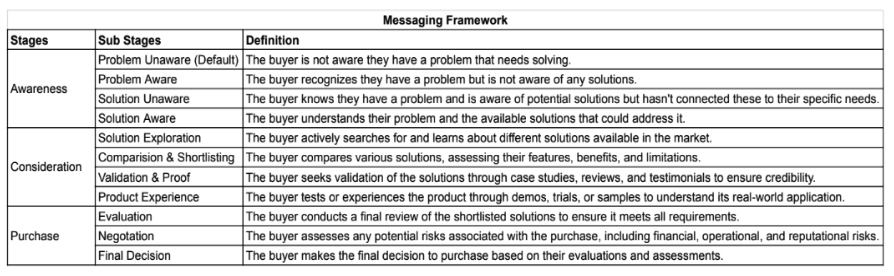
By educating accounts based on their awareness level and gradually guiding them toward understanding their problems and potential solutions, you can effectively move them through the funnel.
Siddharth gives an example, “Initially, people used to market from an inside-out perspective. For example, I’m a cybersecurity solution and I’m selling to the world. This is who I am. This is what I do. These are my benefits. This is my cost.”
“When you start ABM, you’re essentially saying to your prospect, ‘This is who you are. This is why you need cyber security. Are you struggling with total cost of ownership? Are you struggling to onboard a cybersecurity vendor due to delayed implementation? And at risk?”
“Then I will introduce content about onboarding ease, total cost of ownership, quick time to value, and reasons for slow enterprise cybersecurity. And then I will say this is why I’m the best at this. And why these (other options) aren’t the best,“ he said.
Know who you’re addressing.
Ankur cautions against forgetting that you’re selling to multiple personas in the same account, which should reflect in your messaging. “You’ll always have multiple personas. If I’m talking about the marketing guy, product guy, IT Guy, CIO, they’re all different people. The messaging for each comes from the problem we solve for them, and we cannot use a one-size-fits-all message even within one account.”
Arun agrees and suggests bucketing your message by persona/levels of decision-makers.
“These people approach buying decisions with different views but have some common attributes such as pain points and their roles in orgs. This means you could create segment-specific message and relay it to these cohorts of people with common attributes,” he said.
Technology tools are handy for scaling this process. (More tools will be discussed later in this article.)
Siddharth adds perspective: “Even if you cannot segment your audience by pain points, it doesn’t mean you’re not doing a good job. Once you push your content out, you’ll get feedback on sales calls about your content.
“They’ll return and say, ‘This pain point didn’t work for me, but I really like this other point you made. That’s why I am talking to you.’ Then you start segregating. ‘This is the kind of customer that liked this type of content. How can I market more to customers like this?’” said Siddharth.
Refresh the message regularly
Finally, Ankur stresses the need to refresh messaging for engagement and relevance. “Normally, refreshes happen every two to three weeks, then the message gets old, and you start with a new one. You’re trying to ensure the relatability of your brand with a certain type of message and you’re also continuously testing which pitch resonates with your audience.”
To know what’s working and what’s not, you should monitor engagement metrics like email opens, click-through rates, content downloads, and website visits and track the impact on pipeline and revenue.
You can keep your ABM campaigns fresh by regularly introducing new messages and angles that speak to your target accounts’ evolving needs.
What goes into building a bare minimum ABM team?
For companies new to ABM or with limited resources, building a bare minimum team that can execute the strategy is essential. Start by creating a Tiger Team.
The ‘Tiger Team’ approach:
Siddharth suggests starting with a “Tiger team” – a small, agile group of skilled professionals to test the ABM approach quickly. He recommends allocating resources as follows:
- 0.5 Generalist Marketer: Shapes content strategy
- 0.5 Customer Success/Subject Matter Expert or Product Manager: Tailors product knowledge for specific personas
- 1 Full-Time Sales Development Representative (SDR): Owns the entire process and has the most “skin in the game”
- 0.25 to 1 Full-Time Account Executive (AE): Depending on the number of target accounts
“Typically, the person with the most skin in the game leads this. It can be the SDR itself.”
Siddharth emphasizes adding senior resources for the initial team.
“You’d tell your senior resources, I’m giving you a new GTM motion; now it is upto you to prove it works.”
This tiger team needs maturity, accountability, and an understanding of their authority to move ahead.
The three-role approach
Ankur shares the three crucial roles for setting up an ABM team.
1. List Builder/Market Research Specialist: Responsible for identifying and compiling the list of target accounts.
“The first thing I’d want is a smart list builder to know our targets, usually a market research kid or somebody who can source data from the web and enrich/consolidate other sources.Thanks to AI tools, this has become relatively faster / easier now depending on the geos you’re chasing.”
2. Product Marketer: Develops messaging and content strategy for target groups.
“The second person should be a product marketer who can talk about the messaging for each group. If I want to talk to ‘A’ persona in ‘X’ type of companies, what powerful and compelling offering do we have for them, and what kind of outreach will get that message through across mails/calls, content and events.”
3. Campaign Execution Specialist: Handles the technical aspects of setting up and running campaigns.
“…and then you have a campaign execution guy who’s going to create the segments on LinkedIn and put it out.”
Ankur notes that entry-level resources can handle list-building and campaign execution, but the product marketer role requires an experienced strategic thinker.
Bringing it all together
An ideal ABM campaign looks like this:
Step 1: Potential customers know you exist. Utilize targeted advertising, social media campaigns, and content marketing to increase brand visibility among your target accounts. Specific tools (mentioned below) like RollWorks and Leadfeeder can help identify and track the engagement of your potential customers across these channels.
Step 2: Different personas in customer organizations discover your credibility through your messaging across touchpoints. Personalize your content to address specific pain points and interests of various stakeholders within the target accounts. This can include tailored blog posts, whitepapers, webinars, and case studies demonstrating your expertise and success in addressing similar challenges faced by other companies in the same industry.
You could use or customize the sheet below to track the touchpoints. (Download link)
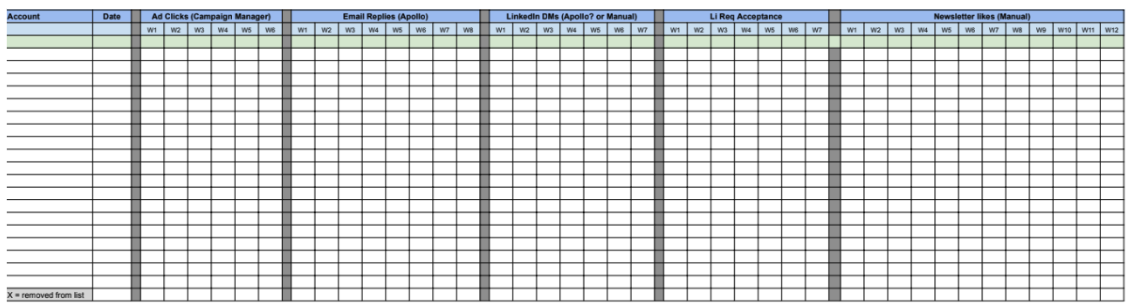
Step 3: Create demand among your target persona, leading to a formal sales conversation request. This step involves nurturing your leads with personalized email campaigns, targeted ads, and direct outreach from your sales team. The goal is to move them from awareness to active interest by showcasing the unique value your solution offers.
Step 4: Once you have engaged the right personas and generated interest, facilitate a smooth transition to a sales conversation. This can involve setting up personalized demos, sending tailored proposals, and involving relevant stakeholders in decision-making discussions. The alignment between your marketing and sales teams is crucial at this stage to ensure that the messaging remains consistent and the handoff is seamless. (more on this below)
Step 5: After successfully converting a lead into a customer, focus on retaining and expanding the relationship. Continue to provide value through regular check-ins, customer success programs, and opportunities for upselling and cross-selling. Utilize feedback and engagement data to refine your approach and ensure long-term satisfaction and loyalty.
Step 6: Continuously measure the performance of your ABM campaigns across different stages of the funnel. Use this data to optimize your strategies, improve targeting, and enhance the overall effectiveness of your ABM efforts.
Aligning sales and marketing teams
At the core of ABM is the need for close collaboration between sales and marketing teams.
Aligning Inbound and Outbound Efforts:
For ABM, you can take an outbound, inbound, or mixed approach. Ankur suggests that it’s mostly a mix that gets things done.
Marketing runs campaigns to drive qualified leads to the SDR team for qualification and demo appointments for inbound.
“Normally, this team can provide a quick demo to showcase the platform. We want to understand more about your intent and your plans. For mid-market accounts, it’s okay to use an elementary BANT qualification — Budget, Authority, Need, and Time — to qualify the buyer as serious before passing it on to Sales.”
On the outbound side, the BizDev team proactively reaches out to potential accounts through LinkedIn, email, and events.
The BizDev team nurtures these accounts and collaborates with pre-sales to develop the need/readiness to engage with sales. It takes time before they can hand them off to sales when they are ready to talk commercials. “For enterprises, if I’ve got a meaningful guy from the company to have a physical meeting with my pre-sales / sales leadership, then the door open job is done. Now, Biz Dev teams move from the driving seat to the navigator seat. The sales guy steers from the driving seat.”
Creating Collaboration
Arun suggests co-locating sales and marketing teams is the best way to ensure collaboration.
“If you co-locate the sales and marketing teams, it works beautifully. It might sound stupid, but it really works. In our office, we’ve turned the glass doors into a writing wall. All the marketing people and I write things down there for the sales team to see.”
He also recommends recording sales conversations and having the marketing team review the transcripts to identify key topics and themes for content creation.

Budgeting for ABM
Arun says it’s wise to initially allocate 2 – 5% of the marketing budget to ABM.
“Typically, they say the marketing budget is anywhere between 35 – 40% of the revenue. 2 – 5% of the marketing budget can be pulled in for ABM.”
Ankur agrees and suggests that budget allocation should be based on the overall spend available after covering essential demand-capture activities like Google ads. He recommends focusing on a smaller, targeted list of accounts with high-frequency engagement rather than spreading the budget too thin.
“I’d suggest targeting a small cohort with high frequency rather than going after a huge cohort with low frequency. Use the available money for, say, five engagements per person per week rather than one engagement per week. That is how I would put that money in,” said Ankur.
Siddharth cautions against expecting immediate ROI from ABM efforts. He states, “You don’t look at ROI when you do an ABM on a monthly or quarterly basis. You do it yearly.”
He emphasizes that engaging accounts and pushing them through the funnel takes time and effort. Judging performance in the short term is not advisable.

What tools are needed to start ABM?
1. CRM Systems:
CRM systems are the foundational platform for ABM, providing a centralized database to store and manage account and contact information, track interactions, and align sales and marketing efforts.
Examples: Salesforce, HubSpot CRM, Microsoft Dynamics 365
2. Account Identification and Targeting Tools:
These tools are used to identify and prioritize high-value accounts based on firmographic, technographic, and behavioral data.
Examples: 6sense, Demandbase, Apollo
3. Engagement and Personalization Tools:
These tools help marketers deliver personalized content to target accounts across channels.
Examples: Recotap, Demandbase, Pardot (by Salesforce)
4. Advertising and Retargeting Platforms:
These platforms let marketers run targeted ad campaigns to reach key decision-makers in target accounts.
Examples: LinkedIn Ads, Terminus, RollWorks
5. Sales Enablement and Orchestration Tools:
These tools help align sales and marketing efforts, providing sales teams with insights, content, and playbooks to effectively engage target accounts.
Examples: Highspot, Outreach, SalesLoft
6. Analytics and Measurement Tools:
These tools help marketers track and measure the impact of ABM efforts on key metrics like engagement, pipeline, and revenue.
Examples: Factors.ai, Bizible (by Marketo), Engagio (now part of Demandbase), Terminus
Metrics to track
1. Number of engaged accounts: Target accounts that have interacted with your ABM campaigns by opening emails, visiting your website, or attending events.
2. Account penetration: The depth of engagement within each target account, measured by the number of key stakeholders reached and their engagement level.
3. Number of discovery calls: Initial calls with target accounts to discuss their needs and how your solution can address them.
4. Number of SQLs (Sales Qualified Leads): Engaged accounts qualified by the sales team as having a high likelihood of purchasing in a finite timeframe.
5. Win rate: The percentage of target accounts that ultimately become customers.
6. Pipeline value: The total estimated worth of all potential deals in your sales pipeline.
7. Pipeline velocity: The speed at which leads move through your sales pipeline stages.
8. CSAT/NPS: Customer satisfaction (CSAT) and Net Promoter Score (NPS) measure customer happiness and likelihood to recommend your product/service.
Ankur also suggests tracking cost per opportunity and cost per win to assess the efficiency of ABM efforts.
“If you’re doing the full funnel stitch, then you’re able to know, okay, this is the set of things that are giving me opportunities, so I’m converting downstream.”
You could use something similar to the tracker below to keep a pulse of your top metrics. (Download link)

In conclusion
If we condense this article into a single sentence, it would be that ABM is about converging your sales and marketing power into a handful of accounts.
From personas to messaging to channels to team structure to budget, one has to keep experimenting and iterating to improve. It’s no silver bullet, but if done right, it could pay rich dividends.
“Wherever I’ve seen ABM work, there’s at least 30% to 40% more ROI than standard inbound and outbound,” Siddharth concluded.

Commentaries


The Outbound Sales Playbook: A Guide for Early Stage B2B Startup Founders
You have an idea and a prototype or a minimum viable product. Now, you want to talk to customers to get them to use or buy your product. What do you do next? Many founders, especially…- Current Section
- Commentary
- Sector
- B2B & Vertical Saas, Horizontal SaaS, Infrastructure SaaS & Dev Tools
- Authors
- Ravi Kaushik Rajagopal
- Published
Customer Marketing Decoded: A SaaS Founder's Playbook for Revenue Expansion
“Sell me this pen.” In the final scene of The Wolf of Wall Street, Leonardo DiCaprio's Jordan Belfort walks around a large conference room, asking everyone to sell him a…- Current Section
- Commentary
- Sector
- B2B & Vertical Saas, Horizontal SaaS, SMB & Vertical SaaS
- Authors
- Vignesh Jeyaraman
- Published

Building a sales pipeline that converts with Shruti Kapoor of Clari and Ex-Wingman
Shruti: “When you are starting up, particularly from a B2B perspective, you're essentially striving to persuade someone within a business to take a bet on you as a founder. Regardless of your product or the caliber of your tech…- Current Section
- Commentary
- Sector
- Infrastructure SaaS & Dev Tools, Horizontal SaaS, B2B & Vertical Saas
- Authors
- Rohit Kaul
- Published