
The Turing Moment: How SquadStack Built AI That Outsells Humans


- Published
- Reading Time
- 11 minutes
- Contents
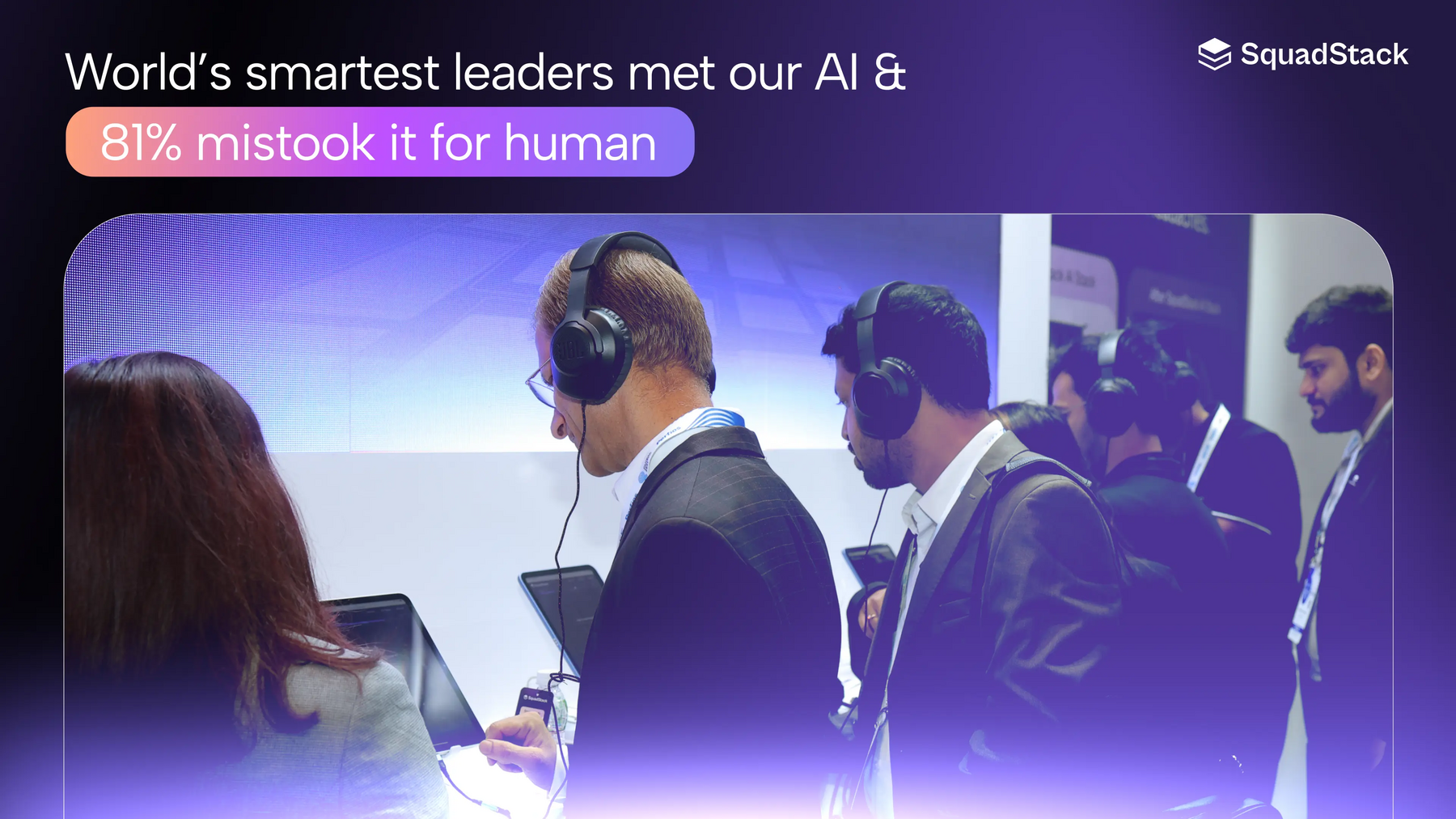
At the Global Fintech Fest 2025 in Mumbai, a crowd clusters around a booth in the exhibition hall. The setup is deliberately simple: a pair of headphones, a tablet, and two phone recordings playing on loop. One is a collections call — a borrower negotiating a payment extension. The other is loan verification — an applicant confirming employment details. The challenge for passersby: guess which caller is human.
Throughout the day, 81% of listeners get it wrong.
Both calls are machines.
These weren’t cherry-picked demos or lab-polished prototypes. They were live, production-grade voice agents handling real sales and collections for some of India’s largest financial institutions.
That day, SquadStack (Fund II) became the first contact-centre company to pass the Turing Test — the threshold where humans can no longer reliably tell they’re speaking to a machine — in real-world conditions.
But SquadStack didn’t start as an AI company.
In 2014, Apurv Agrawal and his co-founders Kanika Jain and Vikas Gulati launched SquadRun — a crowdsourced task marketplace built on one belief: that legacy workflows critical to a customer’s success could be optimized through software while still delivering high-quality output. The method was distributed talent; the mission was better outcomes.
That mission would be tested three times over: a collapsing e‑commerce market forced a reckoning; a serendipitous request from an existing customer sparked a pivot into voice-based sales; then the AI wave demanded reinvention once more.
Each crisis compounded into the next advantage — until an ‘accidental moat’ evolved into a voice intelligence platform.
This is the story of how a company built to connect humans ended up building machines that sound like them.
Seeds of Squad
The first hint of what Apurv would eventually build came in 2009, when he was a first-year engineering student at VIT. A large NGO he’d begun volunteering with was running 200 centres across India on shockingly fragile infrastructure. Their websites were overpriced Blogspot pages. Software updates arrived on burned CDs, couriered between offices. The problem wasn’t a lack of money — it was a lack of access. Developers and designers existed across India; the NGO simply couldn’t find them.
So Apurv built a platform that matched student volunteers — writers, developers, designers — with nonprofits needing digital help.
“With minimal oversight, the system just worked,” Apurv recalls. “Quality emerged from coordination, not control. It proved to me that great talent is distributed — and when connected through the right software, a decentralised workforce can deliver extraordinary results.”
That conviction shaped everything he built next.
In 2014, fresh out of VIT, Apurv founded SquadRun. The idea was simple: build a crowdsourced mobile workforce capable of solving problems at scale. He and his team hustled to onboard their first few hundred workers — students, homemakers, and working professionals seeking extra income — scattered across India, connected only by smartphones.
To the workers, it felt like a game. They’d open an app, complete “missions” — tagging products, classifying images, digitising restaurant menus — and earn SquadCoins redeemable for real money. To the companies paying for the service, it was a quality outcome: thousands of micro-tasks requiring human judgment, completed faster and cheaper than any in-house team could manage.
But building the supply side taught them an early lesson. College students would drift in, earn enough for the week, and vanish. “You need talent that genuinely depends on your platform for livelihood,” Apurv reflects. Homemakers proved more reliable — they stayed, referred others, and eventually became the backbone of the workforce.
With a growing army of reliable contributors, Apurv’s pitch to companies was proudly horizontal. “We have a mini-army. What do you want them to do?”
The rise of e‑commerce provided the tailwind they needed.
Marketplaces were exploding with products, and someone had to make sense of the chaos — tagging items for search, classifying images, cleaning up catalog data, verifying listings. This was grunt work: essential, endless, and perfectly suited to a distributed workforce trained to handle high-volume, judgment-intensive tasks.
At its peak, SquadRun handled 100,000 tasks daily — more than many established BPOs — serving customers like Jabong, Snapdeal, Myntra, and MakeMyTrip. A dozen well-known angels backed the company within months of launch: Deepinder Goyal from Zomato, Kunal Bahl from Snapdeal, leaders from Google, and Kae Capital.
But by 2016, cracks began to show.
The e‑commerce ecosystem was consolidating. Flipkart acquired Myntra and Jabong. Snapdeal was struggling. Smaller marketplaces were shutting down. Data labeling became a commodity — cheaper providers emerged, and the work that remained didn’t require SquadRun’s sophistication.
“We were profitable, global, and yet our biggest customers were dying or cutting 80% of budgets,” Apurv recalls. “That’s when I really internalized that you can be a 10x product in a 0.2x market and it still ends badly.”
SquadRun found itself backed to the wall.
Belief in the mission alone wasn’t enough — it had to be matched with the right market.
The Weekend Hack
The answer came from Myntra. Myntra was already a customer for data tagging when someone on their team asked a question: “You know this whole thing you’re doing for data tasks? The larger BPO market is actually in calling — customer service, logistics ops, sales calls. Can your distributed workforce do that?”
Apurv assigned a small team to hack together a solution. It was considered a side project — interesting, but not core. A weekend later, a scrappy prototype was live: cloud telephony stitched to simple scripts, routed to remote contributors working from their homes.
What grabbed Apurv’s attention wasn’t that it worked — it was how fast it took off. Myntra started pushing more logistics workflows onto the new rail. Other high-velocity internet companies signed up too: MoneyView, Upstox, ZestMoney. They came for pilots and stayed for scale.
What kept them was something traditional BPOs couldn’t offer: speed to launch, real-time visibility into performance, and the ability to tweak workflows like software rather than renegotiating a vendor contract. For companies used to waiting weeks for a call centre to spin up, SquadStack felt like a different species.
For the first time in five years, Apurv felt the unmistakable pull of product-market fit.
“PMF is people banging down your door,” he explains. “That was the first time I truly felt the ‘door-banging’ emotion at enterprise scale.”
The traditional contact-centre model was broken in ways that had become invisible through familiarity. Roughly 30% of spend reached the agent; 50% disappeared into overhead; margins were still terrible, low single-digit EBITDA even at scale.
SquadStack inverted the model. Distributed advisors eliminated the need for expensive real estate. Software replaced layers of middle management. Outcome-based pricing aligned incentives with results. The combination delivered roughly four times better margins than incumbents.
The team pivoted hard, building not just a calling platform but a full stack — everything from lead routing to quality assurance to analytics — stitched together by a distributed workforce. “SquadStack reflected our shift from ‘tasks’ to ‘stack plus outcomes,’” Apurv explains.
But capital wasn’t easy to come by.
“When we pitched to VCs, they practically kicked us out of the room,” Apurv recalls. “BPO was a dirty word — like something you don’t mention in the venture world.”
The industry was also skeptical. The standard pushback: “You want my banking customers’ data going to someone’s house in Ludhiana?”
Then COVID hit. It nearly killed them — and then handed them the market.
Crisis Into Catalyst
“In March 2020, every founder was doing ‘3‑month vs 3‑year’ survival scenarios with their board,” Apurv recalls. “Overnight, a meaningful chunk of our revenue vanished. We were staring at existential questions: do we slash everything or bet into the chaos?”
They chose to bet.
Pre-COVID, SquadStack was still “the weird remote BPO tech company.” Large banks and insurers wanted big glass buildings with thousands of seats in Mumbai or Gurgaon.
When lockdowns hit, that calculus inverted overnight. The same executives who had dismissed decentralised calling were suddenly asking how fast SquadStack could move thousands of interactions off physical floors.
And counterintuitively, compliance got easier. With app-based calling, secure cloud telephony, and 100% recording, a remote advisor was more auditable than a floor where someone could walk out with a pen drive.
“COVID basically compressed 5 – 7 years of mindset change into 12 months,” Apurv reflects.
By 2022, the network had grown to thousands of advisors scattered across Tier‑2 and Tier‑3 India — small towns that traditional BPOs had never considered worth the infrastructure investment.
But the real value wasn’t in the revenue. It was in what they were quietly accumulating beneath it.
The Accidental Moat
Then the AI wave hit — faster than anyone expected.
When LLMs matured, suddenly, every contact-centre company faced an existential question: adapt or die.
“We didn’t anticipate the AI wave to come at that speed,” Karthik Reddy, partner at Blume Ventures, recalls. “The slowdown in customers who spend heavily on marketing — the ones who need outsourced call centres — meant you got a double whammy. Nobody wants a people-expensive business in an AI-first world. They want more volumes, 24×7 reliability.”
For most incumbents, this was a crisis. For SquadStack, it was the moment everything clicked.
“We didn’t wake up one day and say ‘let’s do AI,’ ” Apurv explains. “We were already running hundreds of millions of conversations daily across industries, use-cases, and languages through our own platform. We were capturing 100% of the data — recordings, transcripts, outcomes. We were building our own speech-to-text for messy Hinglish and regional languages because off-the-shelf models weren’t good enough.”
That infrastructure hadn’t been built as an AI strategy. It was simply the most reliable way to supervise a distributed workforce. But when the foundation models matured, SquadStack was sitting on exactly the two things every AI company desperately wanted: distribution into enterprises and a massive, well-structured dataset.
“We have more structured contact center data than anyone else in the world,” Apurv says. “Sierra, Decagon — there are multiple billion-dollar valued assets now globally. None of them have data. We do, because we built a system around data capture.”
In AI, there’s a misconception that performance depends on choosing the “right” model. In reality, the most effective systems are shaped by their training data — its volume, specificity, and whether it reflects real-world complexity.
“The smartest investors ask one question,” Apurv notes. “What is your rate of collecting unique training data?”
The equation is straightforward: more data leads to better decisions, better outcomes, better economics — and a deeper moat.
“The fact that they’ve understood this problem deeply from many years of serving customers with human engines,” says Karthik, “and that they have workloads of trainable data around these human engines — that’s a very powerful learning base, both for business intuition and for the training data that Voice AI needs.”
But data alone isn’t enough. Turning it into a functioning voice agent meant reimagining the entire system around the model.
Inside the Voice AI Stack
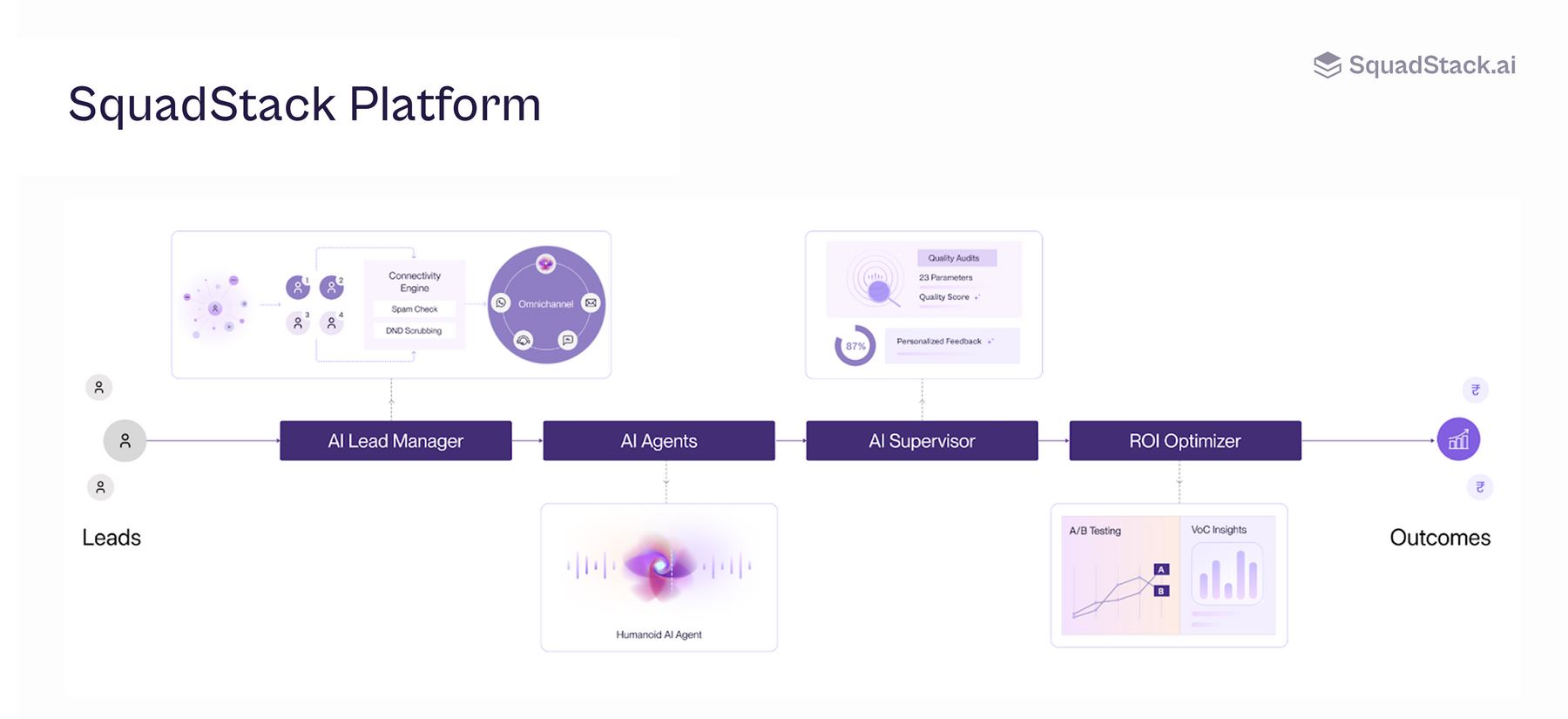
“Beating human numbers is never about a single model,” Apurv explains. “It’s the whole system — telephony, latency, speech-to-text, routing, journey design, QA — everything has to work together.”
This is what SquadStack built to turn that data advantage into voice agents that could match — and eventually beat — human performance.
When a customer answers a call, that system springs into action.
- Perception. If there’s a half-second delay after every sentence, your NPS dies. SquadStack has spent years engineering ultra-low-latency telephony and natural barge-in — so the AI can interrupt and be interrupted like a human. Custom speech recognition, trained on real Indian conversations, decodes Hinglish and regional accents. If this layer mishears the customer, everything downstream fails.
- Decision. A conversation brain — LLMs plus domain logic — decides what to do next: infer intent, clarify, acknowledge emotion, switch languages, handle objections, or escalate. It also chooses which voice and persona to use — Delhi voice for Delhi, Tamil for Chennai. They used to do this with human matching; now they do it programmatically with clones.
- Action. The agent connects to CRMs and internal systems to update records, qualify leads, trigger payment links, schedule demos, or log compliance. It’s not just talking — it’s transacting in real time.
- Compliance. Wrapped around all of this is a layer that enforces RBI/IRDAI rules, consent protocols, DND lists, allowed phrases, and escalation triggers — ensuring the agent behaves like a compliant human in regulated sectors.
- Learning. Every call feeds back into the system — better prompts, better flows, better routing, better rebuttals. Performance data by cohort, geography, and time of day flows into the playbook. The same brain runs across voice, WhatsApp, SMS, and chat, with smooth human handoff for complex or emotional cases.
This discipline shows in results. SquadStack won’t go live unless baseline human metrics, success criteria, and guardrails are locked in upfront — what Apurv calls “ruthless solutioning.” That rigour is why their AI POCs succeed over 95% of the time, in an industry where, according to MIT, 95% of pilots fail.
This full-stack precision is what made SquadStack one of the first voice AI companies to pass the Turing Test — the moment when humans can no longer reliably tell they’re speaking to a machine. At the Global Fintech Fest in Mumbai, 81% of listeners mistook at least one AI call for a human.
“That was the moment we knew,” Apurv recalls. “We weren’t just matching humans anymore.”
Beyond the Turing Test
Passing the Turing Test answers one question: can AI match humans? It opens a bigger one: how large is the prize?
The global contact-centre market is a $500 billion industry that hasn’t fundamentally changed in decades. Voice agents will soon become table stakes — everyone will be able to spin up a basic bot. The winners will be defined by something else entirely.
“Nobody cares if it’s AI, a human, or Elon Musk calling,” Apurv says. “They care about CAC and cost-per-resolution.”
That clarity shapes SquadStack’s roadmap: go deep in India before going wide globally. For the next one to three years, the focus is BFSI, fintech, e‑commerce, and logistics — sectors with massive volumes, complex multilingual journeys, and customers who care about one thing: conversion. In the copilot era, when humans were augmented by software, SquadStack delivered 1.5 – 2x improvements in customer acquisition costs. With AI-native workflows, that number jumps to 2 – 4x.
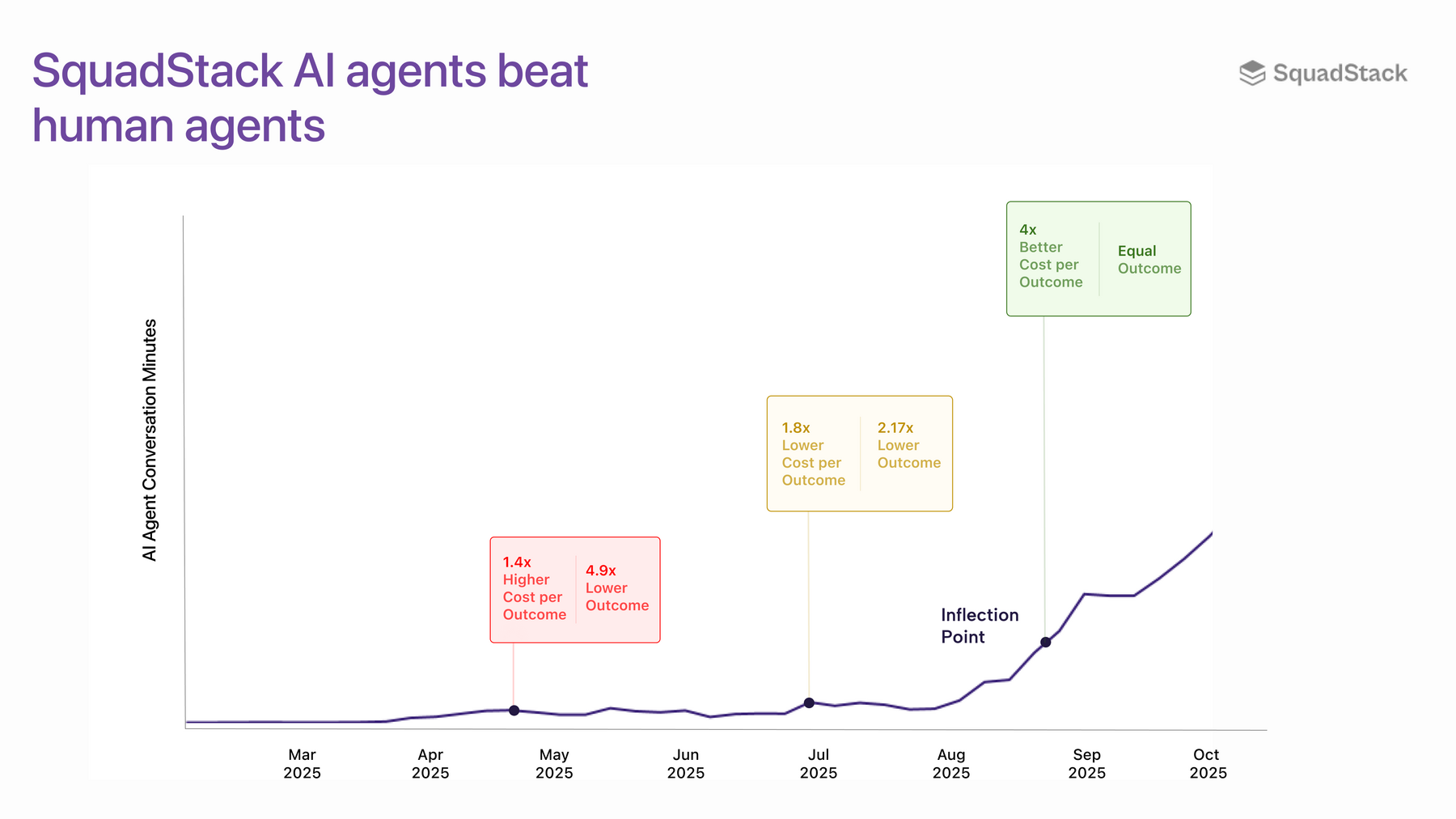
The company charges three to four times what competitors charge — and customers pay it. “This isn’t a cost centre anymore,” Apurv explains. “It’s a revenue generator.” That’s why they’re doubling down on sales — the highest-value, highest-impact workflow in the contact-centre stack.
Once India is locked in, the playbook travels. Apurv says India is the ‘boss fight’ for voice AI: languages, compliance, peak volumes, code-switching mid-sentence, WhatsApp as a primary channel, and a highly regulated BFSI landscape.
“If you’ve solved for India — the nuances, the language complexity, the cost complexity — you can build a great product for any part of the world,” Karthik adds.
The long-term vision is a fundamental restructuring of how contact centres operate. By 2030, SquadStack expects 80% of routine conversations to be handled end-to-end by AI. The remaining 20%? High-value advisory work — humans earning more, doing more meaningful work, stepping in where regulation or nuance demands it.
“Will AI agents completely replace humans? I don’t think so,” Apurv reflects. “The total pie of conversation work might actually grow. Its composition will change.”
“In a foundational shift like this, land-grab matters more than armchair moat-theorising,” Apurv says. “The moat will emerge from data, relationships, and depth of system — not from any clever slide on a fundraising deck.”
— — — — — — — — — — — — — — — — — — — — — — — — — — — — — — — — -
“Even through all its pivots, SquadStack has never strayed from that original mission,” he reflects. “The ability to constantly evolve and get to a natural end state for what was a 2015 – 2016 mission, in 2025 — that’s rare. They stood long enough to ride the wave.”
“But the pivot to AI will define SquadStack in the long term,” Karthik concludes.
The opportunity is to become India’s first voice AI company to cross $100 million in revenue — and to do it quickly. With enterprise adoption accelerating, the leap from $10 million ARR won’t take a decade.
“If we execute well, by 2030 SquadStack should be the company you think of when you imagine ‘Iron Man-style Jarvis for all your customer conversations’ — grounded in India, operating globally.”
At the GFF booth in Mumbai, that future was already speaking — in Hindi, English, Tamil, and everything in between.