
The CFO stack is being rebuilt. India is writing the next chapter.
- Published
- Reading Time
- 7 minutes
- Contents
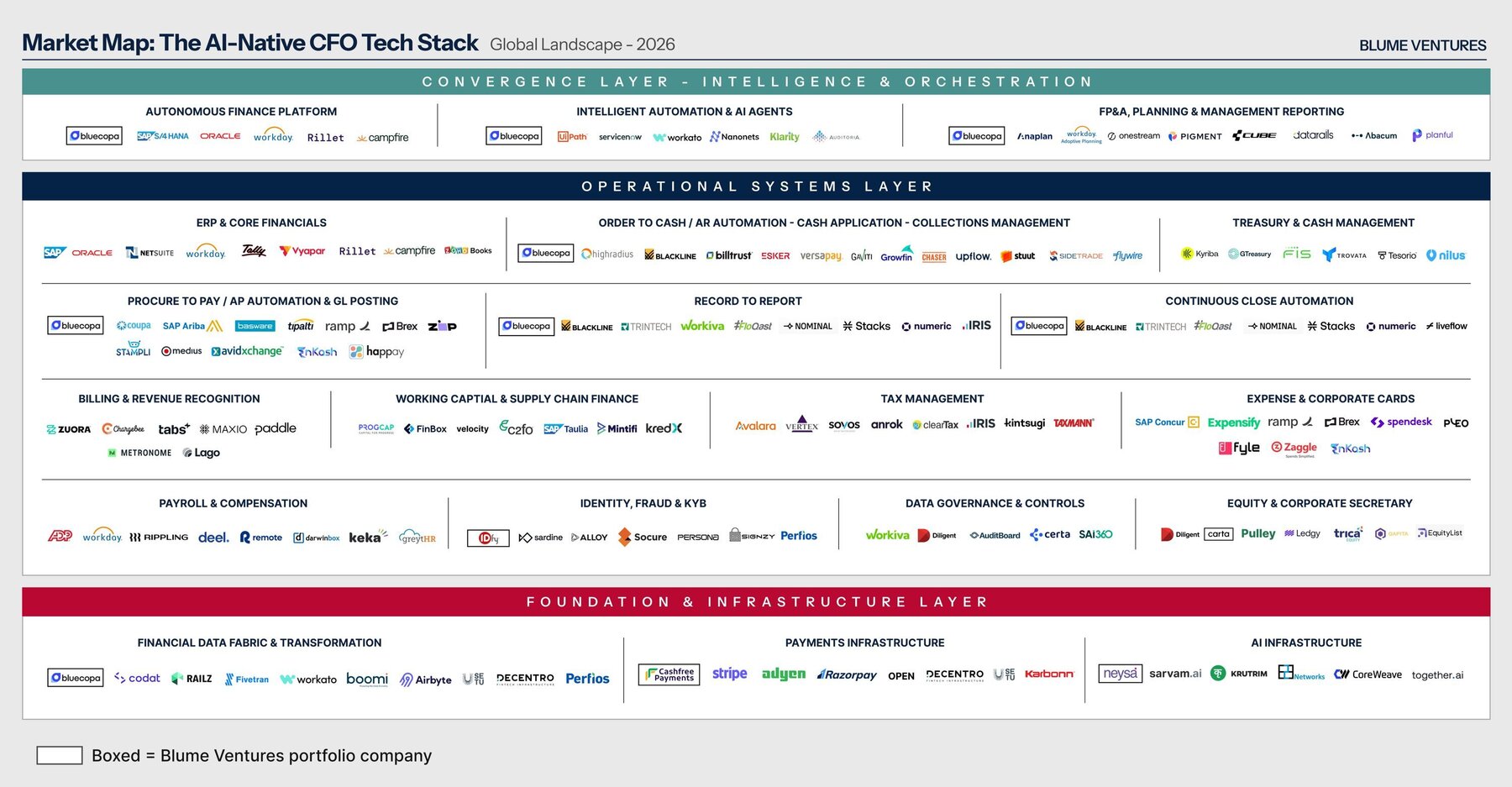
The office of the CFO is moving from workflow automation to financial system intelligence. After two decades of point solution proliferation, the finance function is consolidating around a different architecture: one where AR, AP, the general ledger, treasury and close share a single connected financial model, with no more reconciling across disconnected systems.
Blume has been investing in this thesis across the stack. The map below covers the global landscape across three layers: convergence, operational systems, and foundation and infrastructure. The sections after it set out what 2026 showed and what 2027 is likely to test.
The market map
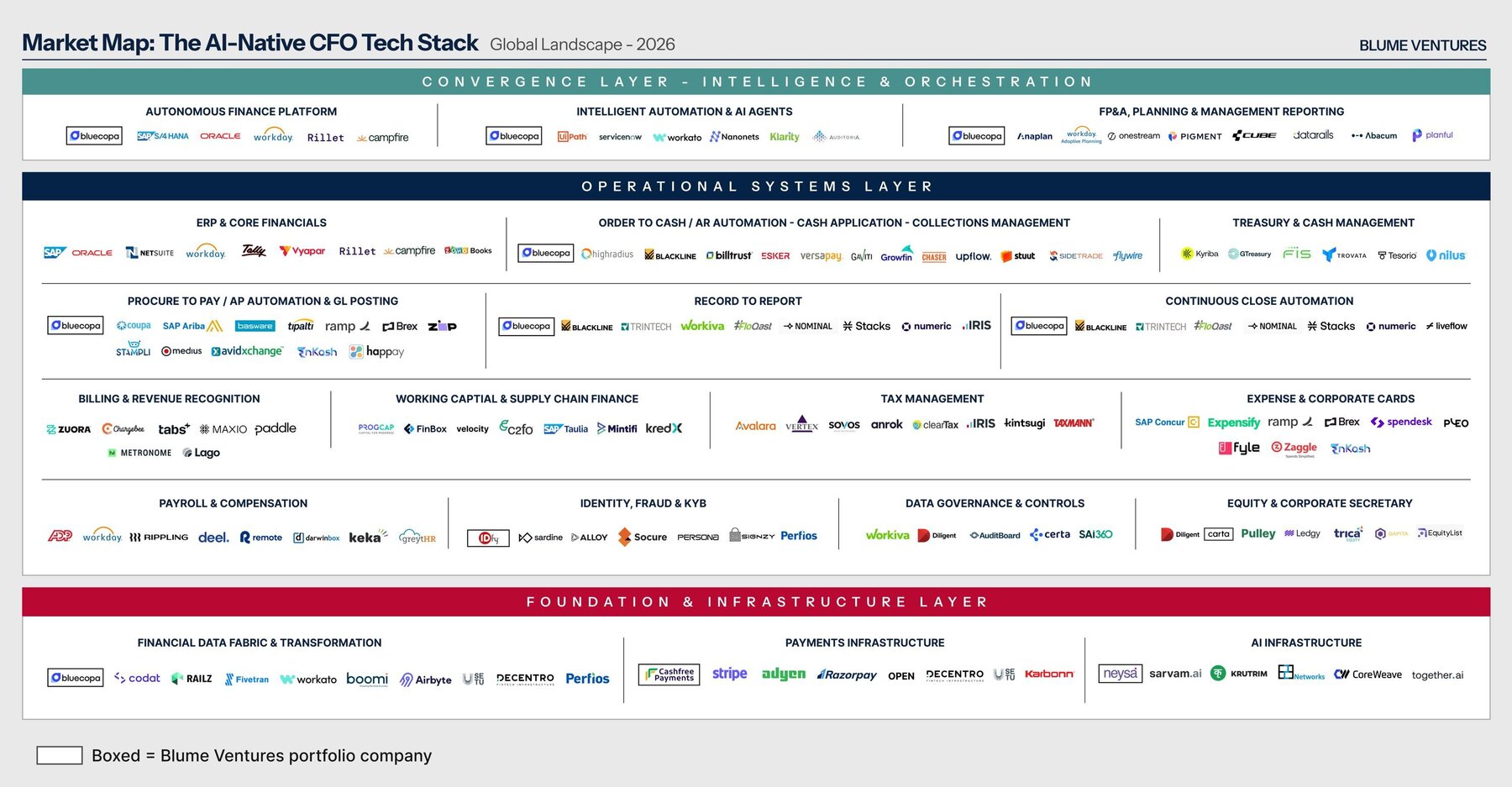
The AI-native CFO tech stack, global landscape 2026. Boxed companies are Blume Ventures portfolio companies. Tap the map to see it at full size.
What happened in 2026
AI use across finance became widespread in 2026, and the value it returned varied. KPMG’s 2026 survey of 1,013 senior finance leaders found 75% actively using AI across the finance function, and three quarters of CFOs raised their technology budgets for the year, nearly half of them by 10% or more.Gartner found 63% of finance organisations said AI implementation ran slower than expected in 2025,3 and when finance leaders rated individual use cases in 2026, the returns on 57% of them were still unclear.
The use cases that did pay back sat on structured data. Data extraction, accounts payable and receivable automation, and report creation typically delivered expected value within nine to 10 months, while forecasting, insight generation and data management took longer.4 Bain’s read of the year is that data and integration barriers are the top AI blocker across every major finance process.5 Governance followed the same pattern. Only 42% of organisations were fully assurance-ready for AI-enabled finance processes, and those that could produce audit evidence for their AI reported three to six times the rate of significant improvement.
The constraint on teams changed during the year too. In January and February, CFOs named building AI talent as one of their two most challenging priorities. By September, Gartner put low AI literacy across existing teams ahead of it, as agentic coding tools put configuration within reach of people who had never done it before.
Outside the finance function, tax authorities kept moving invoice data into real time. Belgium made B2B e‑invoicing mandatory from 1 January 2026 and Poland began requiring invoices through its national KSeF platform from February.7 The UAE spent the year preparing for its January 2027 go-live,8 and India extended its GST Invoice Management System from the October 2025 tax period, keeping buyers responsible for reviewing each supplier record before input tax credit flows through.9 Across these markets, reconciliation became part of staying compliant.
From fragmented workflows to connected financial operations
The old CFO stack ran on point solutions for each workflow, a monthly close run as a project, manual reconciliation between systems and reporting assembled after the fact. The AI-native stack runs those workflows on one financial model and treats compliance data as an asset. Gartner expects that by 2030 people will stop being the manual integration layer for core transactions, with AI agents handling corrections, recoding, approvals and payment matching,10 which only works when the agents read one reconciled set of records.
A few platforms are building toward this. In Blume’s portfolio, Bluecopa works on the finance operations side for large enterprises, alongside the ERPs they already run, and Procol works on sourcing and e‑auctions within procurement.
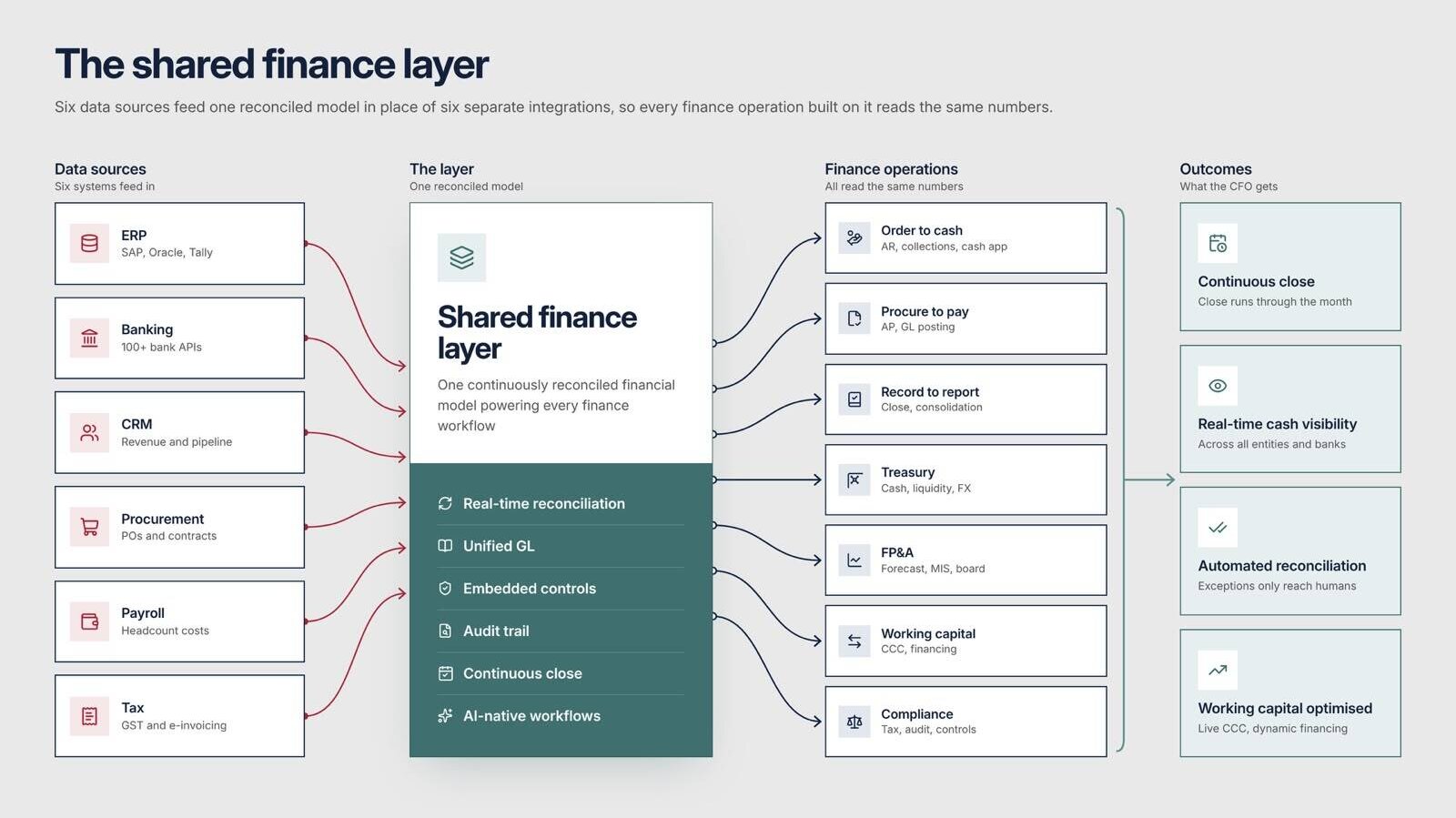
The shared finance layer
Six data sources feed one reconciled model in place of six separate integrations, so every finance operation built on it reads the same numbers.
Why legacy architectures cannot catch up
Legacy finance systems assume financial data is produced in batches, reconciled at intervals and read by people. Module-level AI cannot reason across workflows when the underlying data is not shared, and point solutions joined by nightly syncs grow more brittle with every addition.
The ERP calendar makes this harder to wait out. SAP ends mainstream maintenance for ECC at the end of 2027, and Gartner projects that close to half of ECC customers will still be on it when the deadline arrives.For many large enterprises, 2027 means running old and new ERPs side by side, which is when a connected layer above the ERP earns its place.
The finance function reimagined
By 2030, Gartner expects human work in finance to concentrate on the areas where judgment changes the outcome.AI is unlikely to reduce total finance headcount sharply in the near term. It will reduce headcount growth in transactional roles while increasing demand for finance systems, controls and analytics expertise.
The CFO
Moves from financial steward to strategic navigator, explaining the past less and shaping near-term decisions more. AI oversight becomes a core responsibility.
The Controller
Moves from manual oversight to orchestration, validating AI-generated analyses and deciding which findings warrant action. The title stays and the job description changes.
The Finance Systems Architect
A new role with no clear predecessor, owning the design, integration logic and data governance of the connected financial model. Gartner predicts that by 2028, 20% of finance organisations will put all talent investment into advanced digital capabilities.
Adoption is not linear
The platform shift is not inevitable on any particular timeline. Five things slowed it down in 2026, and every platform in this map is working through them.
Fragmented ERP landscapes
Most multi-entity companies run 2 – 4 ERP systems across entities with inconsistent charts of accounts. Building a shared model on fragmented source systems requires data engineering before AI can operate reliably.
Master data quality
Vendor masters, customer records and GL structures are often years out of date. AI reconciliation is only as good as the data it reconciles.
Change management
Finance teams are trained to distrust systems they cannot fully verify. Adopting AI-generated journal entries and automated close tasks requires a cultural shift that cannot be mandated.
Audit and governance
Most organisations cannot yet produce audit evidence for AI-enabled finance processes, and the ones that can are pulling ahead.
AI literacy
Most finance teams lack the fluency to configure and govern AI systems at the pace the technology now moves, and Gartner names it the most significant barrier finance leaders face.
India and the markets following it
India is among the most active construction sites for this transition. A large Indian enterprise typically runs several legal entities, a separate GST registration in each state it operates in and often more than one ERP, and above the e‑invoicing threshold its invoices are registered with the tax system as they are issued. The companies being built here serve Southeast Asia, the Middle East and Africa, where the same pressures are now arriving. Five infrastructure threads are being built for that reality.
Financial operations
Bluecopa works with large enterprises across India, Southeast Asia, the Middle East and Africa on order to cash, procure to pay and record to report.
Procurement
Global platforms were built for large procurement teams with mature vendor bases. India’s mid-market problem is different: informal supplier networks, manual processes and spend flowing through relationships. Procol is building procurement infrastructure for this reality.
Working capital
India’s MSME credit gap cannot be addressed by platforms designed for US enterprise supply chains. Progcap addresses supply chain finance using alternative data underwriting. FinBox provides embedded credit infrastructure. Velocity turns predictable revenue into immediate capital.
Identity
India’s digital identity stack (Aadhaar, GSTN, MCA21, UPI) creates a data surface for real-time trust decisions unmatched elsewhere. Bureau and IDfy, both Blume portfolio companies, are building on top of it.
AI infrastructure
Neysa, a Blume portfolio company, provides GPU compute that makes AI viable at Indian mid-market price points. Sarvam AI builds foundation models for Indian languages, which matters when financial documents arrive in Hindi, Tamil and Kannada.
The architecture that wins in 2027
The finance stack fragmented for two decades, and consolidation only creates value when the platform shares one financial model, beyond a shared login. When AR aging feeds treasury forecasts, AP data reaches the close without a nightly sync and working capital decisions surface as they happen, finance spends more of its time on decisions ahead.
2027 will judge finance AI on realised value. Gartner is already telling CFOs to measure their AI portfolios by the value delivered, and to stop counting deployments, and Deloitte found 54% of finance leaders now lead enterprise AI and technology capital allocation. Finance is becoming the function that grades the rest of the company’s AI, and its own point solutions will face the same test.
Autonomy will arrive in bounded steps. Deloitte found 95% of finance leaders comfortable with agentic workflows in at least some finance activities, but only 14% support full autonomy for critical decisions, and 42% say their ambitions run ahead of the controls they have in place. The 2027 deployments that hold will land where the data is already reconciled and the audit trail is produced as the work happens.
Compliance pushes in the same direction. The UAE goes live in January, with smaller businesses following on 1 July 2027. Once tax authorities see invoice data as it is issued, the layer that keeps the ledger and the invoice in agreement becomes part of how a company stays compliant. And with close to half of ECC customers projected to miss the 2027 cutover, many large enterprises will run on the ERP they have for longer and look for AI that works across old and new systems at once.
What to settle before the next planning cycle
For most finance teams this shift arrives as a budget line before it arrives as a strategy. A few decisions made early determine whether that budget buys a connected model or one more point solution.
Count your sources of truth
List every ERP, entity and chart of accounts the close depends on. If that list runs past one, the first project is mapping how they relate, and AI comes after it.
Fix master data before automating on top of it
Out-of-date vendor masters and customer records turn into exceptions in every automated match. Cleaning them is unglamorous work that decides whether automation holds.
Start where the systems already meet
Reconciliation touches the bank, the ERP, the sub-ledgers and the people who chase the breaks. Connecting it first exposes every gap the rest of the programme will hit.
Give the financial model an owner
Very few teams have a Finance Systems Architect today. Until someone owns the integration logic and data governance, the platform is run by whoever shouts loudest at month end.
Ask every vendor the same question
Do AR, AP and the ledger share one model, or meet in a nightly sync? The answer separates platforms from point solutions with a common login.
The ERP stays the system of record. The choice in front of CFOs for 2027 is what sits above it: one connected model, or a growing collection of syncs that someone still has to reconcile.