
How an IIT professor built one of India's deeptech successes: The Sedemac story

- Published
- Reading Time
- 7 minutes
- Contents
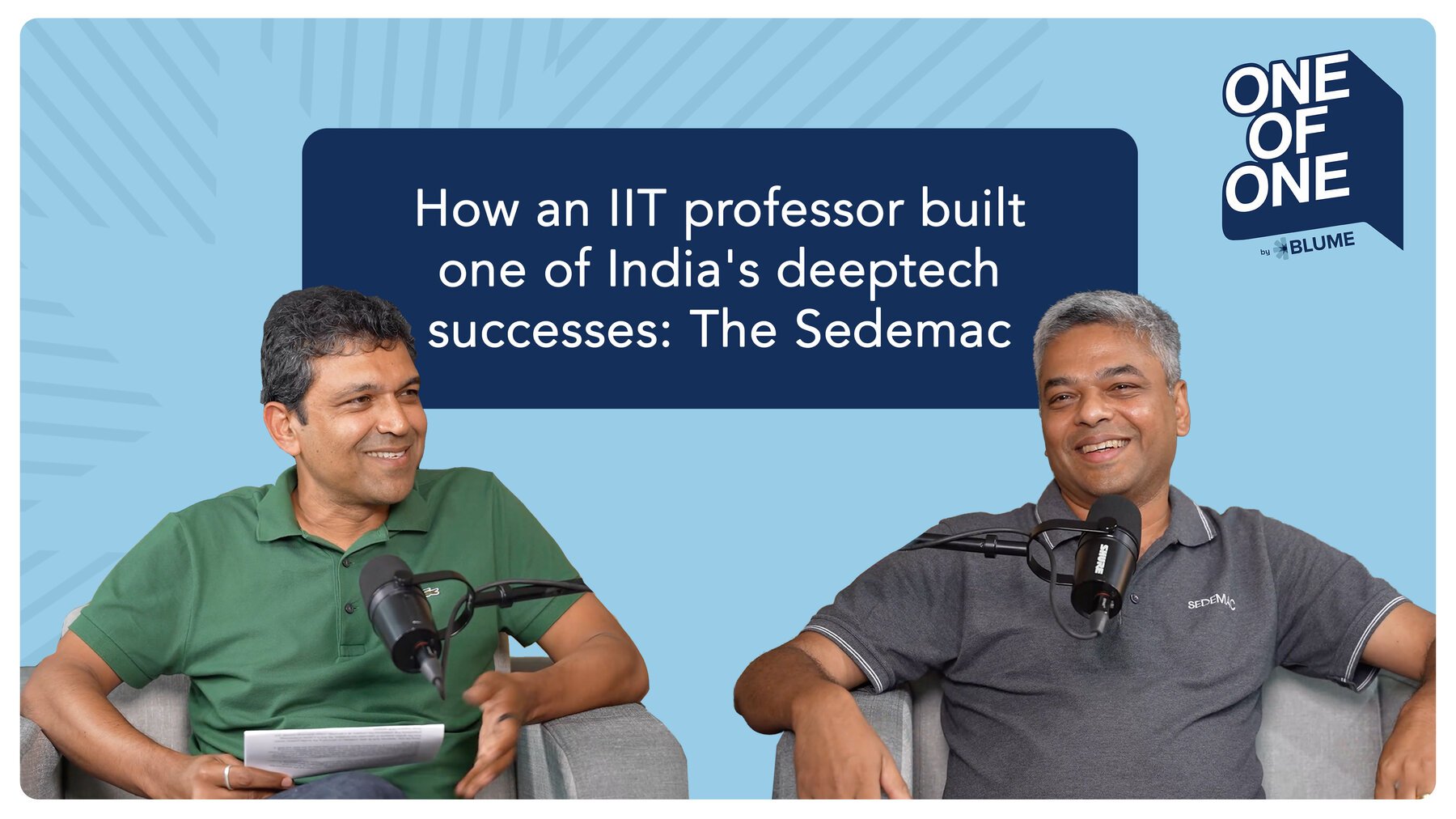
How a side project with three students at IIT-Bombay ended up inside one in three Indian two-wheelers
Back in 2004, Shashikanth Suryanarayanan’s cabin at IIT Bombay didn’t have closed walls. It faced the department office, and he shared it with two senior professors. So when he called in three of his students around 2007 and told them they should start a company, his colleagues, as you can imagine, heard every word.
One of them, Rangan Banerjee, waited for the students to leave. “Shashi,” he said, “I think you’re going to become an industrialist and a prof.”
Banerjee, who went on to become director of IIT Delhi, turned out to be right about both. The company, SEDEMAC Mechatronics, listed on the NSE and BSE in March 2026 at a valuation of close to ₹6,000 crore. At the time of writing, its market cap is more than ₹13,500 crore. Its engine control units sit inside roughly one in three two-wheelers sold in India, and Shashi still teaches at IIT Bombay.
I sat down with him on the campus where the company began for the first episode of this year’s Blume ‘One of One’ podcast. What follows is the story he told me, and the arithmetic that kept the company alive through the years when most of venture capital wanted nothing to do with it.
Bucket B
The cabin conversation had a much older starting point. During his PhD at Berkeley, on a trip home, Shashi met Prof. Bhaskar Ramamurti at IIT Madras. Ramamurti, who is the former director of IIT Madras, had a way of sorting faculty. Bucket A wrote papers, and bucket C only taught. He put himself in bucket B, with the professors who try to build things.
“I distinctly remember deciding I wanted to be in the B bucket,” Shashi says. He had nothing in mind to build. He, however, knew which kind of professor he wanted to be.
Berkeley had what Shashi (and the world at large) considered the strongest controls program anywhere. He then spent six to eight months as a control systems engineer at GE, which he always treated as a layover. IIT Bombay hired him at a recruiting event in San Jose, in a hotel he remembers as “not very good”, and he joined in March 2004, aged 26.
He arrived mid-year, after students had already been assigned advisors. So soon after joining he sent a blind email to every faculty member and student, asking if anyone wanted to work with him. Amit Dixit, then a master’s student in mechanical engineering, replied first and wanted to do wind turbine controls. Pushkaraj (Raj) Panse, another master’s student, had seen a grant proposal Shashi wrote for the government’s Core Group for Automotive R&D (CAR) and asked to join that. Manish Sharma came later.
Between five and ten students worked with him in those years, and most of them graduated and moved on. The group’s early work ran on two industry-sponsored projects worth ₹30 to 50 lakh between them. One was a steer-by-wire vehicle for Sona Koyo Steering Systems. The other was a fuel injection ECU for a two-wheeler under the CAR programme, with TVS Motor as industry partner, and the team demonstrated it working at TVS.
Panse eventually left. Amit Dixit, now joint managing director, and Manish Sharma stayed to found SEDEMAC with Shashi.
Shashi’s reasoning for wanting to start a company was rather straightforward: If a group of good control engineers stayed together long enough, they would keep producing technology someone would pay for. IIT Bombay made that easier than most institutions would have. Its incubator, SINE, was one of the first in India to let faculty hold equity and sit on company boards.
Twelve years early
SEDEMAC stands for Separating Decision-Making from Actuation. It’s an odd name, and Shashi knows it. He just doesn’t think names count for much in B2B, where buyers only care about what you’re selling.
The oddness helped anyway. It got conversations going, and plenty of people assumed the ‘S’ stood for Shashi. It is also a surname in parts of South America, so they’ve gotten used to occasional emails turning up from Peru.
To explain what the company actually does, he uses a ball. When you catch one, your eyes are the sensors, your brain is the controller working out the trajectory, and your hands are the actuators. An engine control unit does the same job on a green circuit board, with a microcontroller in the middle running the physics in software.
Nexus Venture Partners backed the idea really early in August 2008, about two months after the team started operating out of SINE. Naren Gupta of Nexus took 26% for ₹2 crore, roughly $500,000. There was no product and no revenue, and the company had about fifteen people. A Nexus associate happened to walk through the incubator, and when the firm called TVS Motor to check on the team, the fuel injection demo did the rest. “Very lucky,” Shashi says.
The luck, however, had a catch. SEDEMAC’s first product was an ECU for fuel injection in two-wheelers, and India wouldn’t require fuel injection on two-wheelers until the BS6 emission norms of 2020. The company had built for a market that was twelve years away. It also meant going head-to-head with Bosch and Astemo, who already dominated fuel injection globally. SEDEMAC dropped the plan. “If there is nothing new,” Shashi told Autocar Professional, in an older interview, “you will get stuck.”
So SEDEMAC took its control expertise to generator sets and to ignition systems, on the view that controls for small engines were underserved everywhere in the world: Two-wheelers, small gensets and power tools, et al.
Amit Dixit proposed dropping the sensor that tells an engine’s controller how much load it is under, and working out the load from the crankshaft signal instead. SEDEMAC’s Smart Ignition software did exactly that, removing the physical throttle position sensor from carbureted motorcycles. It was sold at first as a software licence running on other vendors’ hardware. TVS, Bajaj, and Hero each put it on every model they made.
Even with all this traction, the company was not yet ‘fashionable’. The venture market of the early 2010s wanted revenue that grew overnight, and SEDEMAC’s grew steadily. Shashi spent five to seven years being told, in effect, that the company wasn’t good enough. October 2013 was the worst point, he remembers, but even in his worst days, he says he slept eight or nine hours a night. If your company sells things that other companies want to buy, nothing else matters as much.
Then in June 2015, a letter of intent came in for an integrated starter generator, and revenue doubled, from ₹18 crore in FY15 to ₹36 crore in FY16.
The 4x rule
Shashi calls himself an “old-school entrepreneur”.
“I will not take a single rupee if I don’t need it,” he says.
Over the company’s life, he counts about 17 separate raises. The early ones were a few crore each, timed to whatever the next prototype needed.
What’s, however, ‘unusual’ or ‘smart’, is how he priced them. Every round used the same formula: four times the next twelve months of projected revenue, which was around the multiple the market gave Bosch’s listed Indian arm. With ₹36 crore of revenue ahead, SEDEMAC’s post-money was ₹144 crore. When the projection reached ₹90 crore, Nandan Nilekani’s family office invested at ₹360 crore, and Nexus put in another ₹10 crore alongside. N. R. Narayana Murthy, another Infosys co-founder, is also an investor, and Mindtree co-founder N. S. Parthasarathy sits on the board.
The formula took the negotiation out of fundraising. Investors could check the number themselves, and Shashi says he never tried to overpitch or underpitch. For a founder who had spent years hearing that his company wasn’t exciting enough, it also meant the valuation never depended on anyone’s excitement.
SEDEMAC raised no fresh equity at all between December 2018 and July 2024, a stretch in which revenue roughly tripled, from about ₹200 crore to about ₹650 crore. In 2024, ahead of the listing, A91 Partners and 360 ONE put in ₹75 crore. The company didn’t need it to grow. The money went mainly to bringing the debt-to-equity ratio back in line.
Why he listed
Offers to buy SEDEMAC came often. Some were formal, and some were hints dropped by the largest names in the industry. Shashi turned them down because a company that takes outside capital ends up in one of three places. It folds, or it gets bought, or it becomes an independent company that survives for decades. “Once we knew we had the firepower for decades,” he says, “an IPO was the natural step.”
He started preparing long before there was anything to list. SEDEMAC began holding half-yearly investor calls in July 2022, the habits of a public company years ahead of time.
The IPO ran from March 4 to 6, 2026, and was a ₹1,087 crore offer for sale of 80.4 lakh shares. Existing shareholders sold, and the company raised nothing. The issue was subscribed 2.68 times, with qualified institutional buyers bidding for 8.46 times their quota. SEDEMAC listed on the NSE on March 11 at ₹1,535, 13.5% above the issue price of ₹1,352. Shashi gave no forward numbers during the offering, and he doesn’t intend to.
So investors judged it on its record. SEDEMAC closed FY26 at ₹1,058 crore in operating revenue, with EBITDA margins around 20%. Shashi believes that a genuine deep tech company has to make real gross margins and scale profitably. If it is still losing money at scale, in his view, it hasn’t yet done the hard thing.
The customer list has also moved well past two-wheelers. It now includes TVS Motor, Hero MotoCorp, Mahindra, Tata Motors, Ashok Leyland and Kirloskar. SEDEMAC holds about 35% of the domestic market for integrated starter generator ECUs in two- and three-wheelers.
Not a cusp yet
At the end, I asked whether India is on the cusp of a deep tech revolution. Shashi wouldn’t use the word. It takes a generation, he said, to build real engineering density and confidence in fundamental physics. The evidence will be five to ten deep tech companies that are profitable and scaling in large markets.
SEDEMAC is one. It took 22 years, from a blind email in 2004 to a stock exchange listing, and its founder never left the classroom.
This is the first episode of the ‘One of One’ podcast. This year’s theme is the orbit shift, the moment a company moves from one trajectory to another.
Author

Karthik Reddy
Karthik Reddy is the Co-founder and Managing Partner at Blume Ventures, one of India’s leading early-stage venture funds with over US$900 million in AUM. Blume invests in emerging tech and tech-led innovation from Seed to Series A…- Current Section
- Co-founder & Partner
- Sector
- Media, Entertainment & Gaming, ConsumerTech