
Hidden in Plain Sight: How Two IITians Electrified India's Last Mile, One Battery Swap at a Time


- Published
- Reading Time
- 10 minutes
- Contents

In a small shop in Delhi’s Janakpuri neighborhood, Pulkit Khurana and Siddharth Sikka sit surrounded by charging batteries and scattered papers. With the June Delhi heat beating down on them, they are poring over handwritten sheets, meticulously tracking every battery exchange for their small fleet of electric rickshaw customers.
The modest 200-square-foot space serves both as an office and as a charging station for lithium-ion batteries for e‑rickshaws, with a makeshift partition separating them.
A skeleton crew of six employees works in shifts, some managing the constant flow of e‑rickshaw drivers while others develop the software that will eventually automate their entire operation. Operating with seed funding of just $350,000, every decision has to be calculated, every resource maximized. The founders often work 18-hour days, personally handling everything from customer service to battery maintenance.
Little did anyone know that this modest setup in Delhi would spark an electric mobility revolution. Siddharth and Pulkit’s start-up, Battery Smart (Fund IV), is today India’s largest battery-swapping network for electric vehicles, processing over 125,000 battery swaps daily across a network of 1,500 stations spanning 50 cities. The network serves 70,000 drivers daily, helping them earn 1.5 times more than their peers, creating real economic impact in India’s last-mile mobility sector.
But those numbers were unimaginable in the summer of 2020, when the first COVID lockdown was in full effect. Investors passed on them since they saw e‑rickshaws as too niche and low-tech. More importantly, they viewed the e‑rickshaw sector as a low-paying market, a red flag for investors looking for large outcomes.
“We were trying to solve a problem that was invisible to most investors since they hadn’t sat in an e‑rickshaw themselves,” Pulkit reflects. “While they were debating whether EVs would happen in India at all, there were already millions of electric three-wheelers on the road. Sometimes the biggest opportunities are hidden in plain sight – or in our case, in the busy streets of tier-two and tier-three cities where VCs rarely venture.“
This disconnect between investor perception and ground reality wasn’t surprising to Pulkit and Siddharth, who together spent years immersed in India’s transportation challenges before spotting the battery-swapping opportunity.

Charged Up: The Friendship That Powered an EV Revolution
Pulkit and Siddharth’s friendship began in the IIT Kanpur dorms in 2008, over discussions about India’s transportation challenges. Their shared fascination with mobility took shape in 2015 when they launched their first venture – a bootstrapped platform connecting office workers with bus services for their daily commute.
Unfortunately, they faced better-funded competitors and couldn’t scale it. After shutting down their venture, Pulkit joined their competitor, Shuttl, spending four years understanding the mobility space, and Siddharth moved into policy, working with the UP Government and NITI Aayog on EV initiatives.
“We were flatmates and friends, discussing what’s next. EVs seemed like the next big thing India needed. But in 2017 – 18, there were more non-believers,” recalls Pulkit.
Amid that cloud of skepticism, they noticed a telling sign: electric three-wheelers were proliferating in tier-two and tier-three markets, running on lead-acid batteries. Intrigued, they quit their jobs in 2019 and spent six months traveling across cities, studying e‑rickshaws. Their research revealed that 10 – 15 lakh electric vehicles were operating daily in India, mostly invisible to the mainstream automotive discourse.
“The demand wasn’t the challenge to EV adoption,” Khurana explains. “The biggest problem was charging infrastructure and battery limitations. Drivers had to buy new lead-acid batteries every six to eight months. Charging took 10 – 12 hours for just 50 – 60 kilometers of range. Most drivers charged overnight but had to stop during the day to recharge. For drivers earning up to Rs 800 (~USD 9) a day, an hour off the road is a significant income loss.”
The founders realized they needed a solution as simple and seamless as filling up at a petrol station.
That’s when it clicked: What if e‑rickshaw drivers could swap drained batteries for fully-charged ones in minutes?
This insight led Pulkit and Siddharth to envision a network of “battery swap” stations where drivers could drop dead batteries and pick-up charged ones. No more overnight or mid-day charging. Just drive in, swap, and get back on the road.
“The customer owns the vehicle while the network provides the battery,” Pulkit says. “Like filling petrol, you go to a station and exchange batteries. A small shop can serve hundreds of customers.”
With their sights set on building a grid of battery swapping stations, Pulkit and Siddharth were revving to go. But just as they were about to take off, they had to deal with a menace that brought the world to a halt: COVID.
A Crisis Becomes the Catalyst
For most companies in the mobility sector, COVID sounded like a death knell. Lockdowns froze movement and social distancing halted operations, particularly devastating for a company just starting out.
The founders’ first strategic pivot came from COVID-era constraints. Operating on just $350,000 in initial funding, they couldn’t predict the next lockdown. Fixed costs like rent and salaries for company-operated charging stations posed too much risk.
They pivoted to a partner-led model where their partner, usually a local shop owner, will host swapping stations. “We’d find people within a five-kilometer radius – grocery stores, parking operators, garages – and convince them to set up infrastructure to charge four to six batteries. Most shop owners were eager to partner with us since they could earn extra money with their existing space” says Pulkit.
This shift was an inflection point in Battery Smart’s journey as it helped them scale operations with lower fixed costs.
Today they have 1500+ partners. Partners invest around ₹8 lakhs upfront and typically recover it within the first year. They can earn ₹50,000 – 80,000 monthly after expenses. The company onboards 80 – 100 new partners monthly without incurring any capex like rent and station staff salaries.
Battery Smart caught another lucky break during COVID. E‑rickshaw drivers were designated as essential service providers, delivering groceries and medicines, and transporting essential workers to metro stations. This designation kept Battery Smart’s network indispensable during lockdowns, enabling the company to stay afloat and emerge even stronger when restrictions eased.
What seemed like an existential threat became the catalyst that validated Battery Smart’s model and accelerated its path to scale.
Swap & Scale: Inside Battery Smart’s Growth Engine
How Battery Smart Makes Money
The Battery Smart model is simple. It removes two major frictions from the lives of e‑rickshaw drivers: high upfront costs and charging anxiety. Batteries are a major chunk of the upfront expenses for a driver. Instead of buying the battery, drivers access batteries through Battery Smart’s network. A flat fee per swap makes it easier for them to know how much they are going to spend daily.
“Our customers earn 50% more than fixed-battery vehicle owners because they don’t have to wait for batteries to be charged and can drive for more hours,” notes Khurana. “Without Battery Smart, a driver typically earns 700 – 800 rupees daily. With our network, they can earn around 1200 – 1500 rupees because they can stay on the road longer.” Battery Smart earns around 240 – 360 rupees per driver daily. The increase in driver’s income more than offsets their payment to Battery Smart.
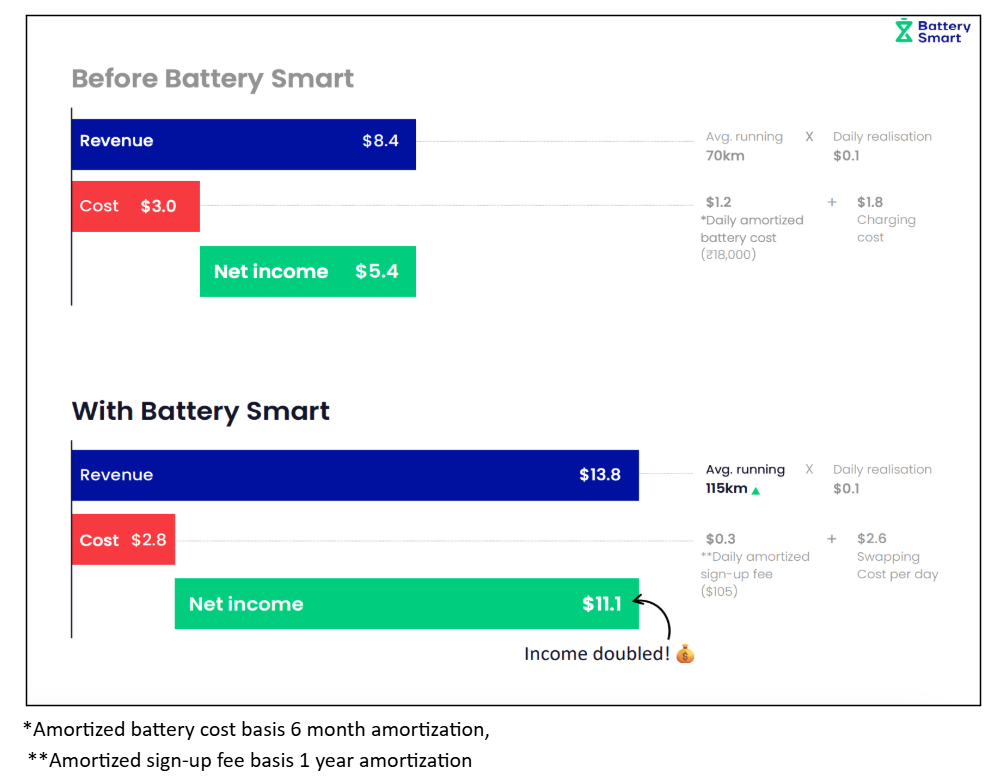
The company has two revenue streams:
- From Drivers: The company charges a flat fee per battery swap, keeping pricing simple and predictable for drivers who pay from their daily earnings.
- From Partners: Station partners invest ₹7.5 – 8 lakhs for a three-year contract to join the network. They earn through revenue sharing, receiving 25 – 30 rupees per swap transaction regardless of Battery Smart’s end customer charges.
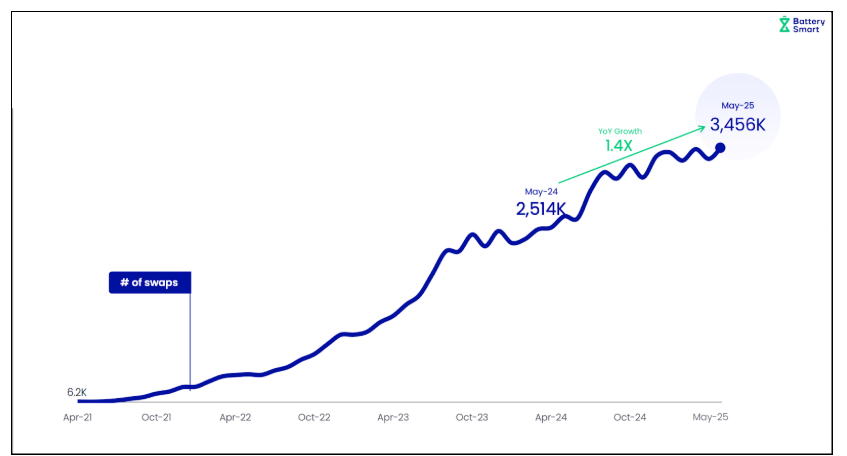
Together, these two revenue streams create a self-reinforcing growth flywheel: every additional driver boosts partner earnings, attracting more partners and expanding station density. Most drivers and partners refer other customers to Battery Smart, resulting in near-zero Customer Acquisition Costs. The model’s efficiency is evident in its rapid scaling – they processed their first million swaps in just three years and now handle 125,000 swaps daily across 1,500 stations. With a 70% three-year customer retention rate and near-zero customer acquisition costs, each new customer represents significant lifetime value for the company.
The Data Engine Driving Expansion
Battery Smart’s expansion strategy is methodical and deeply data-driven. Within cities they already operate in, Battery Smart leverages extensive GPS data captured from their battery fleet — tracking nearly 4 million kilometers of vehicle movement daily — to analyze route patterns, traffic flows, and areas of high driver activity. This rich operational data helps determine the ideal locations for new swapping stations, as well as optimal station capacities, enabling targeted and efficient network growth.
When evaluating new cities to enter, however, Battery Smart employs a different approach. “The primary trigger for us to consider entering a new city is the number of registered electric vehicles in that geography,” explains Pulkit. In these cases, they start with publicly available vehicle registration information and external market insights to gauge potential demand before establishing an initial operational foothold.
This two-layered strategy has enabled Battery Smart to expand radially from their strong base in the NCR, building robust coverage across key markets from Rajasthan to Bihar. Currently, they’re leveraging this proven approach to rapidly enter adjacent regions like Madhya Pradesh and Maharashtra.
Debt as a Strategic Lever for Scale
“Battery Smart is one of Blume’s fastest-growing companies,” says Arpit Agarwal, Partner at Blume Ventures. “Very few people can think and execute at an exponential scale – this team does both.” What makes Battery Smart’s growth story unique isn’t just their execution but how they financed it.
In a category where infrastructure, technology, and logistics are deeply intertwined, access to capital was crucial. Instead of solely relying on equity funding, Battery Smart took a different approach. They’ve raised over ₹1,000 crores (USD 116M) in debt financing – a feat no other Indian startup has achieved in such a short period, putting them at par with large corporates in terms of debt-raising capabilities.
Battery Smart uses debt strategically for growth. “Debt finances battery procurement, which Battery Smart owns on its balance sheet,” says Pulkit. “This lets us control performance standards and lifecycle costs while maintaining fleet-wide consistency.” In a business where uptime, reliability, and standardization are crucial, owning the battery asset gives operational control and long-term margin.
The journey wasn’t straightforward. They started with high-cost, short-tenure loans as a new, loss-making entity. As they proved their model’s viability, they graduated to working with NBFCs, then banks, and eventually international institutions. Today, they are a rated entity that can tap public debt markets.
“We did that entire journey over a four-year period, from NBFCs to banks to international institutions. Now we are a rated entity that can tap into public debt markets,” explains Pulkit.
For Arpit, this approach exemplifies why Blume backed the team: “Very few companies can take debt early and have the business acumen to deliver outstanding growth while staying afloat. Both Siddharth and Pulkit are more realistic in wanting to maximize limited resources.”
Capital efficiency remains core to their operations. “At any stage of our company, whether operating out of a small shop or today when we are well capitalised, we focus more on bottom line than top line,” notes Pulkit. “In a capital intensive business like this, every dollar must go towards growth and improving the bottom line rather than making something look lucrative.“
This disciplined approach to capital extends to every aspect of their operations, particularly in how they’ve built their technology infrastructure and safety systems from the ground up.
Safety Meets Innovation: Inside Battery Smart’s Technology Infrastructure
Engineering Safety at Scale
At Battery Smart’s core lies a sophisticated technology stack to keep drivers safe and deploy batteries where needed the most. What started with paper ledgers tracking battery exchanges has evolved into an IoT network generating insights from 4 million kilometers of driver data daily. Every battery in their network is a smart device, enabling real-time monitoring and predictive maintenance.
“Safety isn’t just a priority — it’s our DNA. Safety is our first, second, and third core value,” emphasises Pulkit. “This commitment goes beyond just corporate jargon — we believe in proactively managing risk due to experiences we had managing our first station”
The company’s safety framework operates on multiple levels. At the foundation is an open-source risk identification system where any stakeholder – employee, partner, or driver – can report safety concerns. Their technology platform predicts anomalous battery behavior, leading to the predictive isolation of 500 – 600 batteries weekly for inspection. AI monitors CCTV feeds ensuring proper battery spacing.
“You get a critical seven-minute window before thermal runaway in batteries, after which a battery starts heating up and shows smoke before catching fire,” Pulkit explains. “Every station has isolation tools and trained personnel to contain potential thermal events within this window.” The company maintains this safety protocol across all 1,500 stations.
Designing for Bharat
Battery Smart takes a unique approach to batteries. While they don’t manufacture them, they own the designs, software, and communication protocols. “We’ve iterated over 20 times on different cells from different manufacturers,” reveals Pulkit. They won’t be obsolete as battery technology evolves since their batteries use standardised form factors and connectors allowing different internal chemistries.
Battery Smart’s attention to detail extends far beyond technical specifications. Their deep empathy for drivers shapes all aspects of their product design, particularly the user interface.
Pulkit explains, “the drivers don’t understand kilowatt-hours or trust odometer readings. So we use flat pricing – you pay the same fee per swap regardless of battery usage.”
The swap process is designed to take under a minute, recognizing that every minute off the road is lost income for drivers.
When Battery Smart started, only 40% of their customers owned smartphones, with most families sharing a single device. To ensure accessibility, they created a dual system — a smartphone app for those with a smartphone, and NFC cards for authentication and payments for others. Today, while smartphone penetration has increased to 80%, they maintain both systems to ensure no driver is left behind.
Impressive as these milestones are, Battery Smart sees them only as a launchpad for a far bolder vision — one that stretches well beyond the swap itself.
Building India’s Energy Future
Despite its success, Battery Smart estimates it has tapped just 3% of its core market. “We processed our first million swaps in three years,” says Pulkit. “Now we do that in a week.” The company’s focus is squarely on scale — expanding coverage in existing markets, entering new cities, and replicating its dense station network. The same model that helped them dominate North India is now being deployed nationwide.
Geographic expansion is just one front. Battery Smart is evaluating new vehicle segments, particularly two-wheelers, which represent a larger share of India’s EV landscape. The two-wheeler market could multiply their customer base and deepen station-level economics — without significantly changing the operational backbone.
The company is also planting seeds for the future. With tens of thousands of batteries reaching end of life yearly, Battery Smart is exploring how to repurpose them for stationary energy use — from home inverters to telecom infrastructure. Because they own the batteries, know their usage history, and face no collection costs, they’re better positioned than anyone to build a second-life battery business at scale. Similarly, their ongoing efforts to shape an interoperability standard for swappable EV batteries reflect a long-term bet: that the infrastructure they’re building will define the category, not just participate in it.
Still, the focus remains on execution. “The EV transition needs friction points removed — upfront cost, charging time, infrastructure,” Pulkit says. “We’re solving for utility first. The drivers pay us from their daily earnings. That keeps us grounded.”
This singular focus on execution has carried Battery Smart from a 200-sq-ft shop to the country’s largest distributed power network for wheels in just five years.The humble battery swap, dismissed as niche only five years ago, is quietly becoming the essential infrastructure of modern Indian mobility.
And as the network expands, the idea that sparked it all remains unchanged: sometimes, the biggest opportunities are the ones most people overlook, hidden in the noise and bustle of everyday life. Just as Pulkit and Siddharth saw in that small shop, what’s truly transformative often waits, hidden in plain sight.


Startups

Battery Smart
Active investmentBattery Smart is India’s largest network of battery swapping stations providing drivers of electric three-wheeled rickshaws and two-wheelers a 2-min battery swap, thereby enabling them to drive more, and earn more. They enable this…- Current Section
- Portfolio
- Sector
- EV & Mobility, ClimateTech, B2B Services