
Ather Didn’t Copy. They Rebuilt EVs From Scratch into a ₹26,000 Cr Company | S4E6 | Destiny Avenged | Weekday Ep.

- Episode
- Episode 6 Weekday Episode
- Published
- Reading Time
- 13 minutes
What does it take to build an EV in a country that had no supply chain, no ecosystem, and no conviction that world-class hardware could be engineered locally from scratch?
In this episode of Destiny Avenged, Tarun Mehta takes us back to the true origins of Ather — long before the scooters, the charging grid, or the brand India now knows.
It begins inside IIT Madras’ CFI lab, where a new culture of weekend building, late-night experiments, and first-principles engineering quietly took hold. Tarun and Swapnil spent years sleeping on yoga mats in the department, teaching themselves battery design, building swappable packs, and prototyping chargers.
But one insight changed everything: India didn’t want batteries. It wanted a world-class electric scooter.
That leap — from component to full-stack — is what eventually became Ather Energy.
This conversation dives deep into:
- How CFI and IIT Madras accidentally engineered a startup culture
- Why Ather took five years before launching anything
- The battery-first approach and the pivot to full-stack EVs
- Why building hardware requires long gestation and no shortcuts
- The engineering advantages EVs unlock that ICE can never match
- Why Ather chose the hardest possible path — and how it paid off
If you’ve ever wondered how an engineering-first company gets built in India, this is the blueprint.
Season Partners: IDFC FIRST Bank and Ultrahuman (Blume portco)
[00:00:00] Tarun Mehta: This is March 2013, we decided to hang around the department and build these batteries and build this battery management system, build the chargers, and build a mock scooter to demo all of it. Toh hum toh college project ki tarah, we keep building it.
People love the idea of the scooter that we are showing these batteries on. They do not want to buy batteries from us. They want to buy a good product from us. I think you will very quickly realize that most deep tech or hardware businesses have a better revenue to capital raise ratio than almost most consumer businesses.
Their problem is not capital. I think internet businesses suck up a lot more capital into things which are not even asset creating, like advertising or discounting. A product business, especially physical product business, you will not have traction till pretty much the end of the journey. So, that is a real problem. And it really makes a lot of investors very nervous.
[00:00:52] Karthik Reddy: 2035, 10 years out, without getting to numbers, what would you want Ather to stand for?
[00:01:07] Tarun Mehta: I think Madras had a very special thing going then. And I think it should be studied more. I think it is worth investing a lot to recreate it. But it is not natural. It will not recreate automatically, just by starting an incubation cell.
I would say there are a few things that really went in favor of IIT Madras at that point. First, this is 2007 when we went to college, first year. That was the year when a bunch of alumni got together to inaugurate this thing called CFI, Center for Innovation.
I think it was a massive lab. I do not know, like 40, 50, 60,000 square feet. They took one of the massive workshops, which was empty, and they donated to the students. And they stuffed it with a whole bunch of equipments. So, you got CNC machines, you got every form of thing that you would need for prototyping, a whole bunch of even raw material, everything just there.
And I realized it much later that what it kick-started in our batch onwards was something that had not happened before because it started becoming common for people to just hang out in CFI over the weekends and often late in the evenings building their thing without it being a resume point.
[00:02:23] Karthik Reddy: Any academic prompt.
[00:02:24] Tarun Mehta: Koi academic prompt nahi hai. Koi extracurricular prompt nahi hai. There was a giant number of people working on drones, gliders, FSE teams started because of CFI. People building race cars. In fact, Swapnil was one of the founding team members of Raftar, the race car team, at campus because of CFI.
And it became just culturally acceptable that, yeah, what are you doing over the weekend? Yeah, I am in CFI. I am building this thing or I am building these robots that trace lines and will win some competition somewhere. I am just learning.
It just started, I think, a culture of that being so common that when I looked at our seniors who could not understand it… I think it hit me much later that this is not common. This was not common before. So, CFI started in 2007. The entrepreneurship club was active, but I am not sure if I would say that was the primary reason honestly.
But then, the Research Park happened in 2009, I believe. This was a bunch of other directors taking inspiration from the Stanford something.
[00:03:33] Karthik Reddy: That is right.
[00:03:34] Tarun Mehta: And they started the Research Park and other two things also I would say happened, Professor Jhunjhunwala, who had been trying to do startups at scale. Literally, a factory of startups for like at least 10 – 20 years before that. And I would give a small amount of credit also to our department, Engineering Design.
A case in point, we were the third batch. We had 22 people or 24 people in our class. I was last doing a census. At least two-thirds of our department attempted to do a startup at some point.
[00:04:03] Karthik Reddy: That is amazing.
[00:04:04] Tarun Mehta: Of our class. And I have heard over the years that they are just a higher number of people from this department who have attempted to startup over the years. Because I think it created the right set of situations.
So, I started making weekend Bangalore trips where Swapnil was. I was in Chennai. I would go on weekends, spend the weekend with him. Slightly pitching him. Theek hai. Trying to brainwash him ke wapis aa ja kuch karte hain. Theek hai. He was dying to anyways. So, esa nahi hai ke bahut fight marni padi. Teen, chaar trip maare and third trip tak to woh convience ho gaya tha.
So, I told him, ek kaam karte hain, let us… So, okay, another thing was happening. So, I was making these trips. On parallel, every weekend I was not there, I was in IIT. So, I would just come back to the campus on Friday evenings after finishing work.
There was a friend from my batch who was still doing his research there. So, he would let me in the department, and I would go crash in the department. In the department, everybody knew, Tarun ka yahan pe yoga mat or ek pillow pada hai. Theek hai, wo aata hai, wahan pe sota hai. Theek hai. Professors also turned a blind eye. They were very nice to us.
So, I would come on Friday night. I would go crash there, and I would use the time to basically, in my isolation, read. I just wanted to read everything about electric vehicles and gradually, I started building some of these battery packs because swappable battery pack pe patent file kiya hai toh let us start building these batteries, kaya hota hia. And car toh bana nahi sakte, toh scooter bana ke dekhte hain.
So, six months in, I have built a bunch of these batteries. I have read a lot about electric vehicles, and I have become a bit comfortable with the idea of building at least battery packs. So, I pitched to Swapnil ki yaar what if, if these electric scooters are going to cross the border and come to India from China. Ye swappable battery pack banayenge. Then, it could solve a lot of problems that consumers have.
So, maybe we should start a business, building swappable battery packs and running a swapping network for the upcoming wave of electrification.
[00:06:03] Karthik Reddy: Which is Battery Smart, which we funded eight years later.
[00:06:06] Tarun Mehta: Yeah. So, I wrote this pitch, told it to him. He sold. I come back. He calls me and says on Monday, ke maine resign kar diya, and they will let me go. I will be in Chennai by the next weekend. I am like, I have still not left my job. Maine to aise hi bola tha tere ko. Maine socha ke ek saal baad chodenge, 6 mahine baad chodenge. Toh isne resign kar diya. Ye to boriya bistra bandth ke aa raha ha Chennai.
[00:06:31] Karthik Reddy: You sell well obviously.
[00:06:32] Tarun Mehta: Hain?
[00:06:32] Karthik Reddy: You sell vision well obviously.
[00:06:34] Tarun Mehta: Or he really wanted to leave. Okay, whatever.
[00:06:36] Karthik Reddy: Out of the two.
[00:06:36] Tarun Mehta: Out of the two. So, now it starts a panic in my head. Acha mujhe bhi chod dena chahiye. Around that time, they give me the probation letter, which means my probation has ended and please sign here to become a full-time employee.
I feel really bad. I am like, I know deep down, I do not want to work. I will not work here. It is a nice company. It is trying to be fair to me. It is offering me full-time employment. So bad if I sign this now. I should not sign this. So, I get the letter, and I run away from the office immediately. Mereko subhe woh letter dete hain 9:30 baje. 12 o’clock, I am back in campus, IIT Madras, middle of a weekday.
Swapnil had already come back to campus. We both go meet a professor, and we pitch to him ke, listen, we really want to leave our jobs. We do not want to do this. We instead want to build batteries for electric vehicles.
The professor is very kind. He is like do not worry. You just need some blessing, right? I am telling you, leave your jobs. I will find a way to support you guys, subsistence. But leave the jobs. The department will support our students. Very good. So, I also leave.
Next month, both of us are now sitting in the department, but we have not started up yet. Because at this point, the idea that this is startup is still not clear to us. What we do know is that electric vehicles anne wala hai, and unka problem battery main ya charging main hai. So, we should do something to solve the problem. So, we are fundamentally builders and problem solvers.
Will this be a startup? We honestly do not know still. So, we do not start up. What we instead do, this is March 2013, we decide to hang around the department and build these batteries and build this battery management system. Build the chargers and build a mock scooter to demo all of it. Toh hum toh college project ki tarah, we keep building it.
We spend the entire year doing this. We have not started up Ather yet. There is no official entity called Ather. There is no funding. There is no investor. There is no angel. There are no founders also. There are just two people building under the name Ather Energy.
Ye built karte karte through the course of 2013, and we kept meeting people pitching this idea, we realized ke yaar people love the idea of the scooter that we are showing these batteries on. They do not want to buy batteries from us. They want to buy a good product from us. Battery is not a product they care about. So, maybe the problem is the scooter and not the battery.
And Swapnil really embraces this idea. He really believes ke yaar banana to pura product chahiye. We should not stall ourselves by just building a midway solution. Technical solution nahi banate hain, pura product banate hain. So, it was actually leap for me because I was a bit worried ke pura scooter kase banayenge.
[00:09:11] Karthik Reddy: Yeah. It is like you are moving full stack from a small piece of the puzzle.
[00:09:14] Tarun Mehta: Yeah. But his confidence was very high. So, we took that leap, and we started pitching the scooter.
[00:09:21] Karthik Reddy: To whom? Sorry.
[00:09:23] Tarun Mehta: Just to anybody.
[00:09:24] Karthik Reddy: Just the idea.
[00:09:26] Tarun Mehta: We just pitched to anybody by the way at this point. Apart from Tiger, who, all credit to Lee, back in the day.
[00:09:32] Karthik Reddy: Lee was crazy enough.
[00:09:33] Tarun Mehta: Lee was crazy and took this bet. But there is not a single VC on a cap table.
[00:09:37] Karthik Reddy: There you go. And he is not Indian by any means. He is as monotonous as they come.
[00:09:43] Tarun Mehta: So, I think the problem is metrics. And I do not think the challenge is capital as much as it is gestation. Let me explain both. It is certainly not a capital problem because take the few hardware companies that have become now large or gone public and compare their revenue generated to capital deployed.
I think you will very quickly realize that most deep tech or hardware businesses have a better revenue to capital raise ratio than almost most consumer businesses, including the ones which are really successful, the most established metrics.
[00:10:27] Karthik Reddy: That is a fascinating stat in itself. We should do some math around that and show that.
[00:10:31] Tarun Mehta: Ather’s worth what? About 2.5 billion today.
[00:10:34] Karthik Reddy: Yeah, 21,000 crores. I checked.
[00:10:36] Tarun Mehta: Yes, roughly that much. We would have raised, including the IPO, maybe 6,000−7,000 crores.
[00:10:46] Karthik Reddy: And pre-IPO?
[00:10:47] Tarun Mehta: Like 700 – 800 million. Sub mila ke bol raha hoon.
[00:10:49] Karthik Reddy: Pre-IPO kitna?
[00:10:50] Tarun Mehta: Valuation?
[00:10:50] Karthik Reddy: No, capital raised.
[00:10:52] Tarun Mehta: Main wahi soch raha hoon. I think we raised 3,000 crores and IPO mein, 2,600 crores. So, 6,000 roughly.
[00:10:59] Karthik Reddy: 6,000 give or take.
[00:11:00] Tarun Mehta: So, about 800 million. So, 800 million went in to create 2.5 billion ka today outcome. And I think it will obviously hopefully compound. And I think you will see similar ratios or even better ratios for many other players. The problem is not capital. I think internet businesses suck up a lot more capital into things which are not even asset creating, like advertising or discounting.
A lot of the deep tech or hardware businesses actually create fundamental IP or real assets behind it. Like agar factory main 1,000 crores ja raha hai, then there is a real asset being created of a 1,000 crores.
[00:11:37] Karthik Reddy: That is right.
[00:11:39] Tarun Mehta: It is however gestation, which also brings me to my first point that I said, the problem really is from an investor’s perspective, metrics.
When things take a long time, you really do not have enough metrics to rub around to have a new conversation every year which is roughly time you need to fundraise. Every year you need to fundraise. So, every fundraise you need a new story.
But for things that take five years to build, how do you cook up a story every year? Like, yeah, we are 20% of the way to building the product, why do not you give us more money? It is very hard.
[00:12:16] Karthik Reddy: Yeah. Not too many VCs will take that bet.
[00:12:18] Tarun Mehta: Internet-enabled businesses, you put in X Rupees, you will get some Y outcome. Kuch customer ayega. App download ayega. Kuch purchase hoga.
[00:12:30] Karthik Reddy: Some GMV is there.
[00:12:31] Tarun Mehta: Some form of GMV or consumer traction is there. But a product business, especially a physical product business, you will not have traction till pretty much the end of the journey. So, that is a real problem. And it really makes a lot of investors very nervous.
Because investors are, let us be honest, if you have the option of choosing an established metric, ke bhai, quick commerce main, these are the metrics on which your next round is made or broken, you can at least have an objective conversation.
I think given the fact that the entire powertrain is electric, you are already starting off on a distinct advantage where you can build a lot of features which are fundamentally electronic or electrical in nature that ICE cannot recreate.
Let me offer a few examples. Cruise control is a feature that if you ever wanted to build on an ICE will require you to put hardware worth ₹4,000 or ₹5,000, ₹6,000 on the ICE powertrain. That is my rough assessment.
On an electric, cruise control is a zero-cost implementation. In our case, ₹100 because we wanted one extra sensor for safety. That is it.
Hill hold, a feature that cars have, two wheelers cannot have because it requires electrical brakes. Electrical brakes will cost you another ₹5,000-₹6,000. On an EV, Hill hold is a zero-cost implementation.
The amount of features that we can open up with an electrical powertrain and really, really, really smart software on it is an order of magnitude higher than what ICE vehicles can ever do at that cost structure. Actually, they cannot. Which is why at least in the scooter world, I believe upgrade is not synonymous with electric.
All the feature sets; you want cruise control, you want Hill hold, you want brakeless experience where the vehicle automatically will slow down, wagerha, wagerha. You want the beautiful touchscreen dashboard. We built this helmet.
[00:14:30] Karthik Reddy: Yeah.
[00:14:31] Tarun Mehta: And in this helmet, now you can just tell the helmet, “Hey, I want to go here.” And it will start navigation there. You can just tell the helmet. Actually, the helmet will tell you that, “Hey, I have detected it is raining. I am turning on rain traction control for you.” And it can turn the traction control on, on the vehicle for you.
[00:14:47] Karthik Reddy: Amazing.
[00:14:47] Tarun Mehta: You cannot do it with an ICE architecture.
[00:14:49] Karthik Reddy: Tempted to get an Ather.
[00:14:50] Tarun Mehta: Yeah. So, my point is that there are many things like these, which because of the electrical powertrain, you can now unlock as experiences, which are very difficult to do with ICE. And I have now become a believer ke that is the real opportunity.
[00:15:04] Speaker: That is a wrap on this weekday episode of the Blume Podcast. We have handpicked these moments to give you the most valuable insights in the least amount of time.
[00:15:15] Karthik Reddy: Our season partner, Ultrahuman, is back for a second time. I am biased as the seed investor here, but their immensely-loved brand is making waves globally. Ultrahuman is a health tech pioneer, redefining how we track and improve our health. Their sleek titanium ring, AIR, and its new rare-metal cousins accurately tracks sleep, movement, and recovery to deliver real-time health insights and personalized nudges.
Ultrahuman is creating a unique health ecosystem built on top of the wearable data. It just launched blood vision in the US in addition to India, a blood testing service that offers a panel of over a hundred longevity and chronic disease biomarkers with the convenience of an at-home test. They are also launching Ultrahuman home globally for environment aware analysis and sleep insights.
Whatever your health fix, go sign up and experience being truly Ultrahuman.
Our season partner, IDFC FIRST Bank has earned its reputation as one of India’s most startup friendly banks through its FIRST Wings program, which provides dedicated mentorship and tailored financial solutions to help early stage ventures scale effectively.
Coincidentally, many of Blume’s portfolio companies, much later stage, also partner with IDFC FIRST Bank for their banking and financial needs. If you are well-funded and scaling, they are great lending and banking partners, and our portfolio companies would attest to that.
Moderator
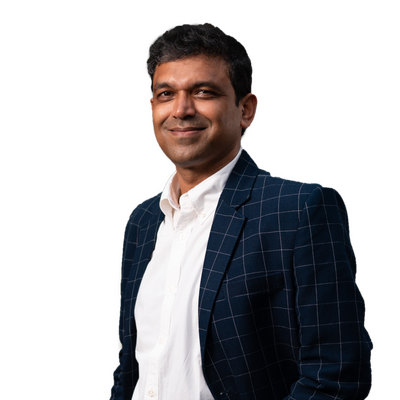

Karthik Reddy
Karthik Reddy is the Co-founder and Managing Partner at Blume Ventures, one of India’s leading early-stage venture funds with over US$900 million in AUM. Blume invests in emerging tech and tech-led innovation from Seed to Series A…- Current Section
- Co-founder & Partner
- Sector
- Media, Entertainment & Gaming, ConsumerTech